Body
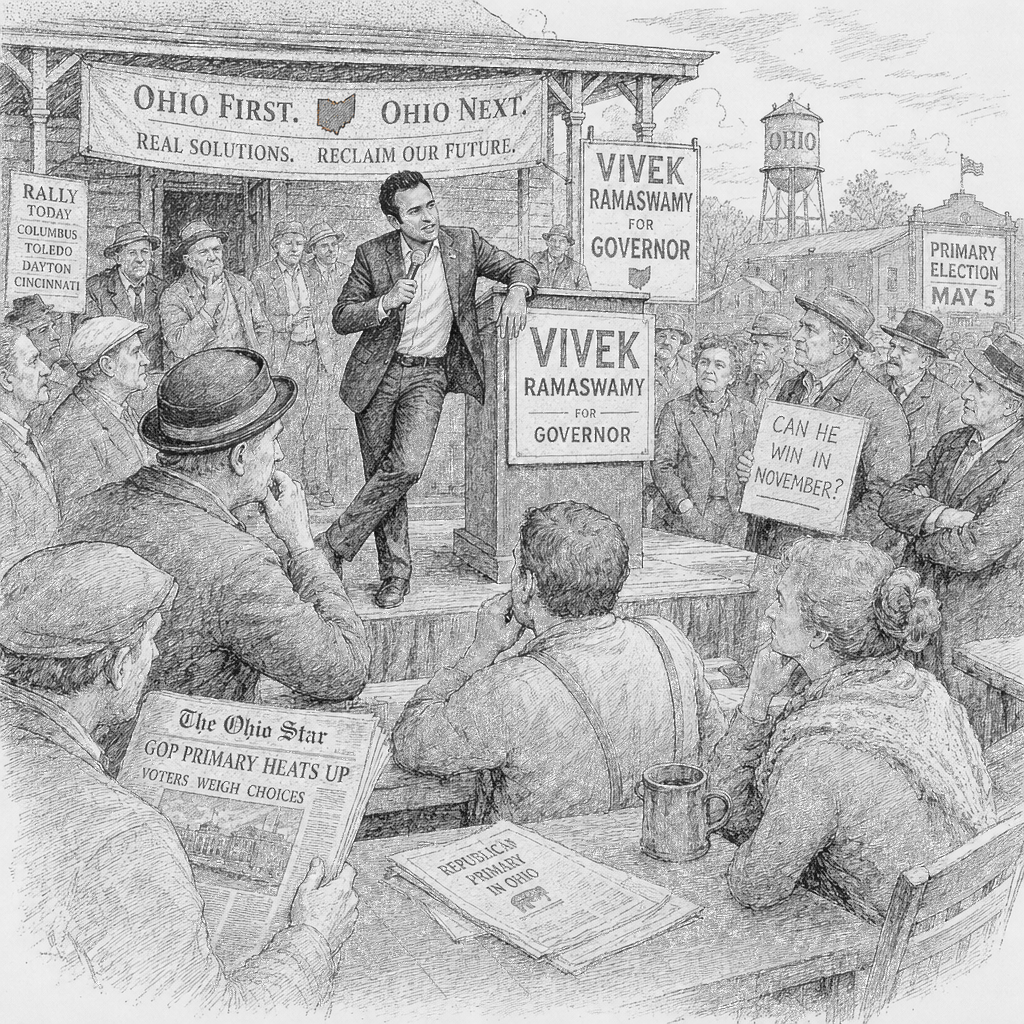
Ohio’s contested Republican primary for governor is approaching with Vivek Ramaswamy leaning into a campaign posture that, according to reporting, has left his GOP opponent with comparatively little attention so far. The shift is notable as Ramaswamy has instead used his national profile—along with connections and support from President Donald Trump—to build a fundraising haul and fund advertising aimed at the November general election.
Ramaswamy’s approach has centered on taking aim at Democrat Amy Acton, Ohio’s former public health director, including through campaign rallies and paid messages. The campaign’s emphasis on the general election is tied to Ramaswamy’s public confidence about the primary outcome, with Ramaswamy telling Republicans at a fundraising dinner that “I believe this year we face the single greatest contrast between two candidates in the history of governor’s races in Ohio,” and adding, “We face the most consequential election for governor in the history of our state.”
Despite that confidence, the primary season has highlighted areas some Republicans say could complicate Ramaswamy’s path with conservative voters. Reporting describes headwinds within the GOP base tied to rising costs of living, criticism over the handling and release of the Jeffrey Epstein files, growing pressure from data center demands, and foreign-policy demands connected to the war with Iran. The reporting also describes scrutiny of Ramaswamy’s specific proposals, including consolidating the state’s university system and raising the voting age to 25, with critics arguing the positions suggest the biotech billionaire is out of touch with average Ohioans.
The concerns raised by Ramaswamy’s critics also extend to how personal attacks have entered the discussion. The reporting says criticism has veered into the personal, including ethnic and racial animosity toward Ramaswamy, a child of Indian immigrants. It also describes how some of Ramaswamy’s supporters worry less about Republicans switching sides and voting for Acton than they do about factors that could reduce conservative turnout in November, potentially producing Ohio’s first Democratic governor in 20 years.
At party gatherings, Ramaswamy’s running mate, state Senate President Rob McColley, framed the race as having multiple opponents rather than a straightforward one-on-one contest. McColley said, “We have three opponents right now in this race,” naming Amy Acton, the national political environment, and “complacency,” and he told Republicans that the “third opponent is the most dangerous opponent we possibly have.”
One source of uncertainty for some Republicans has come from Casey Putsch, described by reporting as an engineer and vehicle designer who calls himself “The Car Guy.” Putsch has attracted fans with provocative YouTube videos that criticize national Republicans and target Ramaswamy, according to the same reporting. Although his events are described as sparsely attended and his campaign has raised $123,000, the reporting says he has won over some conservative voters, including an ambulance manufacturing worker, Tyler Morris.
Morris described why he is interested in Putsch, telling reporters he hears people like Casey speak and that “he’s a guy like me,” and he said Putsch “is just like, do you know what — I want to speak for the average, everyday Ohioan.” Morris also said he used to support Trump but has soured on him and will not back a candidate endorsed by the president—adding that he is “politically cynical” because he believes things have been worsening “regardless of who I vote for.”
Reporting also describes Putsch’s messaging as going beyond policy promises aimed at working-class Ohioans. Putsch has been accused of contributing to the spread of ethnic hatred toward Ramaswamy by repeatedly taking issue with the candidate’s Indian heritage and Hindu faith. As Putsch was beginning his campaign, the reporting says Putsch said Ramaswamy had contempt for “American cultural values,” and it also says Putsch called for Ramaswamy to “be destroyed” in an online video.
The reporting also notes Ramaswamy’s own public messaging in response to racism and antisemitism. After a Ramaswamy opinion piece in The New York Times, the reporting says the piece urged Republicans to reject the far-right, white nationalist element in the Republican Party in favor of a vision of American identity “based on ideals,” and it quotes the column’s language about ancestry and citizenship, including, “No matter your ancestry, if you wait your turn and obtain citizenship, you are every bit as American as a Mayflower descendant as long as you subscribe to the creed of the American founding and the culture that was born of it.” The reporting also describes Ramaswamy rebuking racism and antisemitism within Trump’s “Make America Great Again” movement during an AmericaFest speech at Turning Point USA.
In the reporting, Ramaswamy’s allies characterize Putsch’s attacks as typical of primary politics, while other figures challenge Putsch’s criticism of Ramaswamy’s background and leadership. Ohio Republican Party chairman Alex Triantafilou dismissed Putsch’s attacks as “meaningless to the message of where we are as a party on the ground,” while pointing to Ramaswamy’s national profile, political skills, and fundraising performance, including a reported record $50 million in total contributions, roughly half from Ramaswamy’s own fortune. Aaron Baer, president of the Columbus-based Center for Christian Virtue, similarly rejected Putsch’s disparagement of Ramaswamy, describing Ramaswamy as sharing “our values,” even while saying Baer does not share Ramaswamy’s faith.
Ramaswamy, meanwhile, has been presenting his campaign as if it were moving toward a general election contest. Reporting says he has drawn impressive crowds during visits to each of Ohio’s 88 counties and that the strategy appears to be landing with some voters. Pam Koch, a 70-year-old pharmacy worker who attended a Lincoln Reagan Day dinner where Ramaswamy was the featured speaker, described herself as a “pro-life Christian” and said she came “just to see where he stands, you know, spiritually and (on) everything that we value,” adding afterward that she was “delighted” with what she heard.
For some voters who remain with Putsch, the decision is linked less to money than to perceived policy fit and shared background. Ron Eckles, a retired communications worker who told reporters he is sticking with Putsch, said he sees qualities that overlap with Ramaswamy, including being a native Ohioan and building a business. But Eckles also said he believes Putsch is stronger on gun rights and liked that Putsch is an Ohio State University alumnus, while Ramaswamy attended Harvard and Yale. Eckles said he is undeterred by Putsch’s financial disadvantage, saying, “I believe in miracles.”