The Trump administration’s sanctions target both the refining and shipping links of the Iranian oil trade, with Treasury using access to the U.S. financial system as the enforcement lever. The Treasury Department said the designations include Hengli Petrochemical’s facility in Dalian as well as “roughly 40” companies and tankers involved in moving Iranian crude. Treasury said the measures are meant to deter and punish third parties by also applying pressure through secondary sanctions.
Treasury’s announcement came as the U.S. also moved to disrupt the energy corridor that runs through the Strait of Hormuz, a shipping chokepoint used for a substantial share of global oil and natural gas shipments. The Associated Press reported that the sanctions were announced Friday, and that the administration said it planned to impose secondary sanctions on firms and countries that do business with Iran. The effort is part of a broader push to reduce Iran’s oil export revenue, Treasury said.
Treasury identified Hengli Petrochemical’s Dalian refinery as included in the Friday sanctions. The refinery is described as having a processing capacity of roughly 400,000 barrels of crude oil per day and as being one of China’s biggest independent refineries. Treasury said Hengli received Iranian crude oil shipments since 2023 and generated “hundreds of millions of dollars” in revenue for the Iranian military, according to the Associated Press account of the Treasury position.
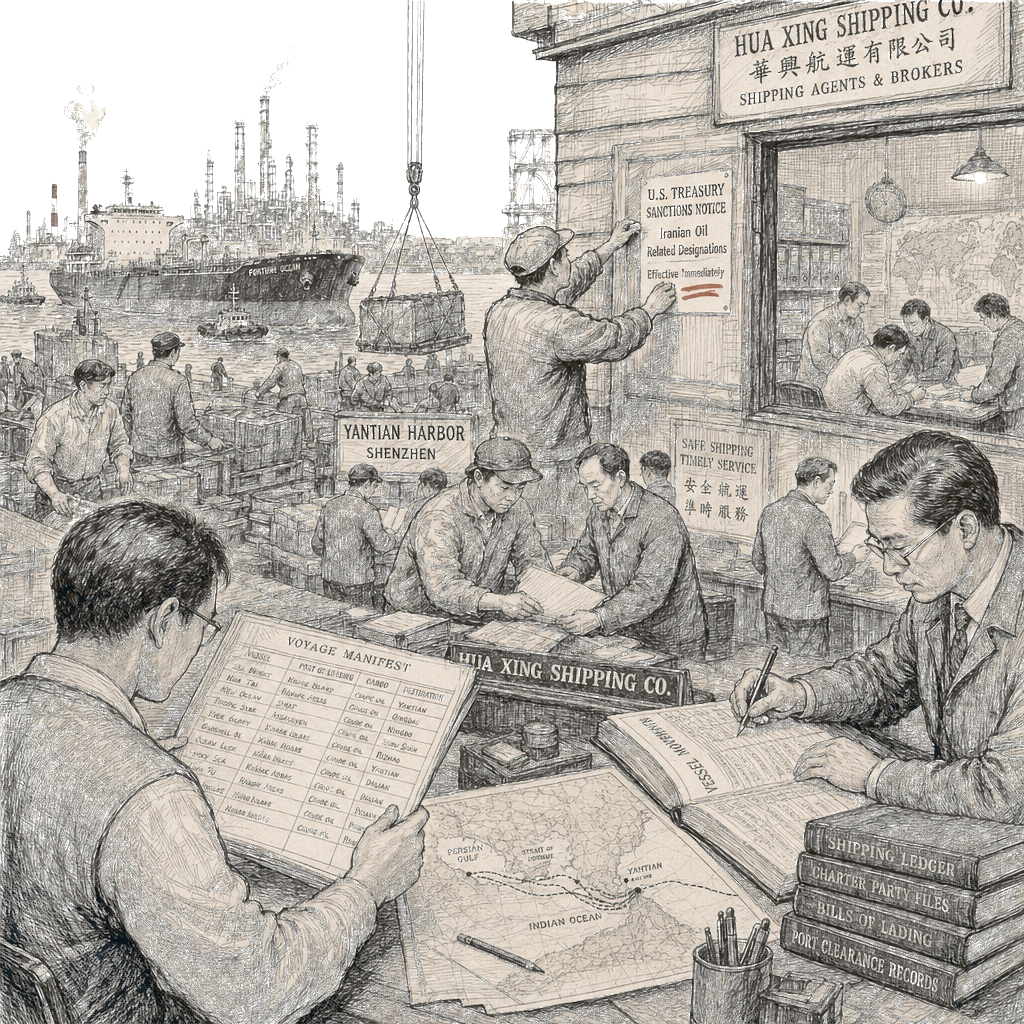
The sanctions also extend to the shipping network used to move Iranian oil. The administration designated about 40 shipping companies and tankers connected with transporting Iranian crude, and Treasury described the policy as cutting off access for those entities and penalizing others who do business with them. Treasury’s language emphasized constricting the “network of vessels, intermediaries and buyers” that Iran relies on, with Scott Bessent saying the U.S. would continue that approach.
The Associated Press said the sanctions arrive with the U.S. and China scheduled to meet at a high level in coming weeks, ahead of a planned meeting between President Donald Trump and China’s President Xi Jinping in China. The report also said the administration had sent a letter earlier this month to financial institutions in China, Hong Kong, the United Arab Emirates and Oman warning that they could face secondary sanctions if they do business with Iran.
Bessent said in a White House press briefing on April 15 that the administration has told countries that secondary sanctions are possible if they are buying Iranian oil or if Iranian money is in their banks. The administration’s case, as reported by AP, was that financial institutions and trade counterparties in multiple jurisdictions can play a role in keeping Iran’s oil exports and payments flowing.
The sanctions and the related pressure come as global energy trade faces disruption risk around the Persian Gulf. AP reported that energy prices have moved higher as the war in the region affects shipping, while Treasury has issued temporary sanctions waivers for some oil routes, including for Russia in the past and a one-time waiver for Iranian oil that was already at sea.
AP reported that the Associated Press was seeking comment from Chinese officials about the sanctions. The AP also reported that China had disagreed with U.S. sanctions in the past, and said that despite that dispute, major Chinese companies and banks have often complied with U.S. sanctions because of their exposure to the U.S.-dominated financial system.
In a statement quoted by AP, a spokesperson for China’s embassy in Washington said the use of sanctions “undermines international trade order and rules, disrupts normal economic and trade exchanges, and infringes upon the legitimate rights and interests of Chinese companies and individuals.” The Associated Press reported that Iran previously said its demands for ending the war include the lifting of sanctions.