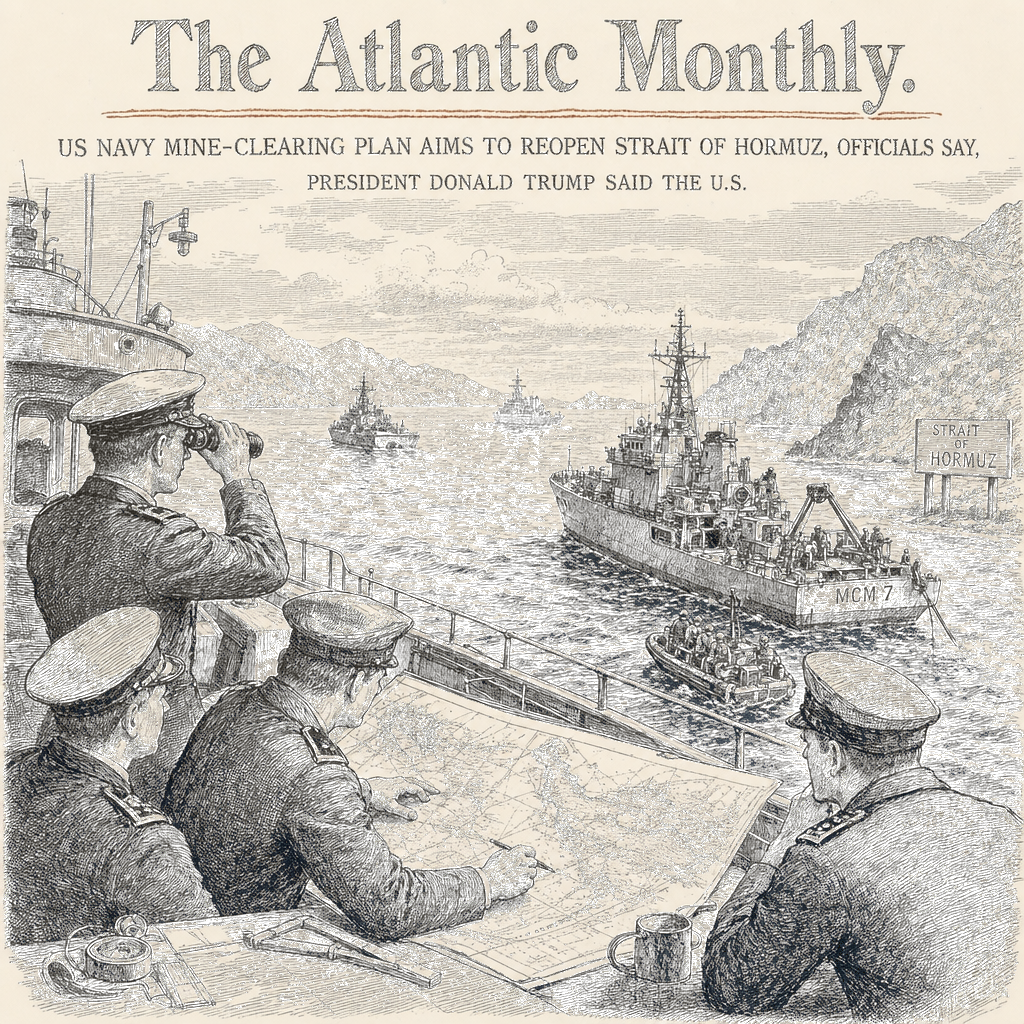
President Donald Trump said the U.S. Navy is clearing Iranian mines from the Strait of Hormuz, a vital route for oil shipments, as disruptions in the waterway increasingly threaten the global economy. The announcement came while the United States and Iran were operating under a tenuous ceasefire, and experts said sweeping for underwater explosives could take months.
Trump said he had instructed U.S. mine-sweepers to continue their activity at a heightened pace. He also said he had ordered the Navy to attack any boat laying mines in the strait, framing the effort as part of a broader push to restart traffic through the waterway.
Pentagon officials told lawmakers that mine-clearing would likely take six months, according to a person familiar with the situation who spoke on condition of anonymity to discuss sensitive information. The information was delivered during a classified briefing at the House Armed Services Committee on Tuesday, the account said. When asked about the estimate, Defense Secretary Pete Hegseth said Friday that the military would not speculate on a timeline, but he did not deny the six-month figure.
In remarks at a Pentagon news conference, Hegseth said, “Allegedly that was something that was said,” and then added that the department “feel[s] confident in our ability, in the correct period of time, to clear any mines that we identify.” Trump said Saturday that mine-clearing would be carried out by the Navy as he sought to reduce the risk to commercial shipping.
Hegseth and Trump’s comments highlighted the central problem for commercial confidence: even if mines are found and removed, the credibility of a “safe” channel can be hard to establish while the two countries remain engaged in a wider war. Emma Salisbury, a scholar at the Foreign Policy Research Institute’s National Security Program, said minelaying is as much about messaging as it is about the physical threat. “You don’t even have to have lain mines — you just have to make people believe that you’ve laid mines,” Salisbury said, adding that the situation could persist even after U.S. sweeps if Iran disputed how thorough the effort had been.
Salisbury also said that even if U.S. forces sweep the strait and declare it clear, Iran would only need to raise doubts to keep insurers and freighters cautious. “There’s only so much the U.S. can do to give that confidence back to commercial shipping,” she said. She suggested that the psychological effect could linger because the mine threat, real or perceived, affects how ships plan routes and whether they will transit at all.
She noted that it was unclear whether a single mine had been deployed. Iran had mentioned only the “likelihood” of mines in the strait’s prewar routes, and estimates of Iran’s mine stockpiles are in the low thousands, Salisbury said. She said most underwater explosives were believed to be older Soviet models, with some newer weapons possibly from China or made domestically.
Salisbury described how mines in the strait likely would not resemble the highly visible devices sometimes depicted in movies. Instead, she said explosives would likely sit on the seabed or be moored to it by cable and float under the surface, and could be triggered by water-pressure changes when a ship passes or by the sound of a ship’s engine.
On how the U.S. effort could proceed, a defense official said the Navy has two littoral combat ships in the Middle East that are capable of sweeping for mines, and another defense official said two Avenger-class minesweepers based in Japan had departed for the Middle East but were still in the Pacific ocean as of Friday. Steven Wills, a retired lieutenant commander who served on an Avenger-class ship, said minehunting and minesweeping can help create a safer corridor through the strait and that minesweeping is typically slower and often follows a conflict.
Wills drew a distinction between minesweeping and minehunting: “Minehunting is walking through your yard pulling individual weeds and dandelions so that you can walk safely from one side to the other. Minesweeping is more like mowing the grass,” he said. Scott Savitz, a researcher with the RAND Corp. who focuses on naval operations and mine clearing, said the Navy does not necessarily have to remove every last mine, citing historical examples of uncleared areas from World War II and, in some cases, World War I because of the resources and time required.
Savitz and Wills also described potential tools and methods. Teams on littoral combat ships can deploy remotely operated, uncrewed vehicles that use sonar and other technology to find mines and can carry charges to destroy the explosives. Wills said explosive ordnance disposal teams, including divers, can hunt for and destroy mines, and that helicopters can search for mines using lasers.
Even with a technical mine-clearing effort, shipping companies and insurers could still take time to adjust. Savitz said shipping firms would eventually be willing to take some risks through the strait, “particularly given how lucrative it is.” He said Iran’s approval procedure for vessels transiting the strait requires ships to take a different route than before the war, to the north near Iran’s coastline.
Insurers have added clauses requiring ship owners to contact Iranian authorities to ensure safe passage, Dylan Mortimer, a U.K. marine war leader for insurance broker Marsh, said. Mortimer said the certification does not mention mines specifically and is intended to cover a range of threats, including missile and drone attacks or seizures. He described mines’ role as at least partly psychological, saying people may continue operating as if mines are present even after a sweep.
“[T]hat plays in the Iranians’ favor, because whether there are mines there or not, people think there’s mines there and they will operate accordingly,” Mortimer said. Those fears, he said, could mean it takes longer to restore confidence that the strait is safe even after the fighting ends.