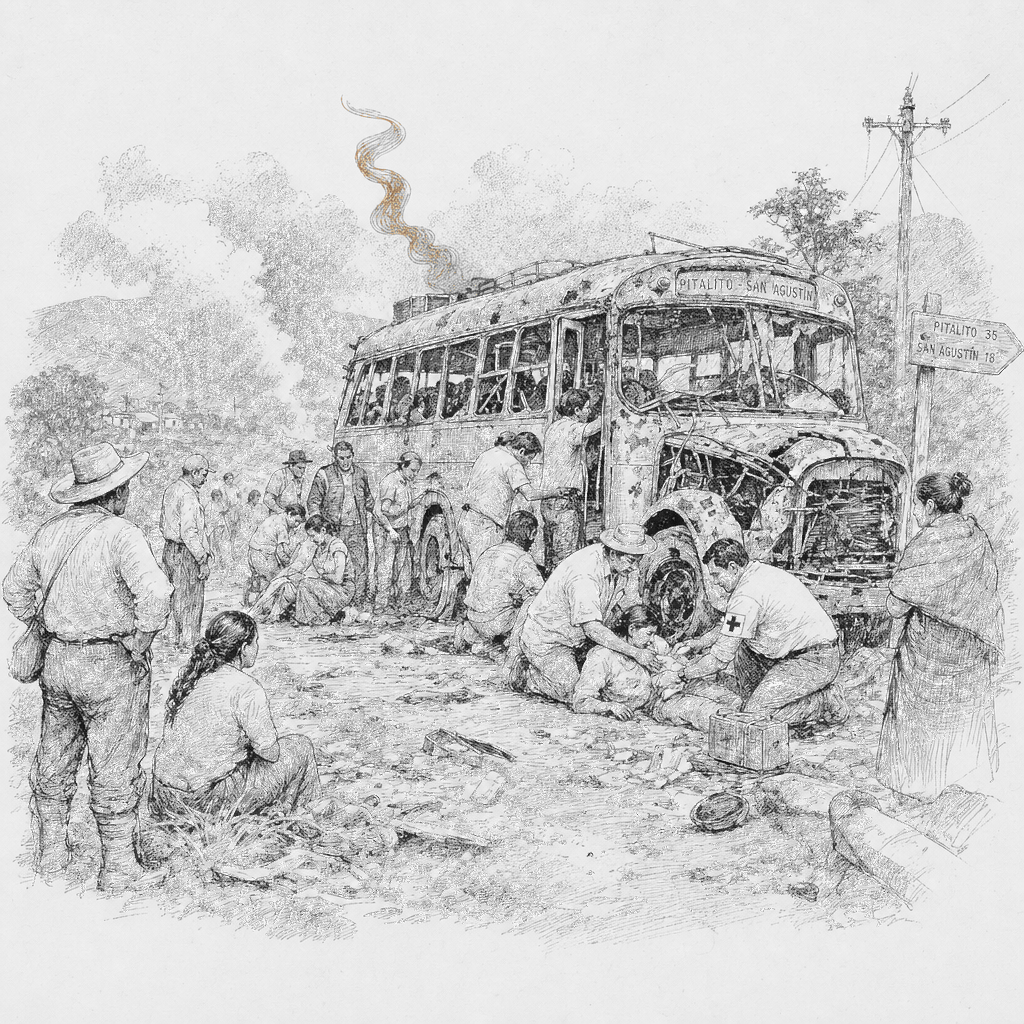
The explosive attack in southwestern Colombia killed 13 people on Saturday and injured at least 38 as authorities described a broader surge in attacks tied to illegal armed groups and drug trafficking in the region.
Colombia’s army chief and other officials said the blast struck a bus traveling on the Panamerican Highway in the municipality of Cajibío, in the department of Cauca. Cauca Governor Octavio Guzmán said on X that the device was detonated as the bus was in motion, and Cauca’s health secretary, Carolina Camargo, told Noticias Caracol that five children were among those injured.
Gen. Hugo López, commander of Colombia’s Armed Forces, said at a news conference that the attack was a “terrorist act.” López blamed the network of a man known as “Iván Mordisco,” whom he described as one of Colombia’s most wanted figures, and also pointed to the Jaime Martínez faction, which he said operates in the region. López and other officials tied both groups to dissident forces that do not abide by the 2016 peace agreement with the state.
President Gustavo Petro condemned the attack in a post on X, saying in the message that those responsible killed seven civilians and wounded 17 others, “many of them Indigenous people.” Petro characterized the perpetrators as terrorists, fascists and drug traffickers in the post.
Officials said the attack was among a sequence of explosions over the preceding days, including incidents that targeted public infrastructure in southwestern Colombia. López said those attacks have “only affected civilians,” and described at least 26 incidents in the past two days in the region.
The reports included a shooting at a police station in the rural area of Jamundí, and an attack on a Civil Aviation radar facility in El Tambo, where authorities said they brought down three explosives-laden drones on Saturday. Authorities said no one was hurt in the radar-facility drone incident. On Friday, officials said two vehicles rigged with explosives were detonated near military units in Cali and Palmira, causing material damage.
The escalation prompted the mobilization of senior officials on Saturday. Defense Minister Pedro Sánchez led a delegation of regional governors and local authorities that was meeting in Palmira when the bus attack occurred, according to the report. Sánchez said on X that “these criminals seek to instill fear, but we will respond with firmness.”
In a separate statement on X, Francisca Toro, governor of Valle del Cauca, called on the national government to provide “immediate support,” asking for reinforcement of public security forces and enhanced intelligence operations and “decisive actions” against crime amid what she described as a “terrorist-level escalation.” Authorities said Cauca and Valle del Cauca function as a hub for illegal armed groups seeking control of sea and river routes that feed into the port of Buenaventura, used as a transit point for drugs to Central America and Europe.
The government has offered more than $1 million for information leading to the capture of “Marlon,” whom authorities identified as the leader of the region’s dissident group. On Friday, local authorities offered more than $14,000 for information leading to the identification and location of those behind the attacks in Cali and Palmira.