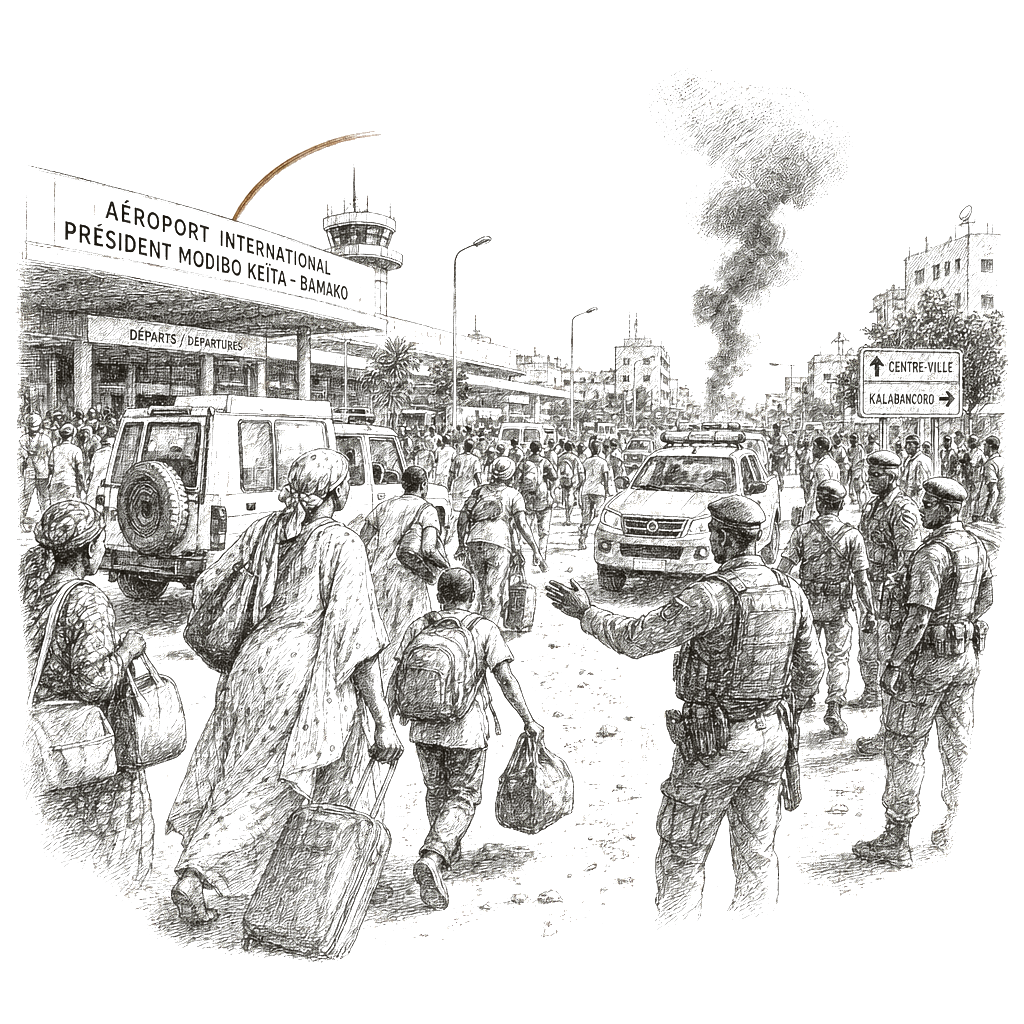
Mali’s government and militant groups gave competing accounts Saturday of what unfolded across the country, as residents reported gunfire and explosions tied to coordinated assaults that included Bamako’s international airport and other cities. The Associated Press reported that the attacks took place amid shifting statements from authorities and militant claims posted online.
In Bamako, AP journalists heard sustained heavy and automatic weapons gunfire from the direction of Modibo Keïta International Airport, about 15 kilometers from the city center. The airport sits adjacent to an air base used by Mali’s air force, and a resident living near it reported gunfire and three helicopters overhead, according to the AP. A helicopter also flew over nearby neighborhoods as the fighting continued.
Mali’s government said the attacks injured people but did not release a death toll. On state television late Saturday, spokesperson Gen. Issa Ousmane Coulibaly said 16 people were wounded, including civilians and military personnel, and that several militants were killed. Another government statement later said the situation was under control, as residents and officials described violence extending beyond the airport area.
The militants’ claim tied the attacks to Islamic militants and a separatist front. The al-Qaida-linked group JNIM said it carried out the Bamako airport attack and strikes in four other cities in central and northern Mali, according to the AP. The claim, posted on JNIM’s Azallaq website, said the operations were carried out jointly with the Azawad Liberation Front, a Tuareg-led separatist group.
Government action in the capital included a curfew for residents in the Bamako district. The governor of Bamako’s district, Abdoulaye Coulibaly, announced a three-day overnight curfew from 9 p.m. to 6 a.m. Residents described attacks in Kati, a town near Bamako that is home to Mali’s main military base, and said the gunfire and explosions woke them.
The AP also reported how the violence affected specific locations and Mali’s military leadership circles. Residents said convoys of militants moved through Kati’s deserted streets, as videos posted on social media showed trucks and motorcycles. The AP reported that Gen. Assimi Goita, the leader of Mali’s military junta, resides in Kati, and that the defense minister Sadio Camara’s residence was heavily damaged by an explosion during the attack, according to a shopkeeper who spoke to the AP. Residents who spoke to the AP did so on condition of anonymity for fear of reprisals.
Elsewhere, reports described violence reaching towns in central and northern Mali. Residents in Sevare and Mopti said gunmen attacked there, while videos from Kidal and Gao showed gunfire exchanges in the streets with bodies lying on the ground, the AP reported. A former mayor of Kidal told the AP insurgents entered the town and took control of some neighborhoods, leading to exchanges with the army, but he also spoke on condition of anonymity due to safety concerns.
The separatist dimension of the attacks appeared in a statement attributed to Azawad. Mohamed Elmaouloud Ramadane, a spokesperson for the separatist Azawad movement, said in a Facebook post that its forces had taken control of Kidal and some areas of Gao. The AP said it could not independently verify that claim, noting that Azawad separatists have been fighting for years to create an independent state in northern Mali, and that Kidal had previously been a stronghold taken by the Malian government and Russian mercenaries in 2023.
The U.S. Embassy in Bamako issued guidance to Americans during the unrest. It sent a security alert citing reports of explosions and gunfire near Kati and the international airport, and urged U.S. citizens to shelter in place and avoid travel there. In Gao, a resident told the AP the explosions’ impact shook his home and that gunfire came from the army camp and the airport, which are next to each other.
A German-linked security analyst also said the scale and coordination of the assault raised concerns. Ulf Laessing, head of the Sahel program at the Konrad Adenauer Foundation, told the AP the assault appeared to be the largest coordinated attack in years in Mali. He added that it was especially concerning that JNIM appeared to coordinate the attacks with Tuareg rebels, saying jihadists and Tuareg rebels teamed up before in 2012, when they overran northern Mali and “spark[ed] the region’s security crisis,” he said.