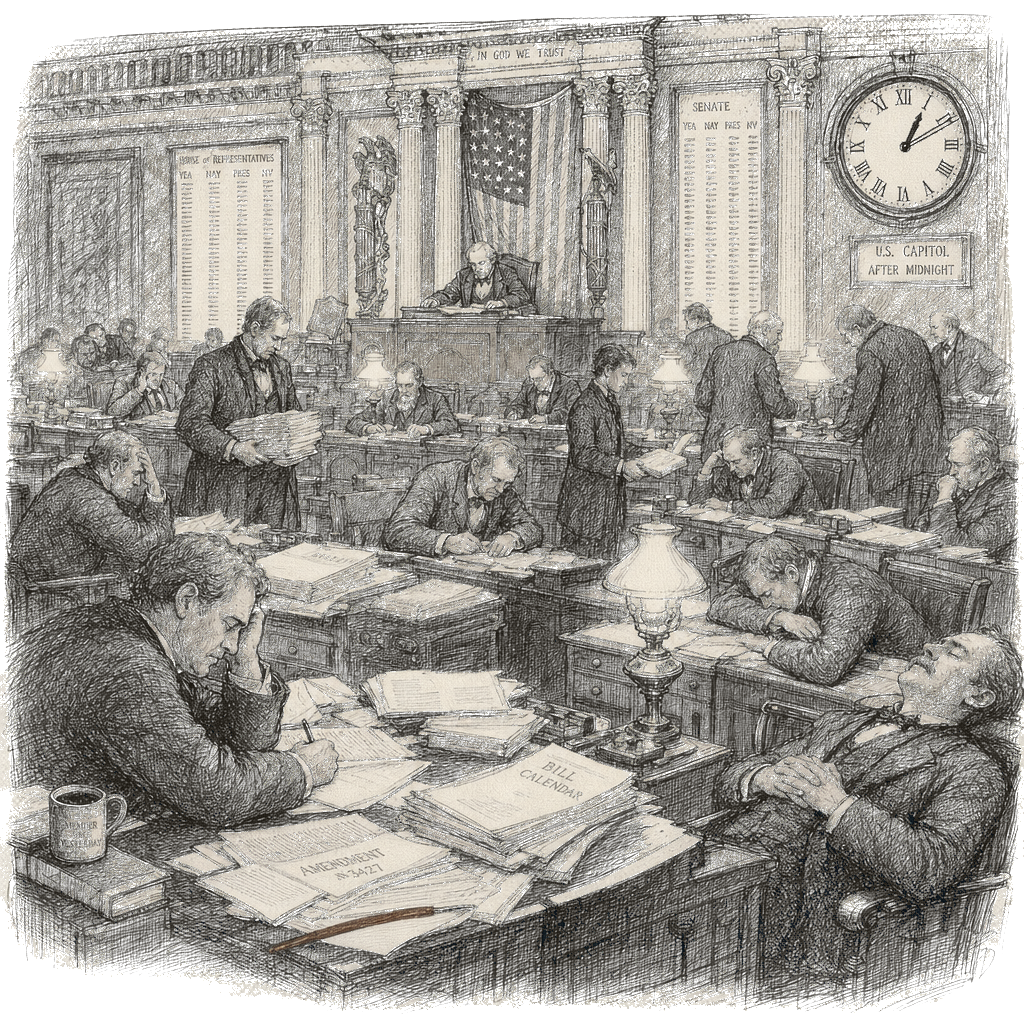
Congressional leaders are leaning more frequently on all-night voting sessions, with members across parties describing the practice as a driver of fatigue, disorder and confusion after dark.
In a late-night amendment sequence this week, Republican Sen. John Kennedy of Louisiana took to the floor near 9 p.m. Wednesday as the Senate prepared for a long series of votes. Kennedy said he was “worried about the health of some of our members” and added, “Not that they’re in bad health, but it’s hard to stay up all night.” More than six hours later, senators wrapped another marathon voting session on amendments just past 3:30 a.m. and filed out of the chamber “dazed, tired and resigned” to repeat the process soon.
Lawmakers said the overnight pattern is not new, but they described it as becoming more common as Congress fractures and the political stakes rise. Republican Sen. Kevin Cramer of North Dakota, who said he has been in Congress for 14 years, argued, “The dysfunction is getting worse,” adding that lawmakers have become “less mature.” He said “It’s not a healthy lifestyle” for lawmakers or the country, and argued there was “less concern for the team effort.”
Several members traced some of the late-night breakdowns to government funding disputes, where leaders use procedural timing to force votes and exhaust resistance. The dysfunction has been recurring, lawmakers said, and in recent weeks it has repeatedly spilled into after-hours fights in both chambers.
In late March, Senate Republicans reached a deal with Democrats to reopen most of the Department of Homeland Security, including the Transportation Security Administration, while Democrats blocked money for Immigration and Customs Enforcement and Border Patrol after shootings of two protesters in Minneapolis. The agreement was described as a breakthrough, and Majority Leader John Thune, R-S.D., passed the spending bill by voice vote “just past 2 a.m.” Senators then returned home for a two-week recess, leaving final passage to the House.
House action later reversed the Senate deal. House lawmakers who were asleep when the Senate agreement was announced woke up and rejected it, saying they would not pass legislation without funding for the immigration enforcement agencies. Senators were then forced to devise a new plan for reopening the department, which remained unresolved at the time of the report.
An equally contentious item—renewal of surveillance powers for federal spy agencies—also devolved into an after-hours standoff. House GOP leaders kept members in session well past midnight as they attempted to pass different versions of a foreign surveillance bill. Leaders ultimately assembled a 10-day extension after 2 a.m. as they scrambled to meet a Monday deadline, leaving both parties exasperated with the late-night maneuvering.
Rep. Jim McGovern, D-Mass., said, “Who the hell is running this place?” He criticized what he described as hurried drafting, saying Republicans threw the bill together “on the back of a napkin in the back room in the middle of the night.” McGovern also said, “Just about everyone agrees that this is serious stuff, the kind of debate that Congress ought to have in the open.”
Other Republicans said the breakdown was predictable. Tennessee Rep. Andy Ogles, a Republican and a member of the House Freedom Caucus who opposed the leadership bills, said, “We warned them that this was gonna happen,” adding, “Unfortunately, here we are at 2 in the morning.”
In the Senate, this week’s late-night vote series unfolded as part of budget reconciliation, an arcane process GOP leaders are using to try to fund two immigration enforcement agencies that Democrats continue to block. Reconciliation allows the majority to bypass the filibuster and pass budget-related bills along party lines, but senators first must clear lengthy amendment voting sequences.
Those sequences can become open-ended “vote-a-rama” sessions in which lawmakers offer amendments to put opponents on record. Republican Sen. Lisa Murkowski of Alaska described the dynamic as a way “to make each other miserable.” Leaders have typically scheduled the marathon votes for the middle of the night, with the goal of exhausting both sides and pushing senators to remain on the floor and vote quickly.
Murkwoski described the toll of the approach during the Wednesday-to-Thursday stretch. She said she was “at 14,291 steps” shortly after 11 p.m., citing her smartwatch and saying her bedtime was approaching. She said that if she could not sleep, she would “get more exercise,” while walking between the chamber and her “hideaway,” a small office senators keep in the Capitol.
Members said similar overnight reconciliation fights occurred last year, when the Senate held extended vote series to pass President Donald Trump’s spending and tax package, which he called “One Big Beautiful Bill.” Murkowski said the latest late nights were “insane,” and she added her mother’s warning: “Nothing good happens after midnight.”
Although overnight votes have happened repeatedly throughout modern history, lawmakers said the frequency has increased. Democratic Sen. Ron Wyden of Oregon, who said he has served since 1981 and described his long tenure as a reference point, said lawmakers now face “a lot of heavy lifting that you have to do to get a bill passed.” Wyden argued “I think at some point you’ve got to have a forcing mechanism,” and said one of the easiest ways is to keep members up until the early hours so they try not to fall asleep “on national TV.”
Democratic Sen. Andy Kim of New Jersey, a relative newcomer elected to the Senate in 2024, questioned whether anyone is watching during late-night sessions. He said, “Are the American people paying attention? How do we get the message out?” Still, Kim said it is important for lawmakers to complete work at any hour, especially with a war involving Iran and lawmakers away from Washington for long stretches. “I don’t mind being here,” Kim said.