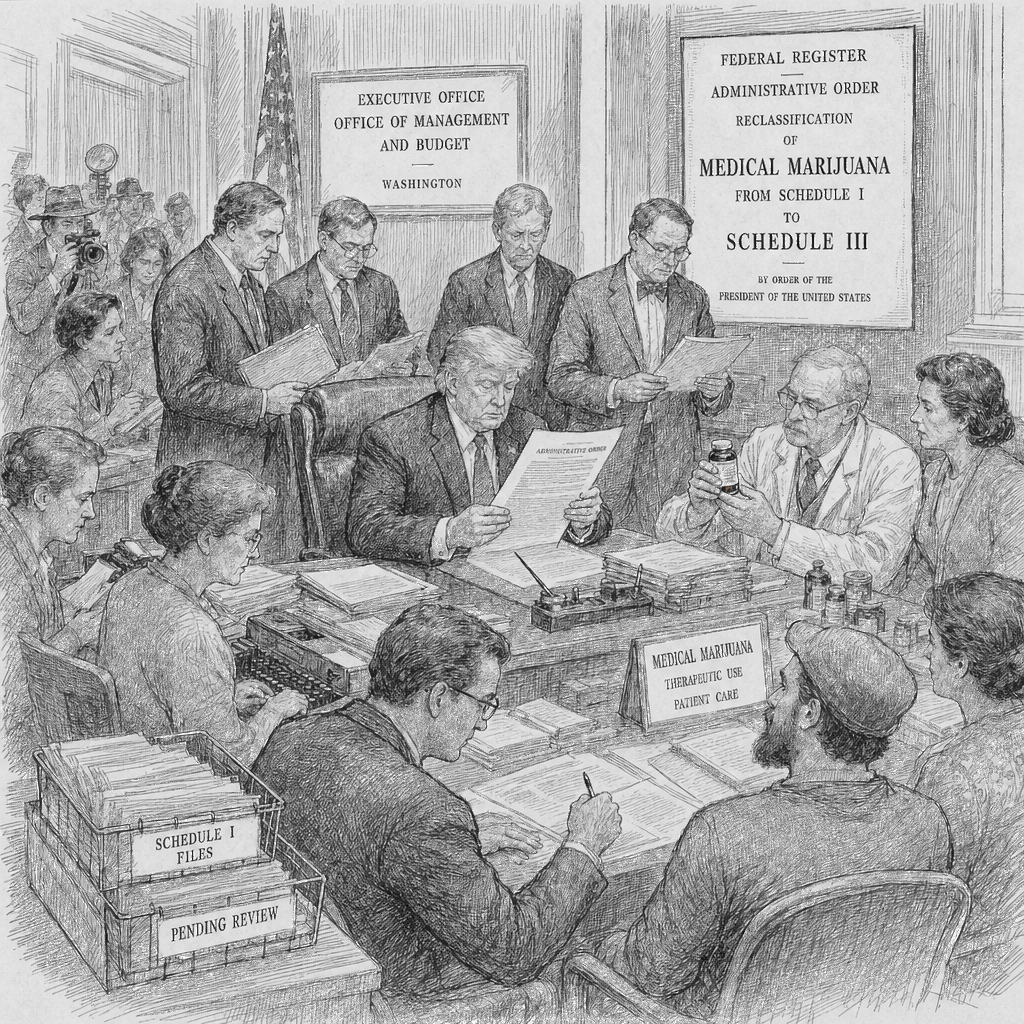
President Donald Trump’s administration reclassified medical marijuana for federal purposes by moving it from Schedule I to Schedule III in a Department of Justice order signed Thursday, according to a federal policy description in an Associated Press explainer. The administration’s action is aimed at how the federal government regulates state-licensed medical marijuana, but the order does not remove federal criminal penalties for marijuana under federal law.
Under current federal policy, possessing marijuana is a federal crime, and selling or cultivating marijuana can carry prison time ranging from five years to life depending on the quantity, the explainer said. The Thursday order instead changes marijuana’s scheduling classification for medical use—shifting it away from Schedule I, which includes drugs such as heroin and LSD that have a high potential for abuse and no recognized medical use, and toward Schedule III, which is described as having moderate to low potential for physical and psychological dependence.
Schedule III includes substances such as ketamine and some anabolic steroids, the explainer said. The Department of Justice order also distinguishes medical marijuana from marijuana sold for recreational purposes, which remains a Class I drug under Thursday’s action even in states that allow adult-use cannabis.
The Department of Justice scheduled a hearing for June 29 to consider whether to broadly reclassify marijuana to Schedule III, the explainer said. The scheduled proceeding would cover the broader question of whether the scheduling change would apply beyond state-licensed medical marijuana.
For businesses that hold state licenses, the policy change could have financial consequences through federal tax rules. The explainer said federal income tax deductions for business expenses are not available for enterprises involved in “trafficking” any Schedule I or II drug, meaning that changing medical marijuana to Schedule III could allow some licensed businesses to claim deductions for expenses such as advertising, marketing, rent, and labor costs related to sales.
Even with that potential benefit, lawyers said the tax treatment could remain difficult in practice. Chicago attorney Irina Dashevsky, who oversees cannabis-related business for the Greenspoon Marder law firm, said it was “nonsensical” because medical products are “the same cannabis, the same methods of creation,” and Denver attorney Rachel Gillette, who leads cannabis industry practice at Holland & Hart, said “it just makes it extremely messy,” according to the explainer.
The policy could also raise questions about timing of the tax deductions. The explainer said the Justice Department has recommended that the Treasury Department apply the deductions retroactively to the full tax years for which businesses operated under a state medical marijuana license, but it noted uncertainty about whether the deductions would apply only from the date of the order.
Public attitudes toward marijuana have also continued to evolve, the explainer reported, citing polling from Gallup. It said support for legalization rose from 23% in 1985 to 64% last year, but declined from 70% in the last few years, largely due to reduced enthusiasm among Republicans. The explainer attributed the shift to Republicans’ support dropping from 55% to 40% since 2023, while Democrats’ support moved from 87% to 85% and independents dipped from 69% to 66%.
Political opposition to the latest scheduling change has remained present in Washington. More than 20 Republican U.S. senators—described in the explainer as including staunch Trump allies—signed a letter last year urging the president to keep marijuana as a Schedule I drug, arguing that marijuana remains dangerous and that reclassifying it would “undermine your strong efforts to Make America Great Again.”
The explainer also described how legalization has corresponded with increased use. It said medical marijuana is allowed in 40 states and Washington, D.C., and that over roughly the past dozen years recreational legalization expanded to 24 states and Washington, D.C. It added that more than 64 million Americans age 12 and older—22%—used marijuana during the previous year, citing a 2024 national survey by the federal Substance Abuse and Mental Health Services Administration, and said that compares with 19% in 2021.
Dr. Smita Das, an addiction psychiatrist at Stanford University, said in the explainer that cannabis use disorder has been rising in the U.S., and she warned that broader federal reclassification could add to changing risk perceptions. She said there had already been “a decrease in risk perception related to cannabis” over the years with state legalization and that the federal change “will probably just add to that.”