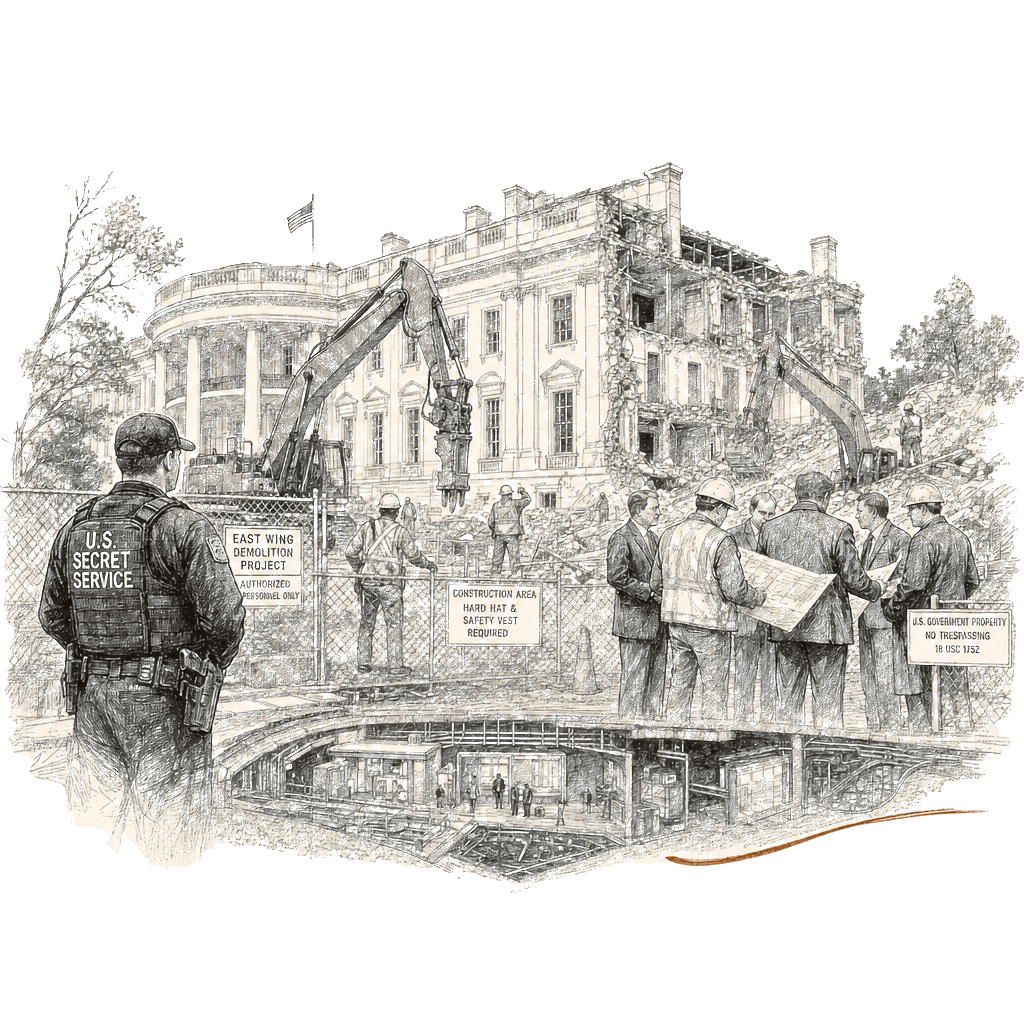
What a secret bunker means for the White House’s East Wing demolition
A federal appeals court decision allowing President Donald Trump to keep building on a planned White House ballroom project has also surfaced details about what officials have described as security work beneath the East Wing site. The project, which was challenged by historic preservation advocates, is being built on the footprint of the former East Wing that was demolished last fall.
The case has revolved around what the administration says is necessary to keep the White House secure while work continues, and what the National Trust for Historic Preservation says is an overreach of presidential authority. In the administration’s appeal, it argued that continuing the project would support security measures that officials say are required for the protection of the president.
The appeals court ruling put on hold a lower-court judge’s order blocking aboveground construction but allowed work intended to support safety and security. In filings accompanying the fight, the administration cited materials to be installed for what it described as a “heavily fortified” facility, including bomb shelters, military installations and a medical facility underneath the ballroom.
Officials involved in White House security emphasized the linkage between what gets built underground and what is constructed above ground. Matthew Quinn, the deputy director of the U.S. Secret Service, wrote in court papers that “An above-ground slab and topping structure is needed to ensure that key underground structures with a security purpose are properly protected and strengthened,” and that “Leaving the project site unfinished imperils the ability of the Secret Service to meet its statutory mission to protect the President.”
The description of the underground facility sits within a longer, partly obscured history of White House bunker planning. A bunker beneath the East Wing dates to Franklin D. Roosevelt’s presidency, after the United States entered World War II, when an underground bomb shelter was installed in 1942. Beyond that foundational period, details remain limited, in part because secrecy around presidential safety restricts what can be publicly confirmed.
Garrett Graff, a historian and national security author, said the Presidential Emergency Operations Center beneath the East Wing has been intended for short-term use, describing it as part of an evacuation-and-continuity logic. Graff said: “The whole point of the sort of presidential evacuation and continuity of the presidency is you want to get the president out of the place where everyone knows that he is and get him into a place where people don’t know where he is.”
Reporting has also documented how high-profile officials have been moved to an underground bunker during major moments. Vice President Dick Cheney was taken to an underground bunker in the wake of the Sept. 11, 2001, attacks after a Secret Service agent entered a West Wing room, grabbed him by the belt and shoulder, and led him to the bunker underneath the White House. Cheney later told NBC News: “He didn’t say, ‘Shall we go?’” and “He wasn’t polite about it.”
More recently, the White House bunker movement narrative has included the summer 2020 period when protests followed the death of George Floyd. At the time, Trump was rushed to a White House bunker as chants from protesters at Lafayette Park could be heard in the building, according to the account described in the reporting.
The legal battle over the ballroom also centers on approvals and federal authority. The National Trust for Historic Preservation has argued that Trump overstepped his authority by moving forward with the project without getting approval from key federal agencies and Congress, according to the reporting. A U.S. District Judge, Richard Leon, ruled in favor of the nonprofit group at the end of March but briefly paused the effect of his decision while allowing underground work to continue.
The administration appealed that order, and the U.S. Court of Appeals for the District of Columbia Circuit scheduled a hearing for June 5 to review the case. As the litigation proceeds, the question of what the above-ground work supports—and what that means for the underground security features described in the filings—remains central to what the court allows and what it blocks.
In public remarks, Trump has also linked the above-ground and underground portions, saying the underground portion would not work without the aboveground facility. He offered a list of security features he said were being put in place while the ballroom is built, including statements that “The roof is droneproof,” that he said the plan includes “secure air-handling systems,” and that the project includes “bomb shelters that we’re building,” as well as “a hospital and very major medical facilities that we’re building.”
The reporting also notes that while taxpayer dollars would pay for the security aspects of the project, Trump has said the ballroom costs would be covered by donations from wealthy people and corporations. With the June 5 hearing approaching, what those security plans amount to in practice—and how the court views the administration’s authority to proceed—remains unresolved.