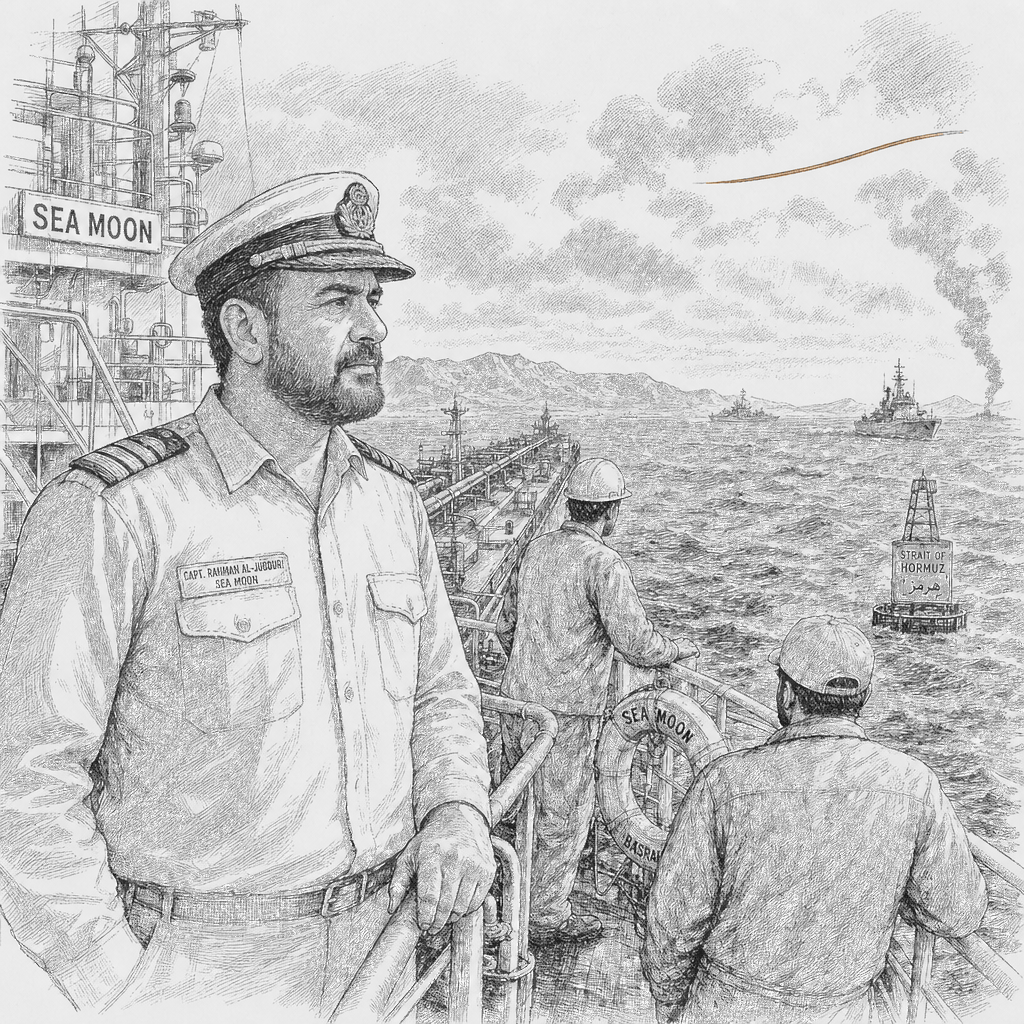
Aboard the Sea Moon, an oil tanker plying contested waters between the Gulf of Oman and the Strait of Hormuz, Iraqi Captain Rahman Al-Jubouri continues to work in one of the world’s most volatile maritime corridors. The tanker moves through waters where the U.S.-Israel war with Iran has disrupted global trade and left some crews stranded and exposed to military strikes.
The widening dangers facing maritime crews have already begun reshaping global commerce. Al-Jubouri’s crew aboard the Palau-flagged tanker has dwindled from 27 sailors to 17, with fear driving departures. This pattern reflects a deeper problem: maritime workers are increasingly unwilling to work in war zones.
A Lifetime at Sea, a New Kind of Danger
A four-decade veteran of maritime trade, Captain Rahman Al-Jubouri has navigated his share of upheaval. He was at sea during the Iran-Iraq War and commanding vessels during the 1991 Gulf War. But when he describes the current conflict, his tone shifts.
“Work has become a real risk; we don’t know when we might be bombed. We’re sailing over a ball of fire,” he said in a phone interview from the Sea Moon.
For the past four months, the Palau-flagged Sea Moon has been Al-Jubouri’s workplace. Since 1984, he has worked at sea—forty years of unbroken maritime service. Now, that same service has placed him directly in the path of escalating warfare. The Sea Moon is en route from the Gulf of Aden toward the Gulf of Oman, bound for Ras Isa port in Yemen to unload its cargo of oil. Although the vessel does not pass directly through the Strait of Hormuz—that critical chokepoint through which global oil flows—the waters remain high-risk. Sporadic military strikes and the U.S. Navy blockade have made the corridor treacherous even at a distance.
The journey has seen significant delays driven by security concerns and logistical disruptions tied to the regional conflict. Commercial vessels have come under fire from Iranian forces and allied groups. As MSI previously reported, American military forces on Sunday seized an Iranian-flagged cargo ship that attempted to circumvent the blockade, the first such interception since naval enforcement began.
The Cost of Preparation
To survive in these waters, the Sea Moon’s crew trains regularly on emergency procedures. “We’ve trained them on how to respond if the ship comes under fire, God forbid,” Al-Jubouri said.
The training is not merely theoretical. Last year, while docked at a Yemeni port, the Sea Moon came under bombardment. “I immediately cut the ropes, prepared the engines, and left the port at my own risk to protect the crew and the ship,” Al-Jubouri said. Shrapnel struck the tanker as it pulled away, causing minor damage. The crew escaped unharmed, and the vessel later resumed operations.
Yet drills and protocols cannot protect against what sustained danger has cost his crew.
An Exodus Driven by Fear
The Sea Moon set out with 27 sailors. Today, it operates with 17. Ten have left—driven away by fear.
“We suffer from being away from our families and our homelands,” Al-Jubouri said. For him, the personal cost is acute. Four months have passed since he last saw his family. Internet access allows periodic contact, but the psychological weight of months at sea, combined with the constant threat of military strikes, has proven unsustainable for many others in his crew.
Food and bottled water are regularly replenished at port with no major shortages reported. Basic provisions remain steady. But the psychological toll—the isolation, the danger, the knowledge that the ship sails over contested waters where the rules of commerce have collapsed into conflict—has proven more difficult to sustain.
Al-Jubouri, with four decades of adaptation under pressure, remains. But his diminished crew reveals what the ongoing war is costing the global shipping industry. As the Strait of Hormuz and the waters around it remain volatile, the economics of shipping are shifting. The cost, measured not just in insurance premiums but in the willingness of human beings to accept the risk, continues to mount.