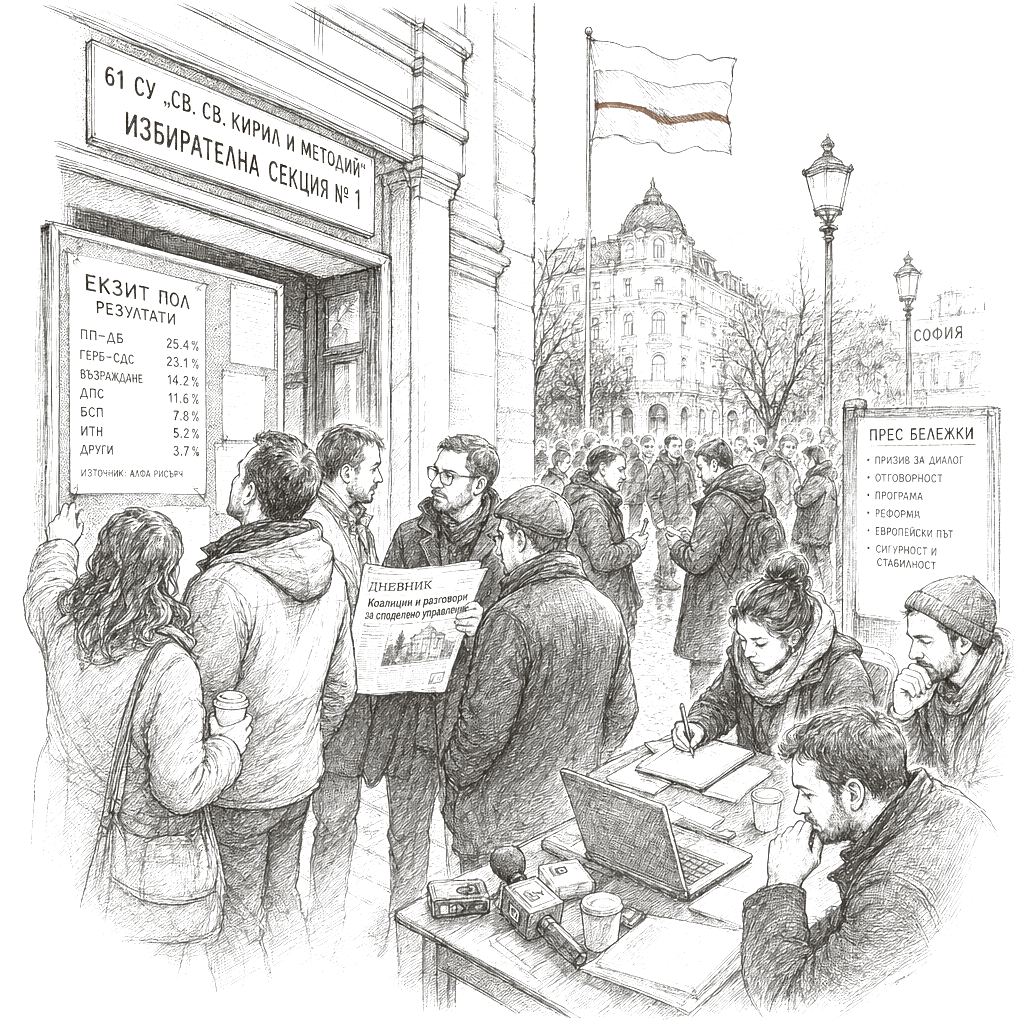
Bulgaria’s center-left coalition led by former President Rumen Radev will win the country’s parliamentary election, an exit poll suggested on Sunday, as voters in the European Union and NATO member state sought to end a cycle of political instability. The coalition appeared unlikely to claim enough votes to govern alone, suggesting protracted power-sharing negotiations ahead.
The election marks another chapter in Bulgaria’s recurring political crises. It is the country’s eighth parliamentary election in five years, a pattern driven by fragmented parliaments, weak governments, and street protests that have repeatedly toppled administrations since 2021.
An exit poll showed Bulgaria’s center-left coalition, led by former President Rumen Radev, winning the country’s parliamentary election on Sunday. The coalition earned 39.2% of the vote in the exit poll conducted by Trend research group, substantially ahead of the center-right GERB party under Boyko Borissov, which was expected to capture 15.1%.
The coalition’s lead was unlikely to translate into sole governing power. Radev said after the initial projections were announced that “we will do our best to prevent having to go to the polls” again. “It will be a disaster for Bulgaria,” he said, “It would mean going from crisis to crisis when what we have to do is work very hard to emerge from these crises.”
Bulgaria’s Recurring Political Crisis
The election was Bulgaria’s eighth parliamentary election in five years, a sign of persistent institutional dysfunction. Voter turnout stood at 43.4%, according to the exit poll. Six parties were predicted to pass the 4% threshold to enter parliament, pointing to a fragmented legislature that would complicate coalition negotiations.
The snap election followed the resignation of a conservative-led government in December, after nationwide protests drew hundreds of thousands of people, mainly young people, to the streets. Protesters called for an independent judiciary and action against widespread corruption that has plagued the European Union and NATO member state.
Since 2021, Bulgaria has struggled with fragmented parliaments that produced weak governments, with none surviving more than a year before being toppled by street protests or backroom parliamentary deals.
Radev’s Anti-Oligarchy Campaign
Radev, 62, is a former fighter pilot and air force commander who resigned from the mostly ceremonial presidency in January to pursue the prime minister’s post. He has cast himself as an opponent of what he described as Bulgaria’s entrenched oligarchic system. At campaign rallies, he vowed to “remove the corrupt, oligarchic model of governance from political power.”
Radev is seen by critics as pro-Russian. He has opposed military aid to Ukraine and favored reopening talks with Russia as a path out of the conflict, though he has officially denounced Russia’s invasion of Ukraine.
Coalition Negotiations Begin
His relatively vague campaign platform has left him open to cooperation with almost any party in parliament, according to Mario Bikarski, senior Eastern and Central Europe analyst at the risk intelligence company Verisk Maplecroft. Bikarski said Radev seems reluctant to enter a formal coalition with the hard right and openly pro-Russian Revival party.
Bulgaria joined the eurozone on January 1, shortly after entering the border-free Schengen travel area. Official results are expected Monday.