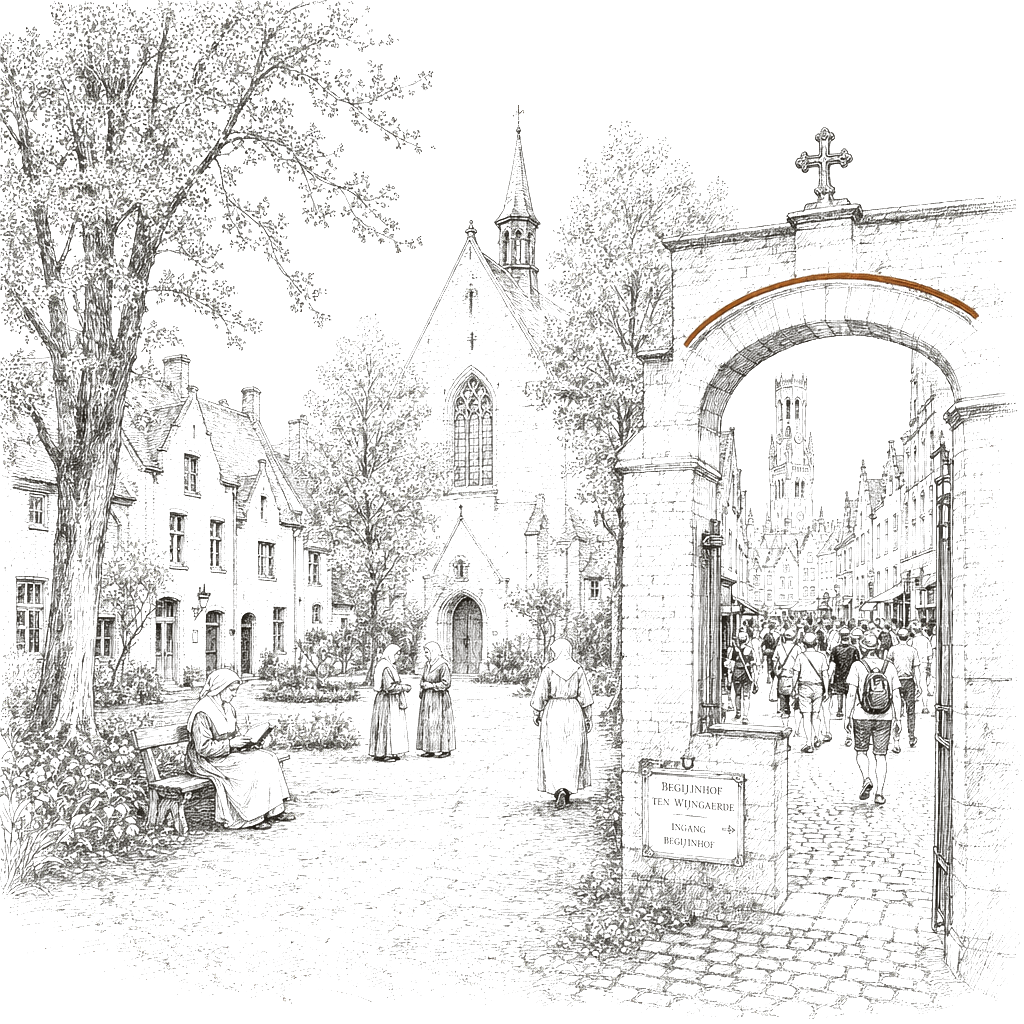
In the heart of Bruges, one of Belgium’s most touristic cities, about two dozen women have found sanctuary from bustling cobblestone streets and chattering crowds at an institution founded nearly 800 years ago. The Princely Beguinage Ten Wijngaerde, a women-only community established in 1245, sits beyond a small bridge and under an ornate arch engraved with the Latin phrase ‘sauvegarde’—safe place. For contemporary residents like Trees Dewever, who has lived there for 22 years, the beguinage provides ‘an overwhelming feeling of calm.’
The beguinage is one of 13 such institutions in Flanders recognized as UNESCO world heritage sites. Originally emerging in the 12th century as refuges for women displaced by medieval conflicts, these communities encoded a form of independence that women fought to preserve for centuries—and that modern residents say remains vital.
A Hidden Sanctuary Amid Bruges’s Tourist Bustle
The clatter of suitcases rolling over cobblestones, motorboats chugging along a canal, and visitors chattering in multiple languages form the soundtrack to Bruges. Yet about two dozen women have found refuge from the noise in an institution that has sheltered women for nearly 800 years.
Over a small bridge and beneath an ornate arch engraved with the Latin word “sauvegarde”—safe place—lies the Princely Beguinage Ten Wijngaerde. Founded in 1245, it remains a pocket of calm in one of Belgium’s most touristic cities.
Trees Dewever, who has lived in the beguinage for 22 years, said it provides “an overwhelming feeling of calm and I think we need that in this world.” Her neighbor, Jo Verplaetsen, a 23-year resident, echoed the sentiment, saying “each day you are thankful to be here.”
A Refuge Born From Medieval Dislocation
The beguinages emerged after the 12th century as a response to devastation. Conflicts in the Middle Ages ravaged the male population, creating a surplus of widows and single women who needed shelter and stability.
Unlike nuns in convents, women who became beguines followed looser rules. They were forbidden to marry while residing in the beguinage, but were allowed free egress, could own their own property, and did not take religious vows of celibacy or poverty. Brigitte Beernaert, who moved into the Bruges beguinage more than 20 years ago, described the arrangement: “Women who didn’t want to become real nuns or religious could have an in-between form, becoming a beguine.”
Beguines worked caring for the sick and poor. They also earned money through needlework and weaving lace, and some invested their profits back into the community. Michel Vanholder, a volunteer at the Grand Beguinage Church of Mechelen, explained the appeal: “They didn’t want to go become nuns but nevertheless they wanted to live together without men because there were not enough men to marry.”
A History of Persecution and Endurance
The beguinages faced periodic persecution from the Vatican. Marguerite Porete, a French Christian mystic and prominent beguine, was condemned as a heretic and burned at the stake in 1310. The beguines and their male counterparts, the beghards, subsequently became subjects of literary imagination: novelists Ken Follett, Charlotte Brönte, and Umberto Eco all drew on their stories.
Architecturally, the beguinages were designed for community—small houses arranged around a main square or along accessible alleys, with gardens tucked between them, and a chapel or church at the center serving as the heart of each community.
A Living Sanctuary
The last beguine in Belgium, Marcella Pattijn, died in 2013 at the age of 92. Yet the central tenet of the beguinage community has persisted: “Once you are in here, you are safe,” according to contemporary residents. Today, UNESCO recognizes 13 beguinages in Flanders, the Dutch-speaking northern half of Belgium, as world heritage sites.
The Bruges beguinage remains women-only. The city owns and maintains the grounds, with residents renting from the municipality. The community organizes public activities—gardening projects, open houses—to foster connection within and beyond its walls. Some residents have recently planted raspberry bushes against the wall near the canal and keep beehives for honey.
Brigitte Beernaert expressed what many contemporary residents feel: “The world is terrible for the moment, and this gives us the impression that it’s still safe here. This gives Bruges already a little bit of a small paradise, if you want. And living inside that paradise feels unbelievable.”
For German tourist Biata Weissbaeker, visiting Bruges with her husband, the significance was clear. “Women need a place like this,” she said. “A safe place that gives them the possibility to go inside themselves.”
The beguinage endures as testament to a form of independence women created for themselves in the medieval world and continue to inhabit today.