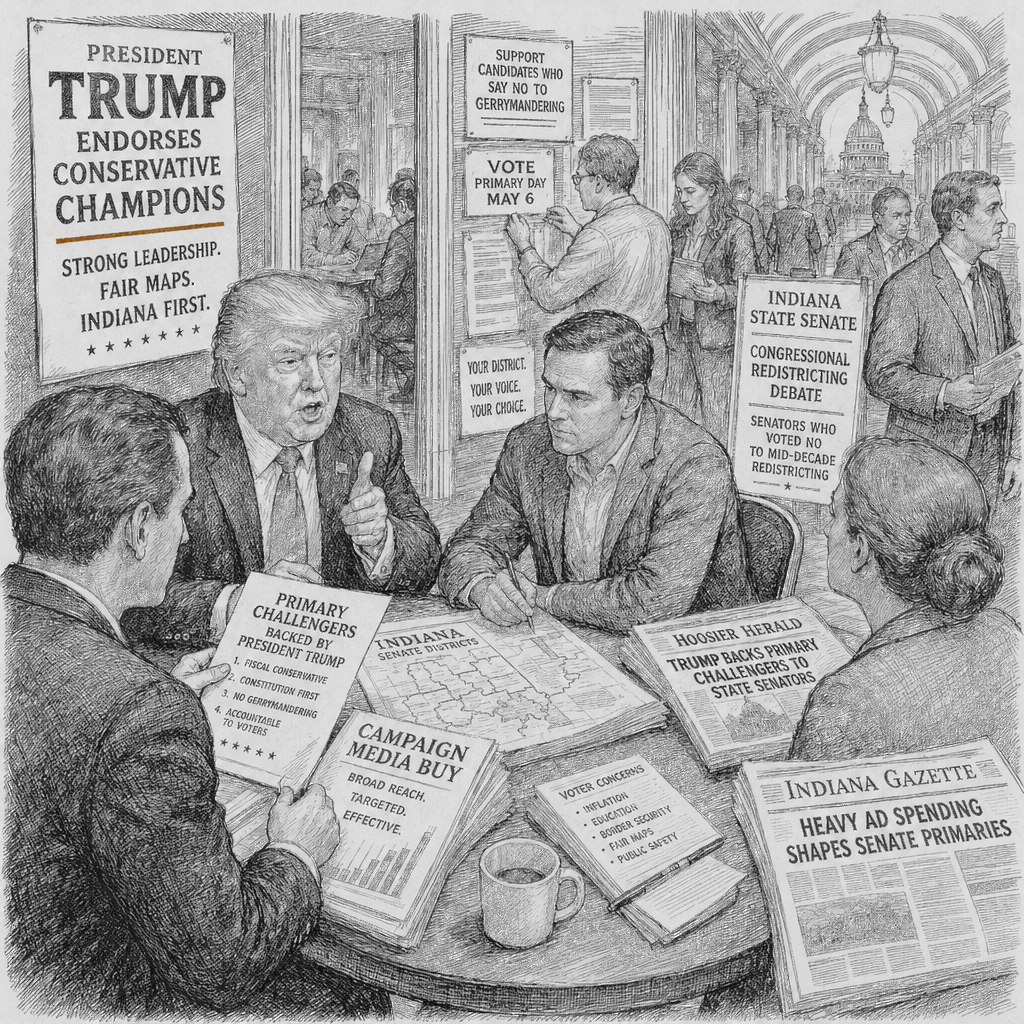
President Donald Trump is endorsing seven primary challengers against Indiana Republican state senators who defied his demand to redraw the state’s congressional map, a campaign backed by more than $4.2 million in advertising spending. The effort, which has no recent precedent, will test Trump’s influence over Republican Party politics in the May 5 primary.
The campaign reflects Trump’s continued push to reshape redistricting across the country to bolster Republican electoral prospects, even after Indiana’s Republican-controlled Senate voted against a new map in December. Some targeted incumbents are receiving protection from unlikely quarters, including former Gov. Mitch Daniels, a Republican who has largely stepped away from politics.
Spencer Deery was knocking on doors in West Lafayette on a Saturday afternoon when a pair of motorcyclists stopped to thank him. “I wanted to thank you for having the courage to vote against the redistricting,” one told the Indiana state senator.
The appreciation is unusual. Most politicians facing the kind of campaign spending Deery now endures—nearly $1 million flooding in to unseat him—find little public support. But Deery’s vote last December against a redistricting proposal backed by President Donald Trump has made him a target in a campaign that tests Trump’s control over Republican politics in the states.
Trump has endorsed seven primary challengers against Indiana Republican state senators who opposed his demand to redraw Indiana’s congressional map. The campaign, backed by national organizations including Turning Point Action, has already attracted more than $4.2 million in advertising spending—a level unprecedented for Indiana state Senate races.
“It’s about sending a message that any state that does not get in line or any lawmakers that do not get in line with the political forces in D.C. should be on the lookout,” Deery said in an interview.
The White House pressure campaign
The White House had pressed hard for the redistricting change. Vice President JD Vance met with Indiana politicians in Washington and Indianapolis, and Trump weighed in directly by conference call. The administration hoped that the new map would help protect Republican control of the U.S. House, but the Republican-controlled state Senate voted against redistricting in December.
Trump later tried to minimize his involvement, telling reporters he “wasn’t working on it very hard.”
The campaign against the seven senators escalated the initial pressure. Gov. Mike Braun and U.S. Sen. Jim Banks, both Republicans, are backing primary challengers. Braun is putting $500,000 from his political action committee into state Senate races, though he framed his involvement around his own agenda rather than the redistricting vote.
“Whether you supported this or that, my goal is to get enterprising senators and representatives,” Braun said. “So when it comes to what you do to either support or not support certain legislators, for me, it’s going to mostly be based on, ‘Are you willing to help me take Indiana into places that all states would want to be?’”
The race for Indiana’s 23rd Senate District
One of the targeted senators faces particularly intense pressure. Deery spent $142,000 to win his seat four years ago in a race where fewer than 11,000 people voted. Now, he is defending against Paula Copenhaver, an activist and aide to Lt. Gov. Micah Beckwith, whom Trump has endorsed.
Trump called Copenhaver a “MAGA Warrior” and “a terrific Candidate for Indiana’s 23rd State Senate District.” On social media, he described Deery as an “incompetent and ineffective RINO incumbent” who “betrayed his voters by voting against Redistricting in Indiana.” RINO stands for “Republican in name only.”
Copenhaver declined to respond to requests for comment. One television advertisement funded by groups supporting her stated flatly: “State Sen. Spencer Deery voted against President Trump’s agenda.”
Deery has spent $167,000 on his own campaign with no outside support.
Threats, protection, and principle
Some opponents of the redistricting proposal faced threats. Deery was targeted by a false police report designed to provoke a dangerous emergency response to his home.
“I don’t work for them,” Deery said of national political figures. “I work for my voters, my constituents.”
Former Gov. Mitch Daniels, a Republican who largely stepped away from politics after his term ended in 2015, has been quietly working to protect the targeted incumbents. Daniels, under whom Deery served as chief of staff before entering the state Senate, recorded a video and raised money for him.
Voters weigh in
The campaign’s effectiveness remains uncertain. Julie Wise, a 48-year-old hospital worker and Trump voter in West Lafayette, said she would not adjust her vote to match the president’s preferences.
“I’m not going to say that ‘because this is what the president wants, this is how I’m going to vote,’” Wise said from her front step.
Beckie Eikenberg, a quality assurance associate at an Indiana pharmaceutical company who describes herself as “libertarian on the conservative side,” said she was skeptical of the advertisements against Deery. She said Trump did not have sufficient knowledge of state issues to shape redistricting decisions.
“He doesn’t necessarily know what’s going on within our state. He’s not here. He doesn’t see the day to day,” she said.
Others, like Curtis Williams, viewed the campaign’s pressure on state senators as inappropriate, though he declined to say how he planned to vote.
The May 5 primary will show whether Trump’s endorsements and the weight of national spending can sway voters who have previously elected these senators and who may see the outside pressure as a test of their own political voice.