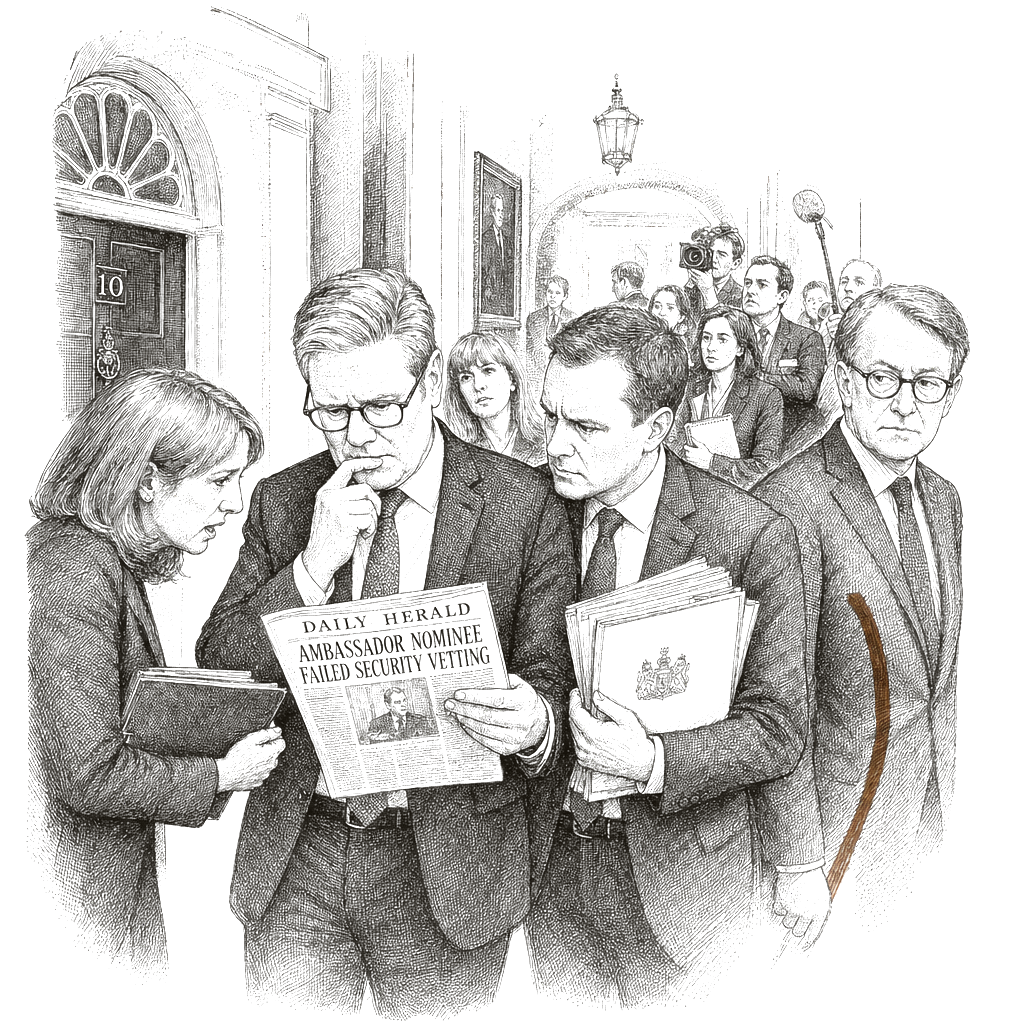
British Prime Minister Keir Starmer faces a fresh threat to his leadership after The Guardian revealed Thursday that Peter Mandelson, whom Starmer appointed as ambassador to the United States, failed security vetting for the role. The revelation raises questions about whether Starmer misled Parliament over how Mandelson cleared the official hurdles required for the ambassadorial post.
The crisis strikes at the heart of Starmer’s political identity. He won the July 2024 general election on a platform of integrity and rule-following, explicitly positioning himself against the scandal-plagued Conservative government he replaced. Questions about whether he misled Parliament now threaten that central claim.
The vetting bombshell
The Foreign Office’s internal assessment found that Mandelson, 72, failed to clear security vetting before he took up the ambassadorial post in early 2025. Starmer told Parliament that “full due process” was observed, but the government acknowledged this week that the Foreign Office had cleared Mandelson for the job despite the assessment.
Olly Robbins, the Foreign Office’s top civil servant, resigned following the revelation. People familiar with the vetting process said that security checks do not produce a binary pass or fail, but a risk-based assessment that leaves final decisions to senior officials like Robbins. The process typically keeps ministers in the dark about sensitive personal information involved.
Starmer is facing questions about whether he directed officials to sidestep concerns over Mandelson. He said he is “absolutely furious” that he was kept in the dark, calling it “staggering” and “unforgivable.” The prime minister is scheduled to address Parliament on Monday. Robbins is due to speak to lawmakers on Tuesday and may offer a different account of events.
The controversial appointment
Starmer’s decision to appoint Mandelson was politically calculated but high-risk from the outset. Mandelson had twice resigned from Labour governments decades earlier over financial or ethical missteps. More recently, he described himself as a “best pal” of Jeffrey Epstein, the financier and convicted sex offender who died in prison in 2019.
The calculation appeared to be that Mandelson’s lobbying skills and previous trade expertise would help persuade the Trump administration to spare the United Kingdom from some of the most onerous tariffs. That effort initially seemed successful.
By September 2025, however, the picture shifted. Emails showed that Mandelson had supported Epstein even as the financier faced jail time for sexual offenses. Starmer fired Mandelson and apologized to the British public and to victims of Epstein’s sex trafficking.
The crisis deepened in January when the U.S. Justice Department released millions of pages of Epstein-related documents. Emails in those files suggested that when Mandelson served in the Labour government between 2009 and 2010, he had passed sensitive government information to Epstein. British police launched a criminal investigation and searched Mandelson’s two homes. On February 23, he was arrested on suspicion of misconduct in public office. He was released after more than nine hours of questioning. Mandelson has not been charged, denies any wrongdoing, and does not face allegations of sexual misconduct.
Integrity at stake
“Starmer set himself up as the guy who always followed the rules, in stark contrast to, say, Boris Johnson, and he came to power effectively promising to ‘drain the swamp,’” said Tim Bale, a politics professor at Queen Mary University of London. According to Bale, the revelations mean that voters now see Starmer as “not only as a liar but as a hypocrite—and hypocrisy is one of the worst sins that any British politician can possibly commit.”
This assessment captures the political danger Starmer now faces. His campaign and early tenure centered on the promise that his government would restore integrity and transparency after years of Conservative scandals. The vetting affair now undermines that fundamental claim.
“This scandal is not ending,” said Kemi Badenoch, leader of the main opposition Conservative Party. “He has run out of people to sack, he has run out of places to hide, he has run out of authority. The buck stops with him. His position is untenable and he must go.”
The path ahead
Starmer’s Labour Party commands a large majority in Parliament, which shields him from immediate removal. However, his political survival ultimately depends on what Labour lawmakers decide to do. Confidence in a leader can erode quickly, even with an overwhelming majority. Boris Johnson was elected with a substantial majority in 2019 and resigned from both the premiership and Parliament three years later after a string of scandals.
When Starmer addresses Parliament on Monday, he will gauge the mood of his party. So far, few Labour lawmakers have publicly called for him to step down. But if more members of Parliament put their heads above the parapet following a weekend of campaigning in their local districts, he may face serious trouble.