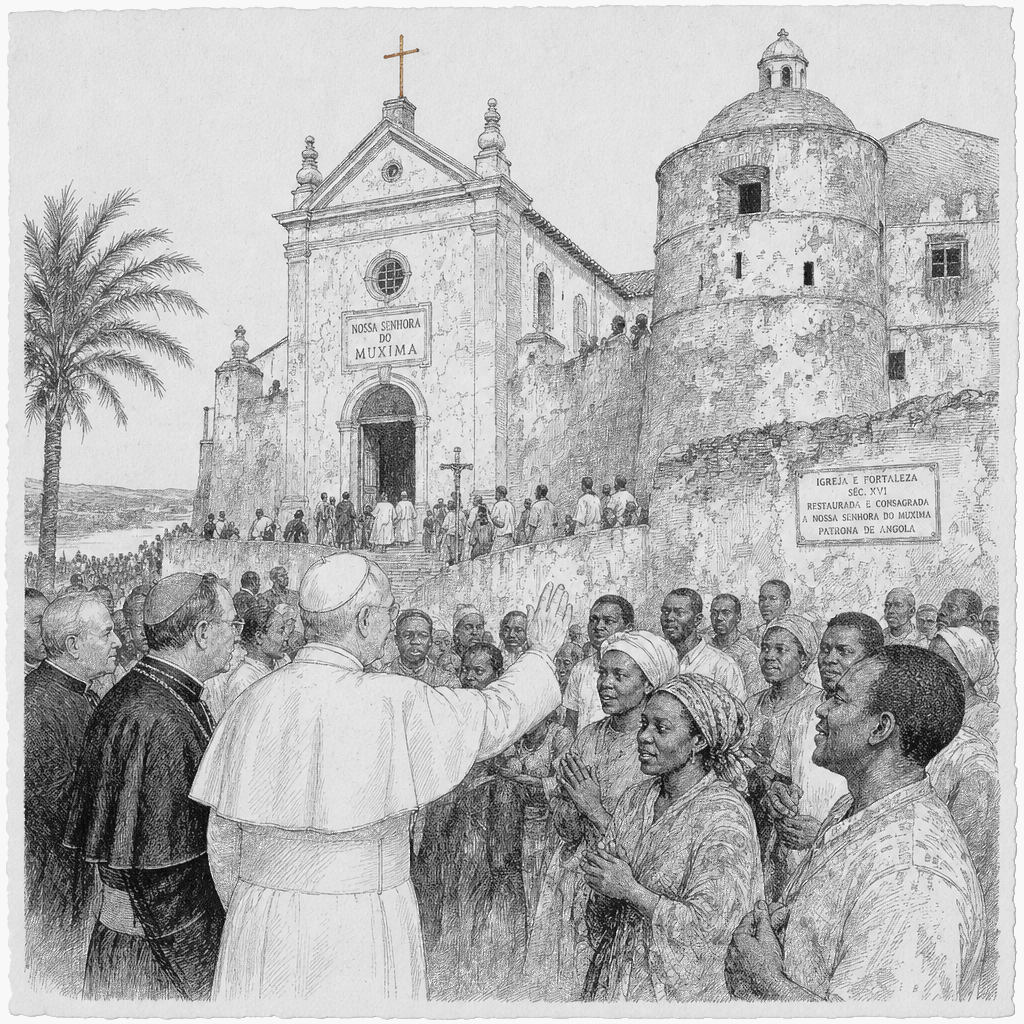
Pope Leo XIV will visit Angola’s Church of Our Lady of Muxima on Sunday, a 16th-century fortress transformed into a pilgrimage shrine but marked by its role in the trans-Atlantic slave trade. The visit gains weight from recent revelations about the pope’s own heritage: his ancestry includes both enslaved people and slave owners. The church, where Portuguese colonizers baptized enslaved Africans before forcing them to the port of Luanda for shipment to the Americas, reflects what historians call the inextricable link between Catholicism and African exploitation.
For African Catholics, the moment carries both symbolic and spiritual power. The pope, the first American to hold the office, has signaled that rebuilding the Church’s presence in Africa—healing what one Vatican scholar called seeing Africa as ‘just making up the numbers’—is central to his early papacy.
The Church and the Slave Trade
The Church of Our Lady of Muxima sits on the edge of the Kwanza River in the Angolan town of Muxima, its white walls overlooking the site where more than 5 million enslaved people began their forced journey across the Atlantic—more than any other single country and nearly half of the roughly 12.5 million African slaves sent across the ocean.
Built by Portuguese colonizers at the end of the 16th century as part of a fortress complex, the church became a hub of the slave trade. Enslaved Africans were gathered there to be baptized by Portuguese priests, then forced to walk 145 kilometers (90 miles) to the port of Luanda for shipment to the Americas.
The Vatican had authorized the Portuguese to enslave non-Christians through 15th-century directives that undergirded the colonial enterprise. The church at Muxima has since been transformed by faith. Around 1833, believers reported an appearance by the Virgin Mary on the riverside esplanade, and the site became a major pilgrimage destination for Angolan Catholics.
“For me, the pope going there to pray the Rosary, he will give that place a new significance,” said Rev. Celestino Epalanga, a priest with the Catholic Bishops’ Conference of Angola. “We have to give it a new sense. To make this place sacred instead of being a place of evil.”
The Pope’s Heritage
The pope’s own ancestry adds another layer to the visit. Last year, a genealogist in the U.S. discovered that Leo—whose birth name is Robert Prevost—has Creole heritage and Black and white ancestors. Census records show his maternal great-grandparents were described as people of color in Louisiana. His ancestry includes both enslaved people and slave owners.
Some of the first enslaved people to arrive in Louisiana were sent from Angola, according to historians.
Leo has not spoken publicly about his heritage. Mariana Candido, a professor of history at Emory University, said she sees complex symbolism in the pope’s visit to a place linked to such an immoral act, particularly given the chance for him to reach out to a new generation of African Catholics.
“I can see how this is a way of connecting to Catholics in Angola, and making the Church more in sync with how people are practicing Catholicism in Angola and in African countries,” Candido said.
Papal Precedent and Modern Context
Other popes have addressed slavery on African visits. St. John Paul II spoke about it during papal visits to Cameroon in 1985 and Senegal in 1992. In 2024, as he left office, President Joe Biden visited Angola and characterized slavery as America’s “original sin.”
It is unclear whether Leo will make an explicit statement on slavery during his Africa tour.
Rev. Stan Chu Ilo, a Nigerian priest and professor at DePaul University in Chicago, said he has seen evidence that the pontiff is developing deeper connections to Africa by elevating African figures within the church, including the recent promotion of Monsignor Anthony Ekpo of Nigeria to a high-ranking Vatican position.
“This pope is actively cultivating African presence within the church and trying to, I think, heal this policy or program of seeing Africa as just making up the numbers,” Chu Ilo said.
Leo said at the start of his trip that he had decided in May of last year—soon after his election—that Africa would be his first papal trip. He described this particular visit to Africa as “very special for several reasons.”
Angola’s Present Challenges
Angola bears the weight of its history. A Portuguese colony until 1975, it descended immediately after independence into a 27-year civil war that killed more than half a million people. Today, the country of 37 million people remains economically unequal despite oil, diamonds, and other resources.
The Vatican has said that themes Leo will raise during his Africa visit include the exploitation of natural and human resources, corruption, and authoritarian regimes.
Olivio Nkilumbo, an opposition lawmaker in Angola’s Parliament, said he hoped the pope would call forcefully for social justice while acknowledging the deep challenges his country still faces. “We still don’t have democracy, don’t have freedom,” he said.
Nkilumbo said he was not a Catholic but praised the Catholic Church in Angola—the country’s dominant religious denomination—for being at the forefront of the fight for equality and justice. Rev. Epalanga, alongside his priestly work, serves as executive secretary of the Catholic Commission for Justice and Peace in Angola, which actively works to promote democracy and ease poverty.