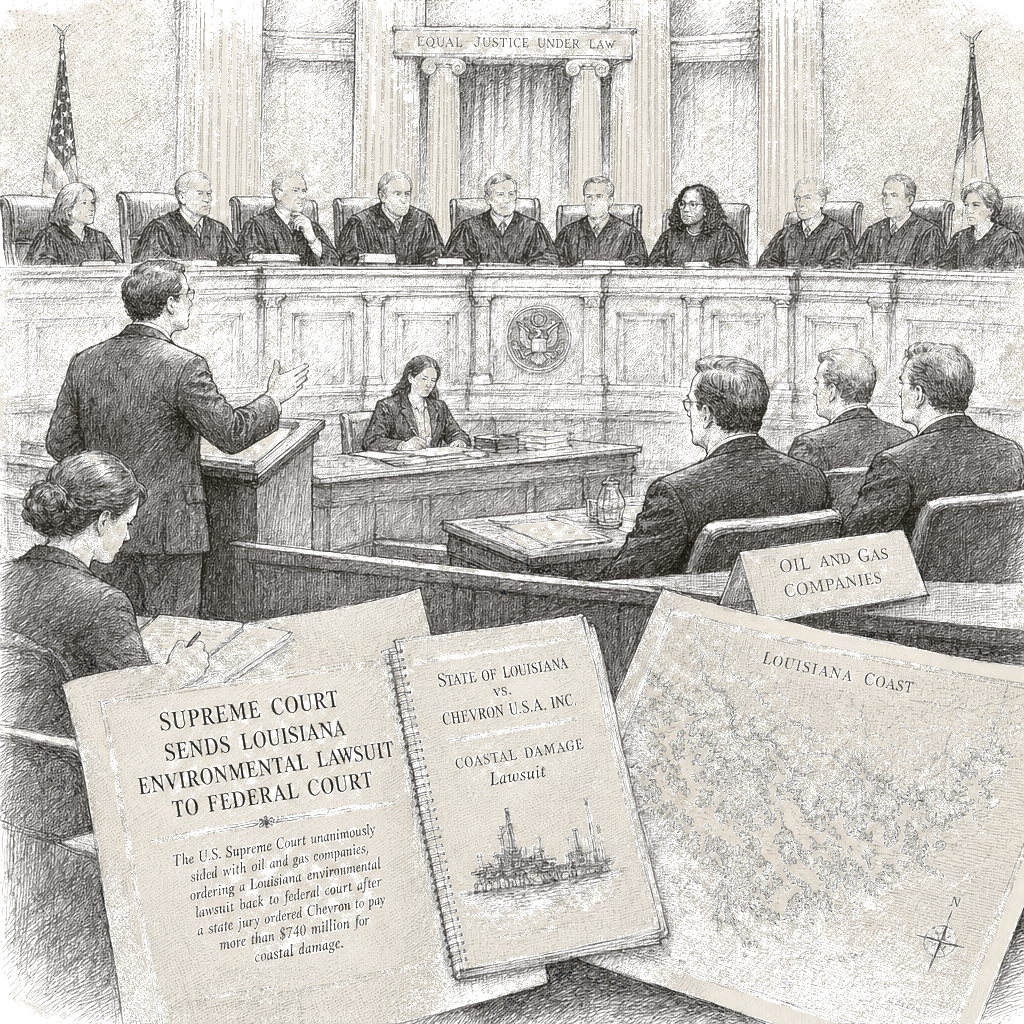
The Supreme Court unanimously sided with oil and gas companies on Friday, ordering a Louisiana environmental lawsuit back to federal court after a state jury ordered Chevron to pay more than $740 million for coastal damage. Writing for an 8-0 court, Justice Clarence Thomas found the lawsuit was related to companies’ World War II efforts to supply aviation fuel for the U.S. government and should be heard in federal court.
The decision is a procedural victory that shifts the legal venue but does not end Louisiana’s efforts to hold oil companies accountable for the thousands of square miles of coastal land the state has lost over the past century, much of it attributed by government scientists to oil industry infrastructure.
The Procedural Victory and Its Scope
The Supreme Court on Friday handed a procedural victory to oil and gas companies fighting environmental lawsuits in Louisiana. The unanimous decision ordered a state court case back to federal court, where the energy industry considers the legal terrain more favorable.
Writing for the 8-0 court, Justice Clarence Thomas found the lawsuit was related to companies’ World War II efforts to supply aviation fuel for the U.S. government and should be heard federally. At stake was a jury verdict from Plaquemines Parish that ordered Chevron to pay more than $740 million to address coastal damage the company had allegedly caused through decades of operations.
The Supreme Court’s decision overturns a 2024 ruling from the U.S. Court of Appeals for the Fifth Circuit and will affect approximately a quarter of the dozens of lawsuits filed in 2013 against various oil giants alleging violations of state environmental laws.
The Environmental Reckoning
Louisiana’s coast has lost more than 2,000 square miles of land over the past century, according to the U.S. Geological Survey, which identifies oil and gas infrastructure as a significant cause. The state’s coastal protection agency has warned that Louisiana could lose an additional 3,000 square miles in the coming decades—an area larger than Delaware—if current erosion rates persist.
A jury had determined that Texaco, acquired by Chevron in 2001, violated Louisiana coastal protection regulations by failing to restore wetlands damaged by dredged canals, drilling wells, and the discharge of billions of gallons of wastewater into marshland.
Chevron says the claims relate to work conducted under federal supervision and before modern environmental regulations took effect. The company denies responsibility for Louisiana’s land loss.
Bipartisan Support for Accountability
The litigation has crossed typical political lines in Louisiana. Republican Attorney General Liz Murrill noted that the jury award came from Plaquemines Parish, one of the state’s most conservative and pro-energy districts. Republican Governor Jeff Landry backed the lawsuits when he served as state attorney general.
John Carmouche, an attorney representing Louisiana interests, said the community would persist despite the Supreme Court setback. “Simply changing where the case will be heard, as has happened, will not deter our efforts to have Big Oil held accountable for the damages they caused and the enormous restoration they owe the people of Louisiana,” he said in a statement.
Anne Rolfes, director of the Louisiana Bucket Brigade environmental organization, characterized the decision as “a bump in the road.” She cited the role of oil industry pipelines and canals in fragmenting the natural coastline and leaving residents more vulnerable to hurricanes.
Industry Response
The energy industry group Grow Louisiana called the decision “an important win for legal clarity,” while the Louisiana Association of Business and Industry described it as a victory for proper legal procedure.
Justice Samuel Alito did not participate in the decision, recusing himself because of financial holdings in ConocoPhillips.