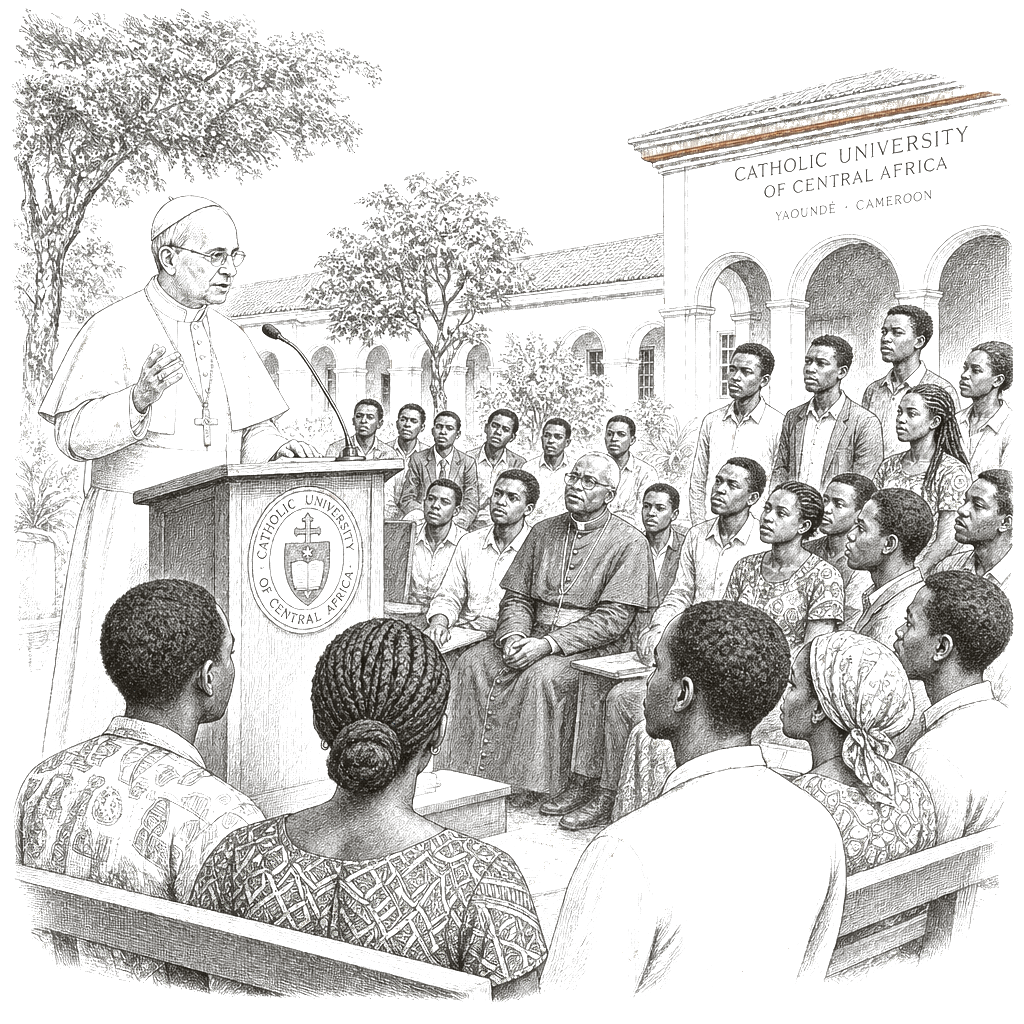
Pope Leo XIV on Friday urged Cameroon’s young people to resist the temptation to migrate and instead work to combat corruption plaguing their country, telling students and faculty at the Catholic University of Central Africa that morally upright citizens are essential to halt the continent’s decay.
“Africa, indeed, must be freed from the scourge of corruption,” Leo said during a Mass and university meeting in Yaounde, highlighting two of the central problems facing the continent: the corruption that perpetuates poverty and the brain drain of talented citizens who leave rather than challenge the system at home.
The Pope’s visit marks his first extended engagement in the world’s second-most populous continent, coming as young Africans increasingly face the choice between staying in countries ruled by aging leaders with entrenched power and seeking opportunity abroad.
The Pope’s call for young people to stay and build their nation at home faces a structural economic obstacle. According to World Bank data, while Cameroon’s official unemployment rate stands at 3.5%, 57% of the labor force aged 18 to 35 works in informal employment—meaning most young adults lack stable income or benefits—even as the country’s 29-million-person population has a median age of just 18.
Pope Leo XIV arrived in Cameroon on Friday with a direct message for the nation’s young people: stay and challenge the corruption keeping your country impoverished.
At a Mass in the port city of Douala, the Pope celebrated with approximately 120,000 people—far below the Vatican’s expectation of 600,000. Cameroon’s organizers attributed the shortfall to security limitations and closed roads that prevented many from reaching the field outside town next to the Japoma sports stadium. Later that day in Yaounde, the capital, he met with students and faculty at the Catholic University of Central Africa to press home his central message.
“Africa, indeed, must be freed from the scourge of corruption,” Leo told the university audience. “The greatness of a nation cannot be measured solely by the abundance of its natural resources, nor even by the material wealth of its institutions. No society, in fact, can flourish unless it is grounded in upright consciences, formed in the truth.”
The Economic Barrier
The Pope’s call for young people to build their nation at home faces a difficult economic reality. While Cameroon’s official unemployment rate stands at 3.5% according to World Bank data, 57% of the labor force aged 18 to 35 works in informal employment—meaning most young adults lack stable income or benefits. The country’s 29-million-person population has a median age of just 18, yet opportunity remains scarce for most.
When the Skilled Leave
The brain drain is severe and measurable. About one-third of trained doctors who graduate from medical school in Cameroon leave annually for more lucrative jobs in Europe and North America, according to the Ministry of Higher Education. The already understaffed health sector loses qualified professionals to international opportunity each year.
Leo framed these departures as a matter of moral choice. “In the face of the understandable tendency to migrate—which may lead one to believe that elsewhere a better future may be more easily found—I invite you, first and foremost, to respond with an ardent desire to serve your country and to apply the knowledge you are acquiring here to the benefit of your fellow citizens,” he said.
Digital Threats to Truth
The Pope raised broader alarm about artificial intelligence and digital environments. As self-referential bubbles online spread polarization and people lose direct human encounters, humanity’s relationship with truth itself is at risk, he suggested. “What is at stake is not merely the risk of error, but a transformation in our very relationship with truth,” Leo cautioned.
The Political Backdrop
His message about staying to build at home comes as Cameroon is ruled by President Paul Biya, who has held power since 1982, is 93 years old, and just secured an eighth consecutive term last year through a disputed election. Catholics represent about 29% of Cameroon’s population, making it a significant source of growth and priestly vocations for the Church.
Leo continues his 11-day tour of four African nations, leaving for Angola on Saturday.