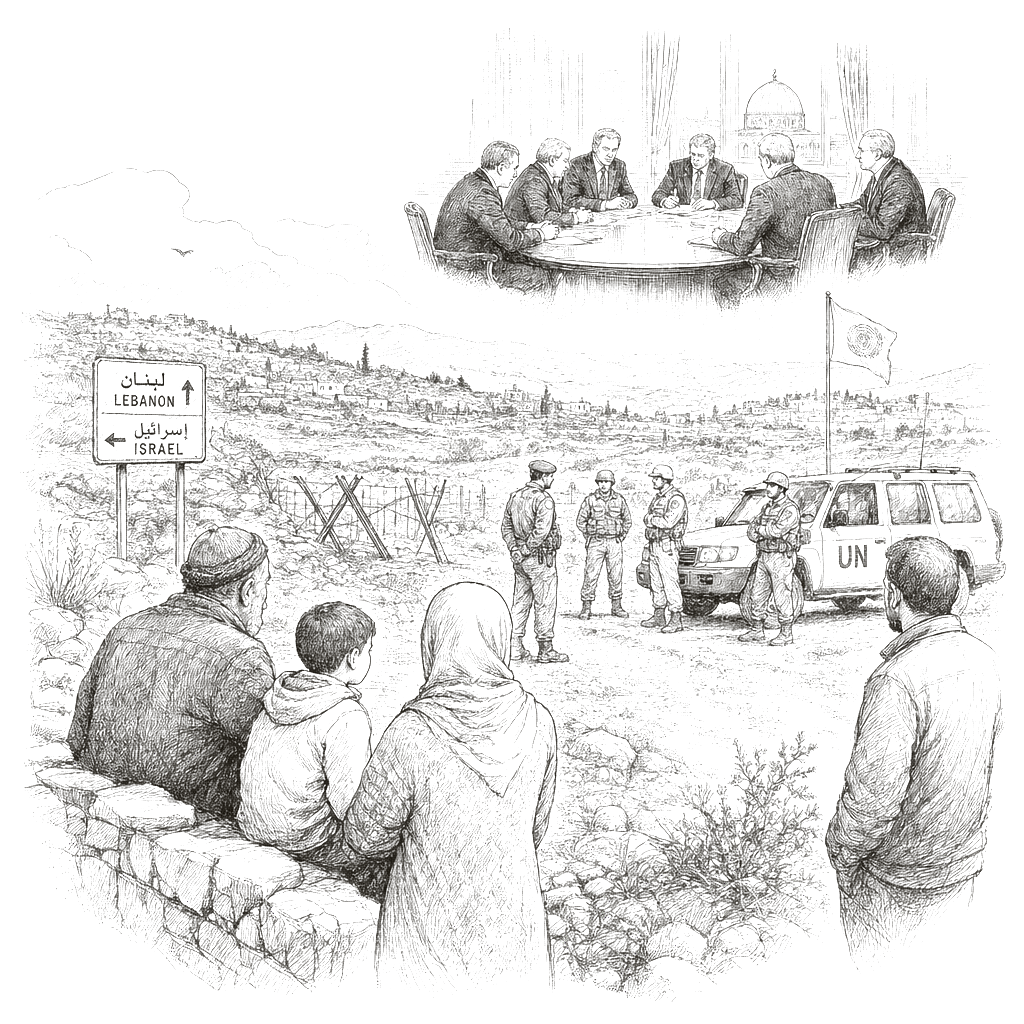
A 10-day ceasefire between Israel and Lebanon’s Hezbollah took effect Friday, temporarily halting months of cross-border fighting and creating an opening for the United States and Iran to pursue a settlement of the wider conflict. President Donald Trump announced the agreement Thursday, describing it as a direct Israeli-Lebanese accord — the first such negotiations in decades. But major obstacles remain, with Hezbollah declining to formally endorse the ceasefire and Israel stating it is “not finished” dismantling the militant group.
The ceasefire appears to have shifted negotiating leverage: as the truce took effect, both Trump and Iran’s foreign minister announced Iran was reopening the Strait of Hormuz, the critical waterway through which roughly one-third of global maritime oil trade flows. The agreement illustrates competing claims about military victory and the conditions under which broader hostilities might end.
Ceasefire Terms and Immediate Impact
The U.S. State Department said the 10-day agreement was intended “to enable good-faith negotiations” toward a permanent peace accord and could be extended by mutual agreement if Lebanon “effectively demonstrates its ability to assert its sovereignty.” The ceasefire calls for the Lebanese government to prevent Hezbollah and other armed groups from attacking Israel, repeating language from a previous ceasefire accord reached in November 2024.
A critical distinction separates the new agreement from previous iterations. The State Department said the pact grants Israel the “right to take all necessary measures in self-defense, at any time, against planned, imminent, or ongoing attacks.” No equivalent guarantee appears for Lebanon or Hezbollah.
Unresolved Military and Political Objectives
Netanyahu said Israel had agreed to the truce at Trump’s request but remained intent on degrading Hezbollah further. “We’re not finished yet,” Netanyahu said. Israel has announced plans to occupy a 10-kilometer buffer zone in southern Lebanon until what it describes as all threats are eliminated. “Israel will maintain its presence until we are sure the threat has been removed and the Lebanese army has taken control,” Netanyahu said.
Lebanon’s President Joseph Aoun stated his government’s objective differently. The goal is to “secure the withdrawal of Israeli forces from the occupied southern territories” and for the Lebanese army to take control of the border area, Aoun said. But Lebanon has been largely sidelined during the conflict; Hezbollah commands the dominant military force on the Lebanese side.
Hezbollah said it would adhere to the ceasefire “as long as it is comprehensive across all Lebanese territories, including border areas, and includes a full halt to hostilities and restrictions on the enemy’s freedom of movement, serving as a prelude to Israeli withdrawal.” The statement implied that Hezbollah may resume rocket attacks if Israel continues to target it and remains in southern Lebanon.
Competing Narratives on Agency and Leverage
Trump asserted direct control over Israeli military operations, posting on Truth Social that Israel is now “PROHIBITED” from bombing Lebanon. The U.S. has characterized the ceasefire as the product of direct Israeli-Lebanese negotiations held in Washington, the first such talks in decades.
But Iran and Hezbollah offered a different accounting of how the ceasefire came about. Mohsen Rezaei, a military adviser to Iran’s supreme leader, said on the social media platform X that while “the Lebanese government and Trump are attempting to claim this ceasefire as their own initiative,” the agreement resulted from “the resistance of Hezbollah’s fighters and Iran’s multifaceted pressures.” Hassan Fadlallah, a member of Hezbollah’s parliamentary bloc, told reporters that Iran had informed Hezbollah leaders of the ceasefire agreement early Thursday, well before Trump’s public announcement.
Two Pakistani officials told the AP on Friday that Pakistan played a role in securing the ceasefire, speaking on condition of anonymity to discuss confidential negotiations. Pakistan has been active in mediating broader US-Iran talks.
Strait of Hormuz Reopening and Geopolitical Dimensions
As the ceasefire took effect, Iran signaled a shift in its negotiating position. Foreign Minister Abbas Araghchi announced that Iran was reopening the Strait of Hormuz, the waterway through which roughly one-third of global maritime oil trade passes. The U.S. had been unable to reopen the strait despite weeks of heavy bombardment and the sinking of much of Iran’s navy. Araghchi directly linked the strait’s reopening to the Lebanon ceasefire agreement, suggesting that Iran had deployed the blockade as a negotiating lever in the wider conflict.
License: This article is released under CC0 — a public domain dedication.
Generated by Main Street Independent’s News Article Generator framework. Framework specification available at /methodology. Human review: not triggered.