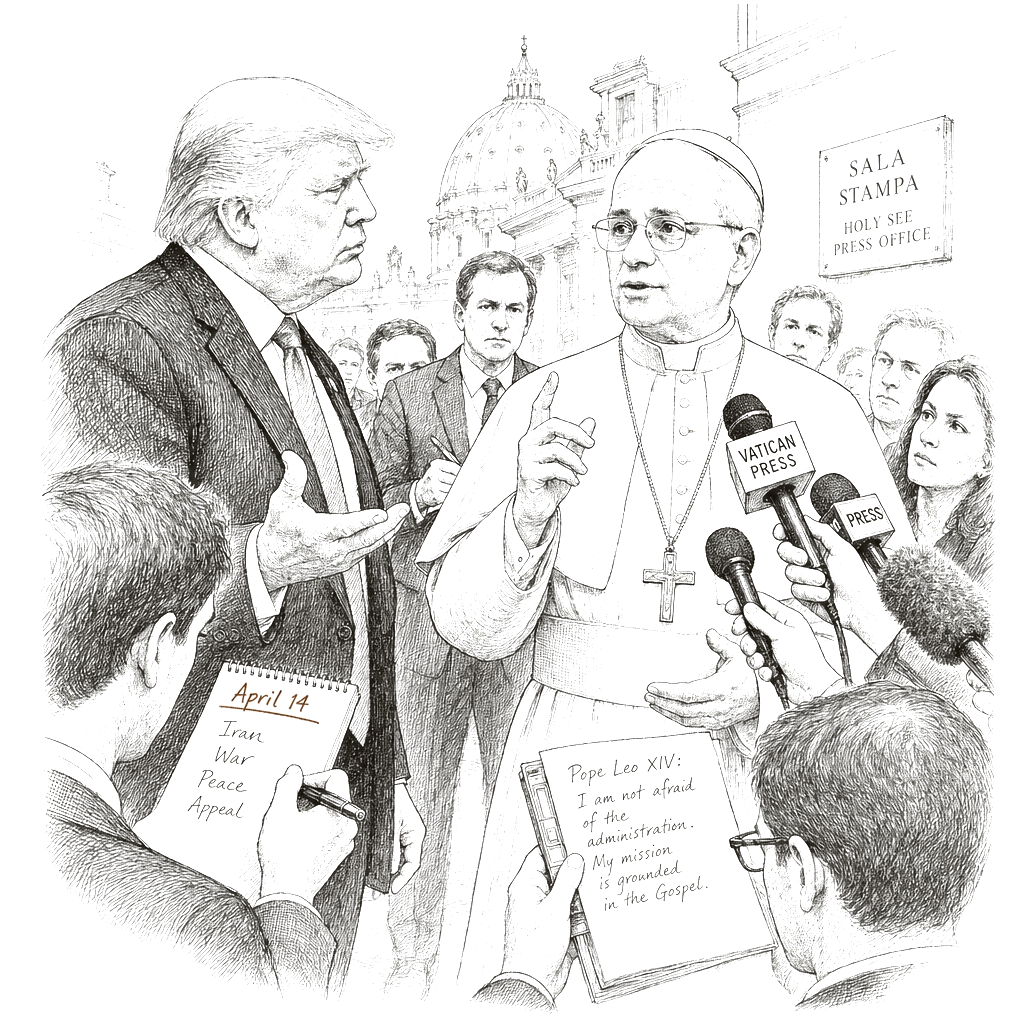
As President Donald Trump and Pope Leo XIV publicly traded rebukes over the war in Iran, the confrontation has highlighted a widening rhetorical gap between political pressure and papal diplomacy. On April 14, the pope met questions from reporters while traveling, saying he was not afraid of the Trump administration and describing his peace appeals as part of the Gospel message the Church exists to carry.
Trump, for his part, has amplified the clash through personal attacks and loyalty framing on Truth Social. In posts from May 8, 2025, Trump celebrated Leo’s election as a national honor and said he looked forward to meeting him, then later returned to the topic to say Leo was “only put there by the Church because he was an American.” By April 14, Trump’s criticism had moved from congratulatory language to direct disparagement, including a description of Leo as “Weak” and assertions that the pope was captive to the “Radical Left,” the Associated Press reported.
The pope’s counter has taken a different tone and a different theory of authority. Speaking to reporters on the way to Africa, Leo said Monday that he was “not afraid of the Trump administration,” adding that the Church’s work focuses on “speaking out loudly about the message of the Gospel.” In a separate framing to the AP aboard the papal flight to Algeria, Leo said it did not understand the Gospel to place his message “on the same plane” as what Trump has attempted, and he said he would continue the Church’s mission.
The personal edge in the rhetoric builds on earlier signals that the two men did not share the same expectations about the pope’s role. Before becoming Pope Leo XIV, Robert Prevost was a bishop in Peru, and the AP said Prevost had described Russia’s 2022 invasion of Ukraine as an “imperialist invasion” aimed at conquering territory for reasons tied to power, with Ukraine’s strategic location playing a role. The AP said the clip resurfaced in Italian media after Prevost’s election as pope on May 8, 2025, after which Trump hailed the election as “such an honor” and the “first American Pope,” also saying Trump was “very happy” about the result.
In office, Leo’s early public message emphasized war avoidance and peacemaking grounded in Scripture. From the balcony at St. Peter’s Square, the pope used the first greeting of the risen Christ, and when he addressed journalists the following Monday he quoted Jesus’s teaching, “Blessed are the peacemakers,” the AP reported. On his first Sunday blessing, the AP said Leo addressed the Russian war on Ukraine and violence between Israel and Gaza, decrying a “third world war in pieces.”
Observers have also pointed to the pope’s approach to messaging as a deliberate boundary against U.S. branding. The AP reported that Leo’s initial public address at his introduction to the world in St. Peter’s Square was in Italian, and that he used Spanish when addressing Peruvian Catholics and citizens where he had served, with a limited amount of English before returning to Italian for remarks. Catholic University professor William Barbieri told the AP that Leo “doesn’t want to be perceived” as coming from the American side or relying on authority as an American, saying the pope “wants to speak in the name of the church.”
The dispute over Iran sharpened during the Christian season when the pope’s peace message intersected with Trump’s escalation. The AP said Trump escalated threats around Easter, and that Leo’s Palm Sunday message included language from Scripture in which God rejects those who wage war, saying: “Even though you make many prayers, I will not listen: your hands are full of blood.” The pope’s rejection of war was also tied to Easter messaging in which Leo called Jesus the “King of Peace,” the AP reported.
As Trump threatened a broader campaign in Iran—addressing civilian infrastructure and calling for eradication of a “whole civilization”—the pope called the threat “truly unacceptable.” The AP said Leo named Trump directly for the first time in Rome when addressing reporters and urged him to seek an “off-ramp” in Iran, while also discussing peace in the language of church teaching rather than political bargaining.
The Trump-and-Leo clash has also taken shape as a struggle over how the Vatican should engage secular power. Leo’s rebuke to the way his message was being treated suggests the pope views Trump’s direct attacks as a category error about what the Gospel demands. In response, the AP reported, Trump has treated the pope increasingly as a domestic rival—first praising him as a U.S. achievement, then accusing him of criticizing Trump and urging him to “focus on being a Great Pope, not a Politician.”
In this unfolding sequence, the pope’s refusal to frame the dispute as personal and Trump’s willingness to frame the papacy through U.S. loyalty have left less room for indirect diplomacy. The contrast has finally drawn the two “megaphones” into overt engagement on global war, with the pope grounding his appeals for peace in Scripture and the Church’s doctrine, and Trump approaching the confrontation through a political lens of leverage and public competition.