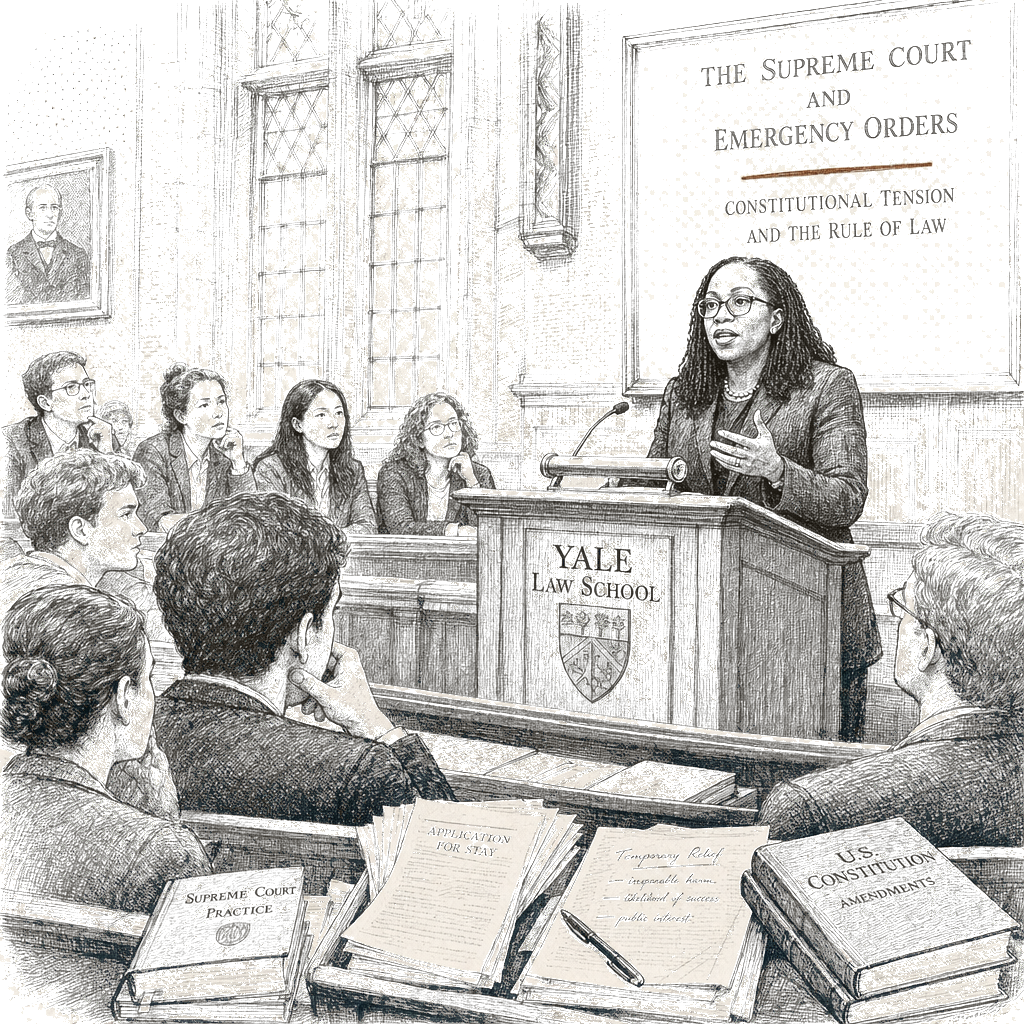
Justice Ketanji Brown Jackson delivered a sustained public critique of the Supreme Court’s conservative majority Monday, calling the emergency stay orders that have allowed President Donald Trump to implement contested immigration and federal spending policies “back-of-the-envelope, first-blush impressions” that can “seem oblivious and thus ring hollow.”
Jackson spoke for nearly an hour at Yale Law School, addressing roughly two dozen emergency orders the court issued last year that let the Trump administration move ahead with immigration restrictions, steep federal funding cuts, and other controversial policies while lower courts were weighing whether those measures were likely illegal. Yale Law School posted video of the event on Wednesday.
The speech was Jackson’s most extensive public challenge to a practice that has enabled key parts of the Trump administration’s agenda to take effect during litigation. She said she intended the address as “a catalyst for change.”
’Scratch-paper musings’
Jackson said the orders — often issued with little or no explanation — amount to “back-of-the-envelope, first-blush impressions of the merits of the legal issue.” A deeper problem, she said, arises when the court then insists that “those scratch-paper musings” be applied by lower courts in other cases.
The orders suffer from an additional flaw, Jackson said: a failure to acknowledge that real people are affected. That failure, she said, makes them “seem oblivious and thus ring hollow.”
She also pushed back on how the court weighs harm when deciding whether to grant an emergency stay. The court frequently treats the president’s inability to put a policy into immediate effect as an injury that outweighs what the challengers to that policy might face. Jackson challenged that framing directly.
“The president of the United States, though he may be harmed in an abstract way, he certainly isn’t harmed if what he wants to do is illegal,” Jackson said during a question-and-answer session with Yale Law School dean Cristina Rodriguez.
A shift in the court’s approach
Jackson said the court used to be more cautious about intervening early in the legal process. “There is value in avoiding having the court continually touching the third rail of every divisive policy issue in American life,” she said.
While she said she could not explain the change, she noted that “in recent years, the Supreme Court has taken a decidedly different approach to addressing emergency stay applications. It has been noticeably less restrained, especially with respect to pending cases that involve controversial matters.”
Jackson said there have been internal conversations among the justices about emergency orders. She chose to speak publicly, she said, because she wanted to be “a catalyst for change.” She is frequently joined in dissent by Justices Sonia Sotomayor and Elena Kagan.
Jackson has previously criticized the emergency orders in dissenting opinions and in an unusual joint public appearance with Justice Brett Kavanaugh last month.
Sotomayor speaks — and apologizes
The previous Tuesday, Sotomayor similarly raised concerns about emergency orders at an appearance at the University of Alabama, taking issue with the conservative majority’s approach.
On Wednesday, Sotomayor issued a rare public apology to Kavanaugh for what she described as “hurtful comments” she made during an appearance at the University of Kansas law school. Referencing a Kavanaugh opinion in an immigration case in which the court granted an emergency order sought by the administration, Sotomayor said her colleague “probably doesn’t really know any person who works by the hour.” Her original remarks were reported by Bloomberg Law.