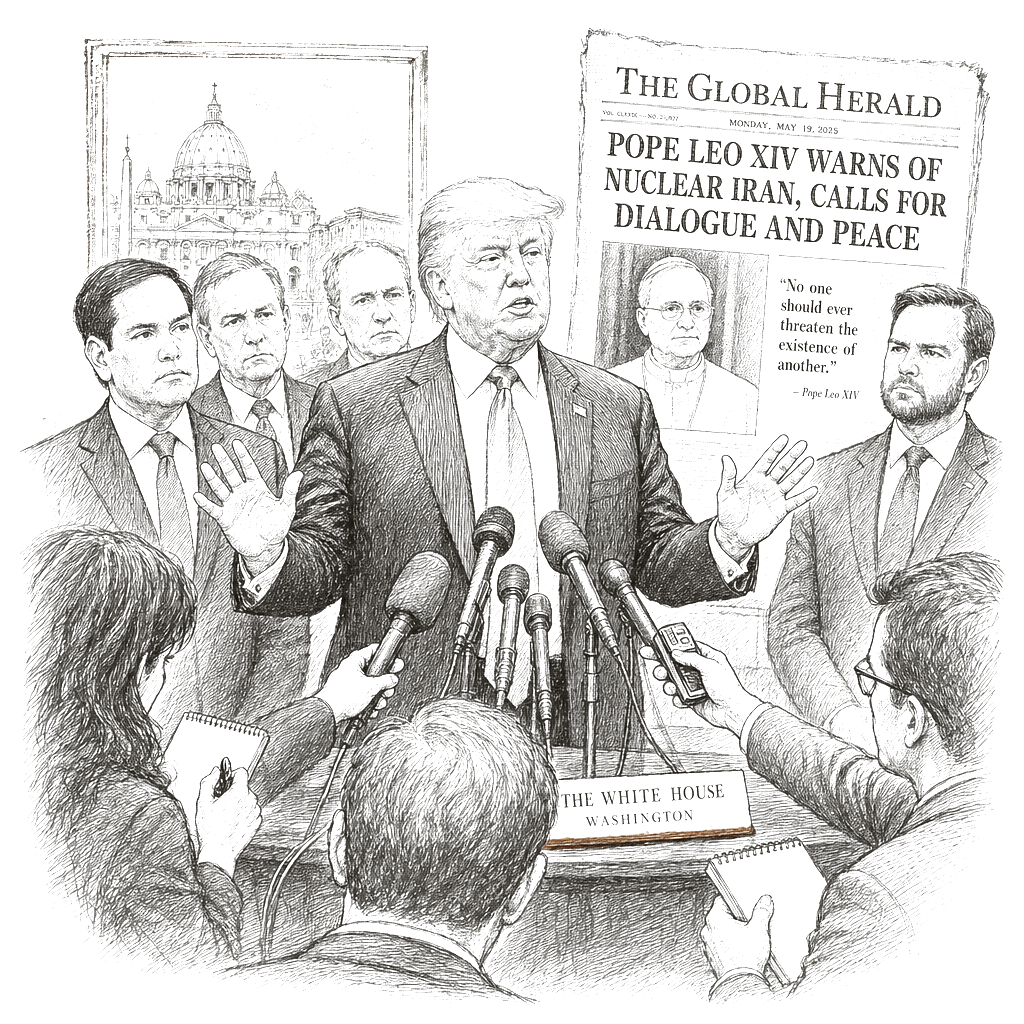
On Monday, President Donald Trump declined to apologize to Pope Leo XIV for criticizing the U.S.-born pontiff over the U.S.-Israel war in Iran, framing the dispute around what Trump said the pope’s views mean for the conflict’s end state. In a hastily called question-and-answer session with reporters at the White House, Trump said the pope was “very much against what I’m doing with regard to Iran,” and he said Pope Leo “would not be happy” with what Trump argued was necessary for the crisis. He also linked the pope’s stance to his broader warnings about Iran’s potential nuclear capability and said, “I think he’s very weak on crime and other things, so I’m not” going to apologize.
Trump’s remarks came after a newly public exchange between the president and the pope, a back-and-forth that has intensified as the Iran war stretches into its seventh week. The timing also intersected with diplomatic engagement on the U.S. side, with the pope speaking out about war in the days around the start of face-to-face U.S.-Iran negotiations in Pakistan during a fragile ceasefire. Trump continued to criticize the pope in public while Vice President JD Vance, also a Catholic, defended Trump’s own approach and later characterized Trump’s social media posting as “a joke.”
In the White House session, Trump also addressed a much-criticized social media post that had depicted him in a biblical-style image, with Trump wearing a robe and laying hands on a bedridden man as light emanated from his fingers. Trump said he “did post it” and explained his understanding of the image by saying he thought it was “me as a doctor” associated with the Red Cross and that the intention was to show him “making people better.” He blamed “fake news” for any confusion and said he believed the post was supposed to portray him as a doctor rather than as Christ, while the account had drawn criticism from a wide range of people, including some evangelical supporters.
Trump did not give details on how the post was removed, and the account deleted it late Monday morning. After posting the Jesus-like healer image Sunday night, Trump had also continued his denunciation of Pope Leo in broader comments posted while traveling back to Washington from Florida. Trump later told reporters, “I’m not a fan of Pope Leo,” and he said of the pope, “I don’t think he’s doing a very good job,” adding that “He likes crime, I guess,” and describing him as “very liberal.”
Pope Leo, meanwhile, responded to Trump’s criticism in remarks carried by reporters aboard the papal plane en route to Algeria. The pope said that “To put my message on the same plane as what the president has attempted to do here, I think is not understanding what the message of the Gospel is,” and he said he was “sorry to hear that, but I will continue on what I believe is the mission of the church in the world today.” He also said, “I’m not afraid of the Trump administration or of speaking out loudly about the message of the Gospel, which is what the Church works for,” describing his focus as a call to peace, dialogue and multilateralism among states.
Earlier, the pope’s public statements had included direct criticism of the U.S.-Israel war in Iran, including comments he made during an evening prayer service at St. Peter’s Basilica on Saturday. In those remarks, Leo told reporters that a “delusion of omnipotence” was fueling the war, and he also expressed that Vatican appeals for peace and reconciliation are rooted in the Gospel while warning against the use of force. Trump had taken those remarks and amplified his criticism in social media posts, including writing that Pope Leo was not doing “a very good job,” that he “don’t want a Pope who thinks it’s OK for Iran to have a Nuclear Weapon,” and accusing the pope of being elected pontiff “because he was an American.”
Trump’s criticism included claims that Pope Leo should focus on church leadership rather than politics, and it drew a separate response from U.S. Catholic leadership. In a statement, Archbishop Paul S. Coakley, president of the U.S. Conference of Catholic Bishops, said he was “disheartened” by Trump’s comments, adding that “Pope Leo is not his rival; nor is the Pope a politician.” Coakley said the pope “is the Vicar of Christ who speaks from the truth of the Gospel and for the care of souls.”
Beyond the pope and the president, the dispute spilled into wider international political attention, including remarks from Iran’s president, Masoud Pezeshkian, who assailed the “desecration of Jesus” while also speaking up to defend the pope. Trump’s social media post was also discussed in Washington as lawmakers and officials tried to place the moment within the broader push and pull between diplomatic channels and public messaging. Vance, for his part, said the Jesus-like depiction was “a joke” and described it as a sign that Trump was “not filtered,” telling Fox News Channel that “Of course, he took it down because he realized a lot of people weren’t understanding his humor.”
The episode unfolded as the pope began an 11-day trip to Africa and as the dispute over Iran played out in both religious and political settings. While popes and presidents sometimes differ on policy, the reporting described the current clash as unusually personal, with Trump posting broad accusations about the pope’s motives while Pope Leo told reporters he would continue to speak out against war and promote peace through dialogue.
Winfield reported from aboard the papal plane. Associated Press writer Michelle L. Price contributed to this report.