Body
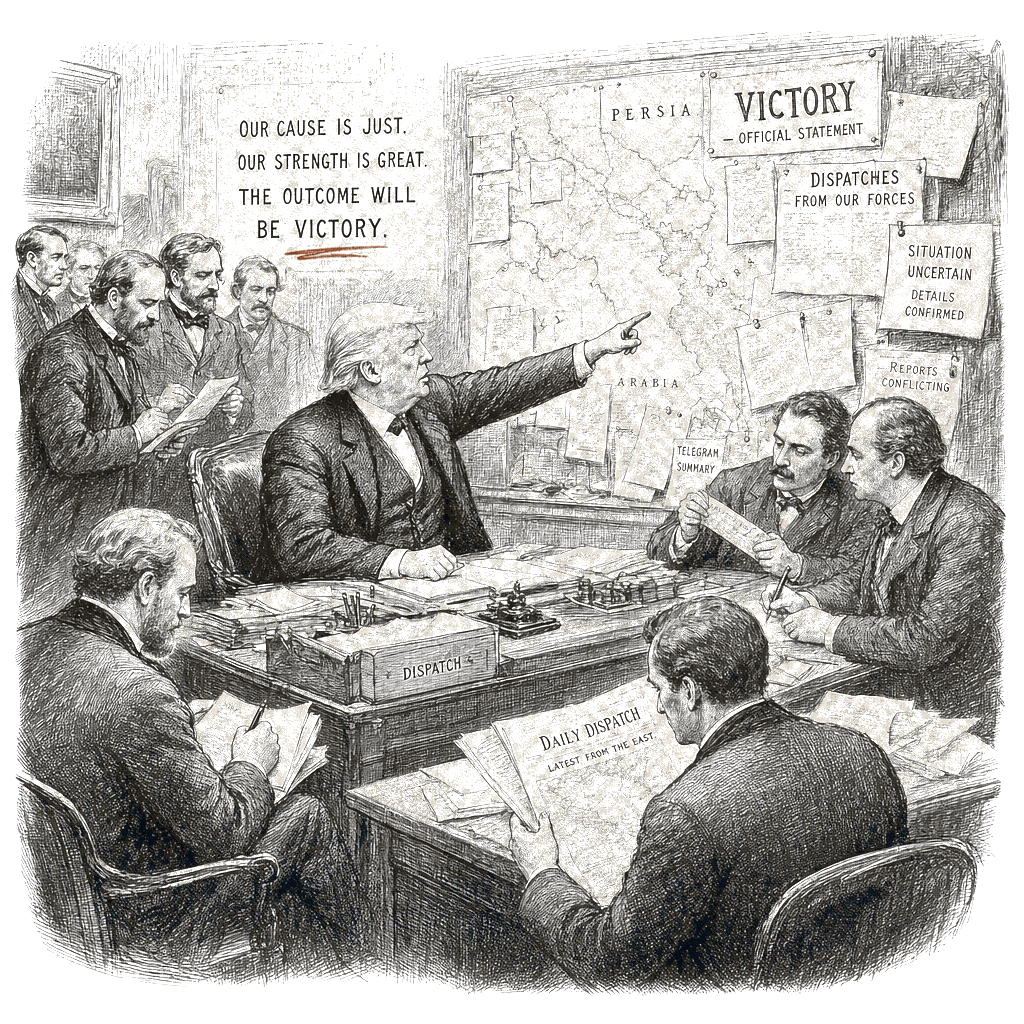
In the Iran war, Donald Trump has cast repeated setbacks and unfavorable developments as proof that he and the United States are winning, an approach AP describes as a consistent feature of his political communication. The analysis says Trump moved to claim victory within days of the war beginning and kept returning to that message as Tehran carried out strikes on U.S. and allied targets and as disruption spread through global commerce. Even after a ceasefire, Trump has continued to characterize events as aligning with U.S. goals rather than as evidence of a reversal.
AP reports that Trump also used direct language to challenge the framing of the war as going against the United States. When the Wall Street Journal’s editorial board wrote that Trump had claimed a premature win, AP says Trump responded in a Thursday social media post, writing: “Actually, it is a Victory.” On Saturday, AP reports, he posted that news outlets “love saying that Iran is ‘winning’ when, in fact, everyone knows that they are LOSING, and LOSING BIG!” AP also says that when Trump was asked later about negotiations with Iran, he responded, “Regardless what happens, we win.”
The AP analysis links the messaging shift to changes in Iran’s leadership and to what Trump described as evolving battlefield and political circumstances. With a ceasefire now in place, AP says Trump argues that the United States accomplished its goals. AP adds that the president has pointed to a change in rule after Iran’s supreme leader, Ayatollah Ali Khamenei, was killed, while also saying he was replaced by his son, Mojtaba Khamenei, who is seen as more hard-line. In that framing, AP reports, Trump said Iran would not be allowed to have a nuclear weapon, even as Tehran was said to stockpile enriched uranium, and AP says the Strait of Hormuz was reopening under Iranian military control.
AP’s analysis broadens beyond the Iran war, describing what it calls a longstanding “can’t-lose” narrative in Trump’s public life and earlier business and political chapters. David Cay Johnston, author of The Making of Donald Trump, is quoted describing Trump’s mindset as one that treats narrative control as a tool: Johnston said Trump has this fictional narrative in his head and that he is “like a screenwriter.” AP reports Johnston said that when you need to change the narrative, you can just change it, quoting him: “When you need to change the narrative, you just change it.”
Sarah Matthews, a former first-term Trump White House deputy press secretary who resigned after the Jan. 6, 2021 riot by Trump supporters, is quoted by AP describing why acknowledging defeat is difficult for the president. Matthews told AP that the president’s “ego won’t allow him to acknowledge defeat” and that “reality just kind of bends” to it. AP reports Matthews said, “That was the messaging strategy,” adding that it was, “How can we redefine this loss as a victory?” She later said she regrets it and that “there was ‘always a way to find an excuse to justify that loss and defend his position.’”
AP also describes how Trump’s win framing reached beyond elections into governance. The analysis says Trump’s administration has presented favorable interpretations even when court rulings and other official developments undermined Trump’s aims. In AP’s description, the pattern includes efforts to work around Supreme Court decisions on tariffs and shifts in how the Department of Justice responds to court blocks on executive orders, with AP saying some reversals were made so the non-appeals did not appear to admit defeat.
The analysis further ties Trump’s sense of winning to earlier influences and a business-to-media style. AP quotes Johnston again about lawyer Roy Cohn, crediting him in part with rules about never conceding and never admitting defeat, and AP says Cohn is credited with imparting key rules to Trump. Johnston told AP that Cohn “taught Donald, you never concede as much as a comma.” AP adds that Johnston said the stance amounted to “Whatever position you’ve taken, that’s the position, and anybody who challenges you, they’re wrong. They’re disgusting. They’re incompetent. They’re idiotic,” and that if they were law enforcement they were corrupt.
AP’s analysis also places the narrative around win-making in Trump’s entertainment and rallying style. It references Trump’s early public persona and The Apprentice pilot from 2004, and it quotes Trump in that context from the show’s voice-over script, including “I fought back,” followed by “And I won. Big league.” The analysis also quotes John Bolton, one of Trump’s first-term national security advisers and an early supporter of strikes against Iran, saying Trump’s declaration of victory over Iran was always “baked in the cake,” and that “The world for him is divided into winners and losers” and “And he’s always a winner.”
In a final section, AP describes how Trump’s win framing appears to continue even when the substance points to losses, including court and business outcomes. AP includes a reference to Trump’s years in Atlantic City, and it also cites his talk about being able to “hang around losers” to feel better, alongside a view quoted by Thompson about Trump’s ability to represent “American Rich Guy.” The analysis is credited to AP’s Will Weissert.