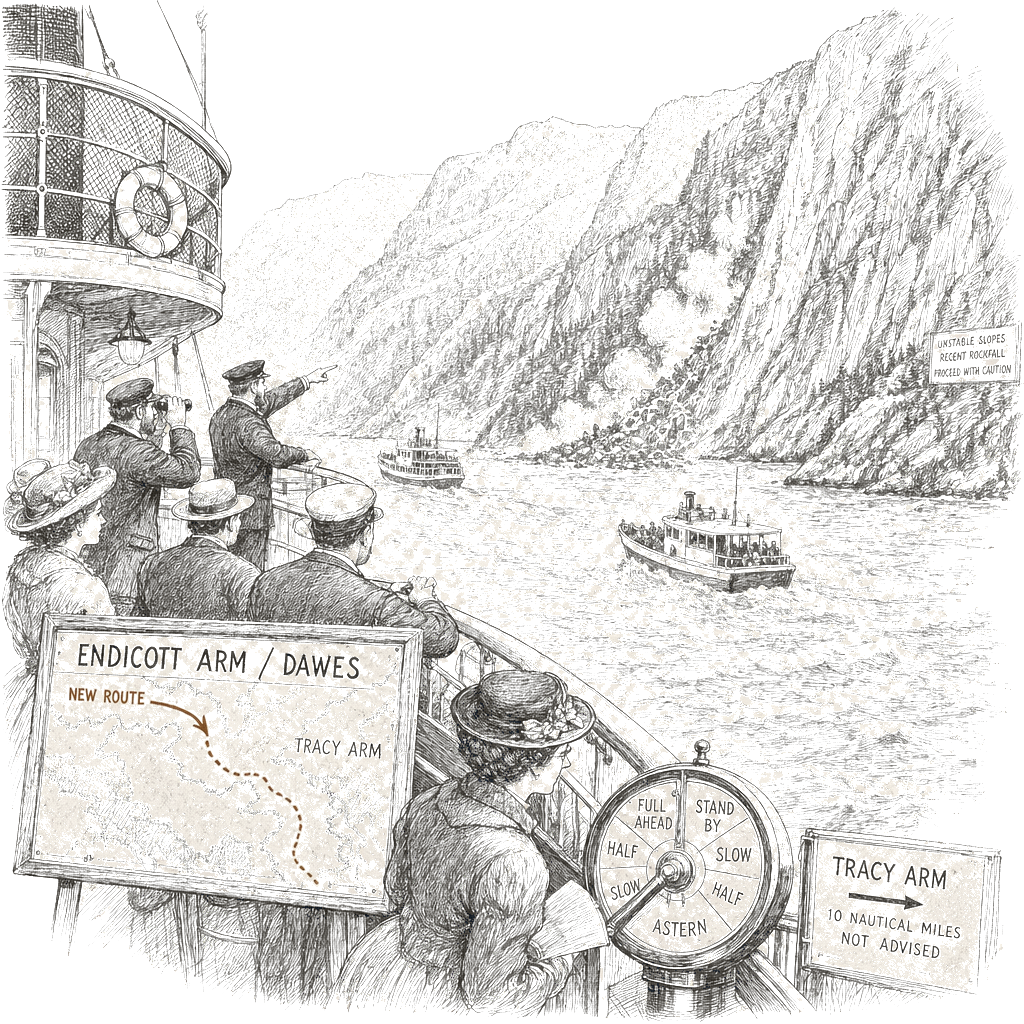
Cruise companies to Alaska are avoiding a popular excursion to Tracy Arm in southeast Alaska after a massive landslide last summer generated waves and left nearby slopes still considered unsafe, the Associated Press reported on Tuesday.
For years, many itineraries have sailed up Tracy Arm—an approximately 30-mile (50-kilometer) fjord south of Juneau known for two tidewater glaciers, the North and South Sawyer, plus waterfalls and wildlife such as seals and bears. But major cruise lines have begun replacing that stop with a nearby alternative: Endicott Arm and Dawes Glacier.
The switch reflects safety concerns tied to what happened on Aug. 10, 2025, when a landslide originating high on a slope above the toe of the South Sawyer glacier, near the fjord’s head, sent water surging more than a quarter mile (more than half a kilometer) up the opposite mountain wall, officials said. The landslide also generated a tsunami, prompting operators to rethink where ships can safely travel.
Officials said no ships were in Tracy Arm at the time and that there were no reported deaths or injuries. However, kayakers camping on an island near where Tracy and Endicott arms meet reported that much of their gear was swept away by rushing water.
Gabriel Wolken, manager of the state’s climate and ice hazards program, said the region’s fjord network has long been susceptible to landslides, but the failed slope had not been identified as an active hazard before last summer’s collapse. Scientists are working to understand what caused the slope to fail and what other hazards might exist in the fjord, he said.
A U.S. Geological Survey spokesperson, Steven Sobieszczyk, said the area remains unstable. In an email, he said continued rockfall and small-scale sliding from the exposed landslide scar are expected and could impact the water, potentially causing a future localized tsunami.
The Associated Press reported that major cruise companies including Holland America, Carnival Cruise Line and Royal Caribbean said they are replacing a Tracy Arm visit with Endicott Arm. MSC Cruises, Virgin Voyages and regional tour company Allen Marine also are doing Endicott and Dawes Glacier instead. Norwegian Cruise Line said it does not have voyages that sail by Tracy Arm.
Endicott already has been a stop for some ships previously and an alternative when Tracy Arm conditions—such as excess ice—have been unsafe. Still, a travel agent who has long sold the Tracy Arm experience said the substitution is not the same.
Nate Vallier, who owns the Alaska Travel Desk, described Tracy Arm as a signature fjord stop and said the alternative is “still beautiful by any means, but it’s just not the same.” Vallier also said he would have liked cruise companies to give travelers more advance notice about itinerary changes.
The AP described one family’s experience with a switch due to conditions in Tracy Arm last year: Kimberly Lebeda of Wichita, Kansas, said she booked tickets for a Tracy Arm excursion after researching the area. She said that the night before the stop, the family was told they would go up Endicott instead because of ice, and that they transferred from the ship to a smaller boat with glass windows, seating and snacks.
Lebeda said her family saw seals on ice floes, waterfalls and “a wall of ice” calving from Dawes Glacier. She called it “an amazing thing to witness,” adding that she considered it worth it and exciting even though she had not been to Tracy Arm before and could not compare the two directly.
After leaving Seattle, the first ships of the season are due April 21 in Ketchikan, with Juneau service the following week.
The episode serves as another example of how Alaska’s glacier-and-fjord tourism can hinge on geologic conditions that change faster than scheduled travel. Seeing a glacier—particularly a dynamic, calving glacier—remains a bucket-list draw for many tourists, and Tracy Arm’s popularity has been reinforced by how it offers visitors a view into a wider landscape beyond Juneau’s Mendenhall Glacier, which has diminished or retreated from view at some hiking overlooks, Vallier said.
Even as operators shift stops, officials’ warnings suggest the Tracy Arm region’s hazards won’t quickly disappear. Sobieszczyk said that even after an initial slide, steep landslide areas can keep changing for years, and he cautioned that future localized tsunami conditions remain possible.