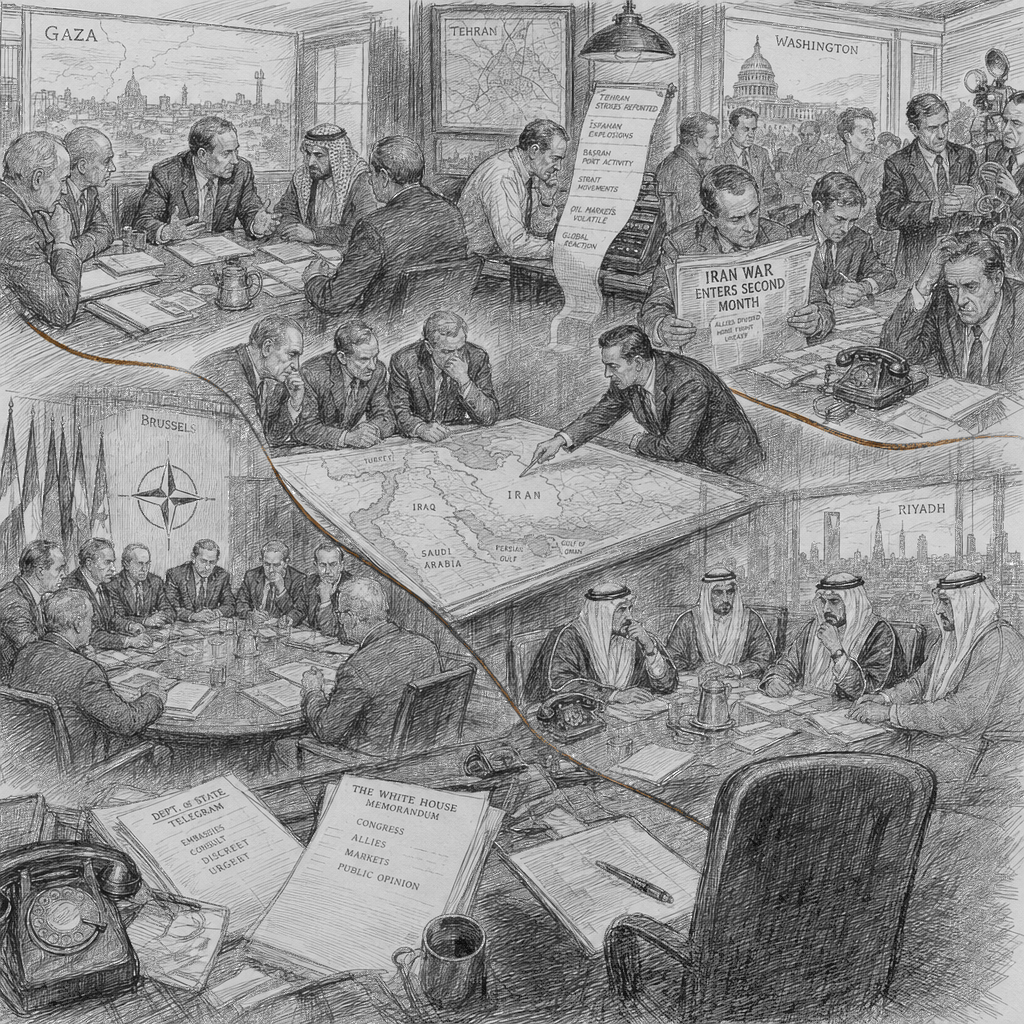
The Iran war’s knock-on effects are now traveling beyond battlefields, showing up in what governments hope a ceasefire can mean—and what voters and markets may do if it does not. As the U.S. and Iran enter face-to-face talks Saturday in Pakistan amid a tenuous ceasefire, Associated Press journalists describe a conflict that has reshaped calculations across the Middle East and beyond, from Israel’s political timetable to Gulf energy shipping and NATO cohesion.
In Israel, Associated Press Deputy News Director for the Middle East Josef Federman said the war has left Prime Minister Benjamin Netanyahu with ambitions that have not been fully met. Federman reported that Netanyahu set out goals on Feb. 28 aimed at removing threats tied to Iran’s missile and nuclear programs and its support for hostile proxy groups, along with pledges to create conditions for a popular uprising. Netanyahu acknowledged in a televised address after the ceasefire that “we still have goals to complete,” even as he characterized the campaign as successful, saying “immense achievements” and declaring that “Iran is weaker than ever, and Israel is stronger than ever. This is the bottom line of this campaign.” With elections later in the year, Federman said the practical question for Netanyahu is whether Israelis accept that assessment after months when many grew fatigued by nonstop air-raid sirens and the disruption of daily life.
The ceasefire talks also reflect a different calculus in Tehran, as Associated Press News Director for the Gulf and Iran Jon Gambrell described “depleted” Iran finding leverage. Gambrell said that even the threat of sea mines and possible attacks from Iran’s Revolutionary Guard has kept ships away from the Strait of Hormuz, constraining international energy flows. He also reported that hard-liners have tried to frame the death of Supreme Leader Ayatollah Ali Khamenei, reported as 86-year-old, as a transition to a younger successor in his son Mojtaba. Ahead of the Islamabad talks, Gambrell said the government laid out maximalist demands, including continuing to enrich uranium—linked by the report to one of the reasons U.S. President Donald Trump gave for going to war—while describing Iran’s military sites as damaged, its missile arsenal broadly depleted, and unrest as a continuing factor tied to the scale of destruction in Iran’s economy.
In the Gulf, Gambrell said states that had sought to keep themselves out of the conflict still saw direct consequences from Iranian attacks that hit airports, energy sites, military bases and civilian targets with drone and missile fire. He reported that some refineries closed or said they could not meet promised oil output even after the ceasefire, and that Iran’s control of the Strait of Hormuz by threats alone has meant the region cannot count on energy shipments reaching markets as usual. At the same time, the report said the Gulf is not unified in its responses, with opinions ranging from Oman’s diplomatic efforts to the United Arab Emirates denouncing Iranian aggression and insisting the status quo cannot stand.
Lebanon’s uncertainty is also tied directly to how far any ceasefire is meant to reach, with Associated Press News Director for Lebanon, Syria and Iraq Abby Sewell describing a situation in which the U.S. and Israel disagree with Iran. Sewell said the U.S. and Israel are at odds with Iran over whether the ceasefire extends to fighting between Israel and Hezbollah in Lebanon. According to the report, Iran says it does, while the U.S. and Israel say it does not. Sewell reported that Lebanese and Israeli officials have agreed to direct negotiations intended to produce a ceasefire, with Lebanon seeking a halt to Israeli strikes before talks begin and Israel seeking disarmament of Hezbollah; Netanyahu, in turn, said the negotiations would also include discussions on a potential peace agreement between Israel and Lebanon, which do not have diplomatic relations.
Those talks are taking place against a grim backdrop, Sewell said, with analysts warning that Lebanon lacks the capacity to disarm Hezbollah by force or to enforce a ceasefire that Hezbollah rejects. The report said the Israel-Hezbollah war had already displaced more than a million people and killed nearly 1,900, and that, as the negotiating process begins, it continues.
Outside the region, the strain described in the reporting includes NATO, where Associated Press White House reporter Aamer Madhani said Trump has repeatedly tested the 32-member alliance. Madhani reported that Trump cut off direct U.S. military assistance to Ukraine, threatened to take Greenland from Denmark, and pushed members to spend more on defense, and that the tone has continued as differences with allies over Iran raise questions about whether NATO can hold. Madhani said the report’s account includes Trump deriding allies as “cowards,” calling NATO “a paper tiger,” and comparing U.K. Prime Minister Keir Starmer to Neville Chamberlain, whom the report described as associated with appeasement toward Nazi Germany. He also reported that Trump criticized allies including Spain and France for restricting the use of their airspace or joint military facilities by U.S. forces supporting operations in Iran.
In the United States, Associated Press White House reporter Will Weissert said the war’s economic effects have worked against the domestic political narrative Trump had promised to deliver. Weissert reported that Trump won back the White House vowing to curb inflation, bring down prices many Americans saw as too high and trigger a jobs boom, and that the Iran war has done the opposite by raising gas prices, shaking stock markets and sending wider economic shock waves as the labor market weakens and inflation rises again. Weissert also said that with midterms looming, the economic pressure is compounded by political messaging missteps, including Trump’s initial dismissal of affordability worries as a hoax and his subsequent decision to stop trips to swing states as the war consumed his administration. Weissert noted that while a ceasefire might stabilize oil prices and markets, reversing broader economic pain could take far longer.
Energy prices and market disruptions form another thread linking the regional conflict to domestic costs. Associated Press economics reporter Christopher Rugaber said the conflict largely shut down the flow of ships through the Strait of Hormuz, through which about one-fifth of the world’s oil travels, and damaged oil and gas production facilities across the Middle East. He reported that oil prices rose internationally after the disruption, with Brent crude moving from roughly $70 per barrel before the war began in late February to more than $119 at times, and that Brent rose 0.7% to $96.58 on Friday. Rugaber also said prices at the pump rose in the U.S., reaching about $4.15 a gallon compared with just under $3 before the conflict began, and that higher gas costs can constrain consumer spending and slow the economy, potentially worsening unemployment. The report also described a rise in U.S. consumer prices, saying they increased 3.3% in March from a year earlier, up sharply from 2.4% in February and the biggest yearly increase since May 2024.
Rugaber’s account of the economic channel underscores how negotiations that appear tactical on paper may produce political and economic consequences for months. As the U.S. and Iran weigh what a ceasefire should cover, and as Netanyahu and other leaders prepare for electoral pressure, the reporting suggests that the war’s endgame is likely to be judged not only by what each side claims on the battlefield, but by whether shipping routes reopen, prices stabilize and alliances endure.