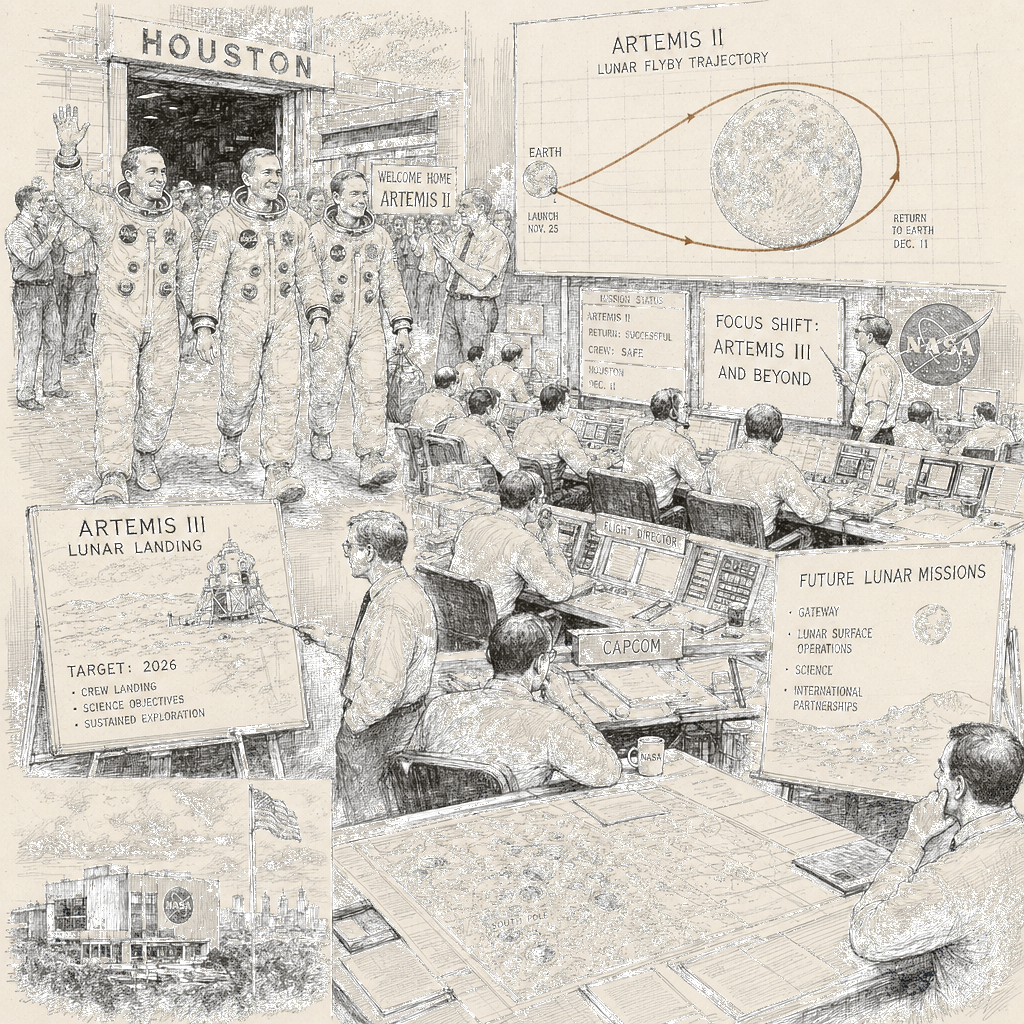
The Artemis II astronauts came home to Houston with their families and, within days of splashdown, NASA turned the focus to what comes next in its Artemis program—down to the docking tests NASA wants to run before crews attempt a lunar landing.
NASA Administrator Jared Isaacman introduced Artemis II commander Reid Wiseman, pilot Victor Glover, Christina Koch and Canada’s Jeremy Hansen at Saturday’s homecoming celebration, saying the mission’s lunar return meant the wait was over for people who look up and dream about what is possible. MSI previously reported that the Artemis II crew returned to Houston after a record moon flyby.
The celebration followed the crew’s Friday Pacific splashdown and the completion of a mission that NASA framed as a “lunar comeback” aided by Artemis II, featuring new images of the moon’s far side and a lunar sequence that included a solar eclipse. Entry flight director Rick Henfling said the next mission was close, observing after the splashdown that Artemis III is “right around the corner.”
NASA said Artemis III has already been added to the docket for next year, with Artemis III’s yet-to-be-named astronauts practicing docking their Orion capsule with a lunar lander—or multiple landers—in orbit around Earth. The plan puts two private companies at the center of the next hardware milestones: Elon Musk’s SpaceX and Jeff Bezos’ Blue Origin, both of which are working to have their landers ready first.
NASA said the docking mechanism planned for Artemis III’s close-to-home trial run is already at Florida’s Kennedy Space Center. It also said a latest-model Starship is close to launching on a test flight from South Texas, and that a scaled-down Blue Moon vehicle is set to attempt a lunar landing later this year.
As Artemis II concluded its stretch toward later lunar operations, Musk’s Starship and Bezos’ Blue Moon are lined up in NASA’s schedule for Artemis IV’s moon landing in 2028. NASA said the Artemis IV landing target is the south polar region, which Isaacman has described as the preferred location for a future moon base, and it said vast amounts of ice are almost certainly hidden in permanently shadowed craters there—ice that could provide water and rocket fuel.
The agency also framed Artemis III as a risk-reduction step similar to how Apollo 9 supported later moon landings. NASA said it plans to announce the Artemis III crew “soon,” echoing the idea of using earlier missions to shrink uncertainty before more complex surface work.
Artemis II also marked a first for several categories, including the first woman, the first person of color, and the first non-U.S. citizen to fly to the moon. Isaacman described the crew as “Wonderful communicators, almost poets” while it awaited recovery from the trip, and Artemis II commander Wiseman issued a rallying call to the next crews at the homecoming, saying it was time “to go and be ready” because it takes courage and determination.
NASA officials tied the program’s next steps to both technical work and the human stakes of sending astronauts back out again. NASA Associate Administrator Amit Kshatriya said the hardest part is getting so close to crews and their families, and then having to launch them again, describing the balance between taking risk and ensuring it remains manageable.