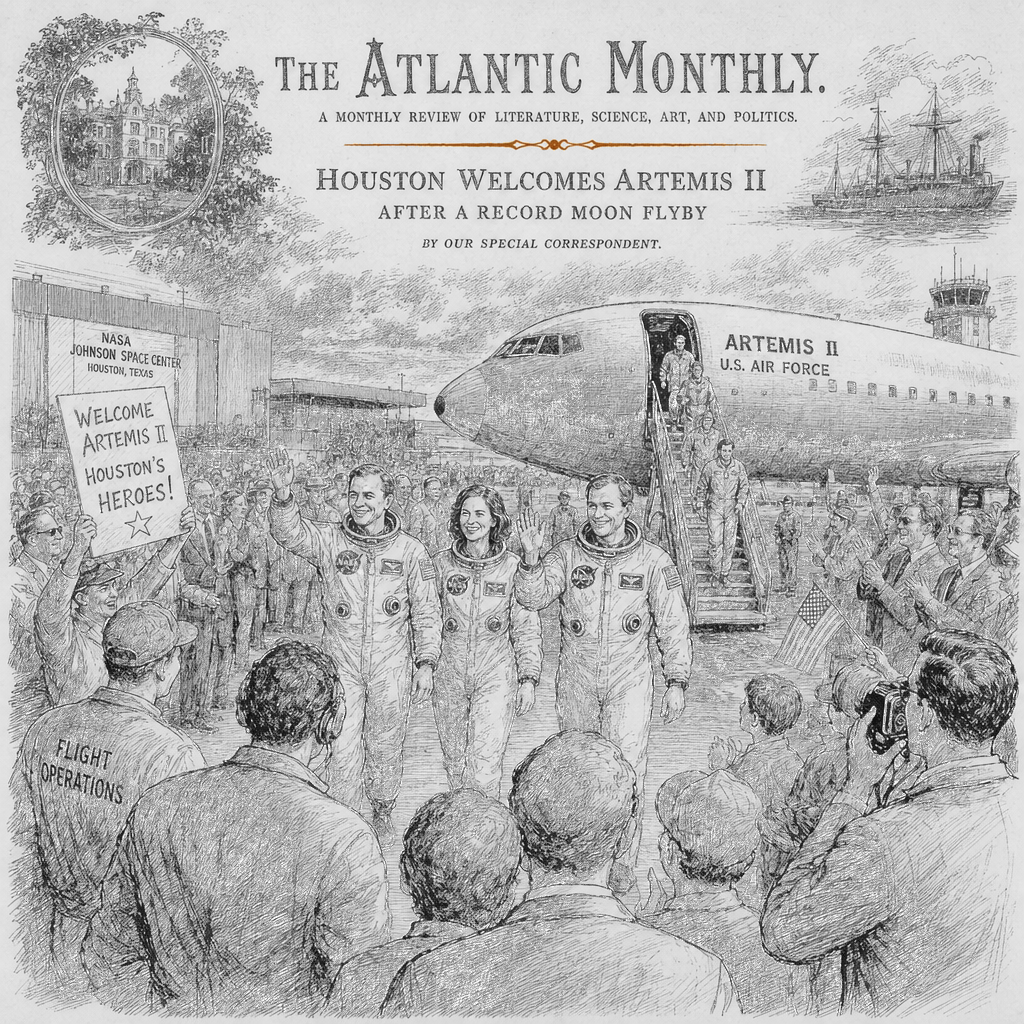
Artemis II’s moon-traveling astronauts came home to Houston on Saturday, getting a thunderous welcome at Ellington Field near NASA’s Johnson Space Center after their splashdown in the Pacific the previous evening, the Associated Press reported. Hundreds of people—many tied to NASA and the broader space community—turned out to mark the crew’s return from a mission NASA said set a record for deep space travel.
The four-member crew arrived in Houston from San Diego, where the recovery had concluded. The astronauts—commander Reid Wiseman, pilot Victor Glover, Christina Koch, and Canada’s Jeremy Hansen—emerged one by one from their lunar capsule following the splashdown, then reunited with family members before the public ceremony.
At the hangar stage, the ceremony included space center workers and invited guests, with NASA Administrator Jared Isaacman introducing the crew to a standing ovation. The crowd included flight directors and the launch director, Orion capsule and exploration system managers, high-ranking military officers, members of Congress, and NASA’s astronaut corps, including retired astronauts.
AP noted the emotional backdrop of the date: the homecoming came on the 56th anniversary of Apollo 13’s launch, when a problem nearly turned the mission into a disaster before turning into a triumph. Wiseman, described by AP as emotional, said, “This was not easy.” He added that “Before you launch, it feels like it’s the greatest dream on Earth,” and that once they were out in space, “you just want to get back to your families and your friends.”
Glover told the crowd, “I have not processed what we just did and I’m afraid to start even trying.” Hansen said the four embodied love “and extracting joy out of that,” describing the astronauts’ experience as a mirror for others: “When you look up here, you’re not looking at us. We are a mirror reflecting you. And if you like what you see, then just look a little deeper. This is you.”
During the nearly 10-day Artemis II mission, the crew traveled farther into space than earlier moon voyages and captured views of the moon’s far side that had not previously been witnessed by human eyes. AP also said a total solar eclipse added to the cosmic milestones and that the mission returned an “Earthset” photo showing Earth behind the moon.
In AP’s account of the mission’s key numbers, the astronauts’ record-breaking flyby reached a maximum 252,756 miles (406,771 kilometers) from Earth before the crew made a turnaround behind the moon. The mission’s Earth imagery also echoed the “Earthrise” photograph from 1968 associated with Apollo 8, AP said, as Koch described what she said stood out to her.
Alongside the achievements, AP reported that Artemis II included a more routine challenge: a malfunctioning space toilet. NASA said it planned a design fix ahead of longer moon-landing missions.
AP said the return marked the first time humans flew to the moon since Apollo 17 closed NASA’s first exploration era in 1972, and it noted that 24 astronauts flew to the moon during Apollo, including 12 moonwalkers. AP added that Apollo 13 commander Jim Lovell, who also flew on Apollo 8, recorded a wake-up message for the Artemis II crew before he died last summer.
NASA’s focus after Artemis II, AP said, is already on what comes next. The agency is preparing for Artemis III next year, which will involve a new crew practicing docking between a capsule and a lunar lander in orbit around Earth, setting the stage for Artemis IV in 2028 when two astronauts attempt a touchdown near the lunar south pole. “The long wait is over. After a brief 53-year intermission, the show goes on,” Isaacman said at the ceremony, AP reported.