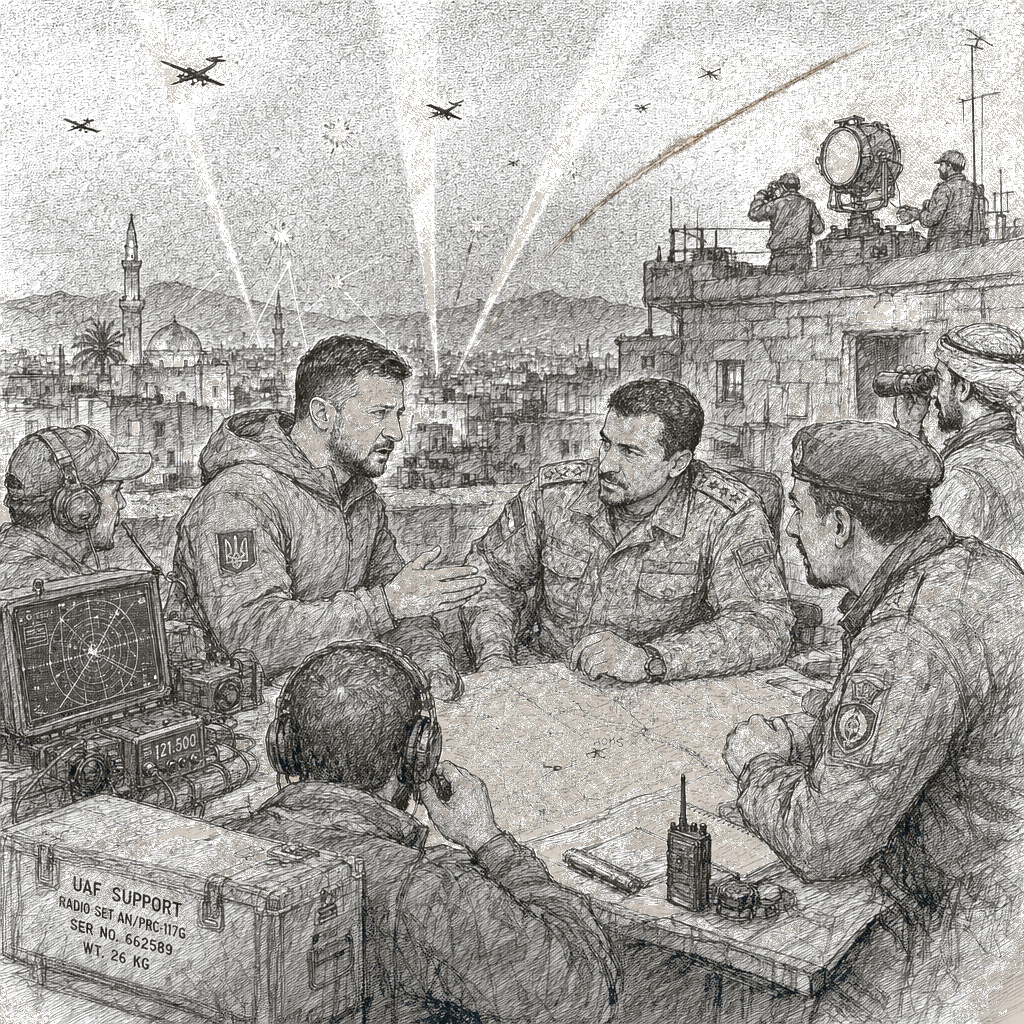
Ukraine’s President Volodymyr Zelenskyy said Ukrainian forces took part in operations abroad during the Iran war that involved countering Iranian-designed Shahed drones, framing the effort as support for partners facing the same weapons Russia uses in Ukraine. Zelenskyy said the work included shooting down the drones in multiple Middle Eastern countries, and he described the operations as active deployments rather than training or exercises.
In remarks to reporters that were embargoed until Friday, Zelenskyy said Ukrainian forces participated in active operations using domestically produced interceptor drones that he said were proven in countering Shahed drones. “This was not about a training mission or exercises, but about support in building a modern air defense system that can actually work,” Zelenskyy said, adding that Ukraine’s involvement aimed at strengthening partners’ ability to counter the specific threat.
Zelenskyy said Ukraine took part in the defensive operations before a tentative ceasefire was reached among Iran, the United States and Israel this week. He did not name the specific countries involved, but he said Ukrainian personnel operated across several nations and helped strengthen partners’ air-defense systems. He previously said that 228 Ukrainian experts were deployed in the region.
Zelenskyy said Ukraine’s participation comes with reciprocal arrangements aimed at protecting Ukraine’s own energy infrastructure. In exchange, he said Ukraine is receiving weapons to defend energy sites, along with oil and diesel, and in some cases financial arrangements. He described the partnerships as something that would be “be marketed” as Kyiv seeks to formalize and expand its defense export role, and he said, “We are helping strengthen their security in exchange for contributions to our country’s resilience,” adding, “This is far more than simply receiving money.”
The disclosure drew attention as diplomats and military officials weigh whether conflict in the Middle East could divert Western support from Ukraine, particularly air-defense supplies. Zelenskyy said partners were continuing to supply missiles for Patriot systems and that a new batch had arrived in recent days, and he said Ukraine was working with all partners to keep its air defenses in place.
Zelenskyy also warned that the coming spring and summer would be difficult for Ukraine, pointing to political and battlefield pressure as the United States turns toward domestic politics and elections. He said he urged U.S. envoys Steve Witkoff and Jared Kushner to visit Kyiv and proposed a trilateral format involving Moscow, while saying it remains unclear whether Moscow and the envoys will come or whether talks would instead take place in a third country.
Separately, Zelenskyy said he expects Western allies to restore full sanctions on Russian oil after a 30-day sanctions waiver expires. He warned that easing sanctions could allow Russia to sustain its war effort and offload key energy assets. Zelenskyy said Russia has profited from higher global energy prices and pointed to damage to oil and gas infrastructure in the Gulf and Iran’s blocking of the Strait of Hormuz, a vital sea route for global oil supplies.
He also said Ukraine has stepped up strikes on Russian energy sites to cut oil revenues as prices rose and U.S. sanctions eased. Zelenskyy said partners had urged Ukraine to scale back those attacks during Iran’s disruption of the Strait of Hormuz, but he argued Russian oil has a limited impact on global markets. “I won’t say who asked us to do this. But partners did ask — it’s a fact. They asked at different levels, from political to military leadership,” Zelenskyy said.
In a separate development reported by the AP in the same briefing, Zelenskyy said Ukraine is ready to mirror any ceasefire steps after Russian President Vladimir Putin announced a temporary Easter truce. Putin on Thursday declared a 32-hour ceasefire over the Orthodox Easter weekend, ordering Russian forces to halt hostilities from 4 p.m. Saturday until the end of Sunday. Zelenskyy said in a post on X that Ukraine would act accordingly after the proposal made during Easter holidays this year.
Kremlin spokesman Dmitry Peskov described Putin’s move as a “humanitarian” gesture but said Moscow remains focused on a comprehensive settlement based on its longstanding demands. Peskov also confirmed that Putin’s envoy, Kirill Dmitriev, is in the United States for meetings focused on economic issues and said Dmitriev was not involved in talks about the war in Ukraine, with the trip “doesn’t mean the resumption of the talks.”
Despite that diplomatic emphasis, the AP reported that previous ceasefire attempts have had little impact, with both sides accusing each other of violations.