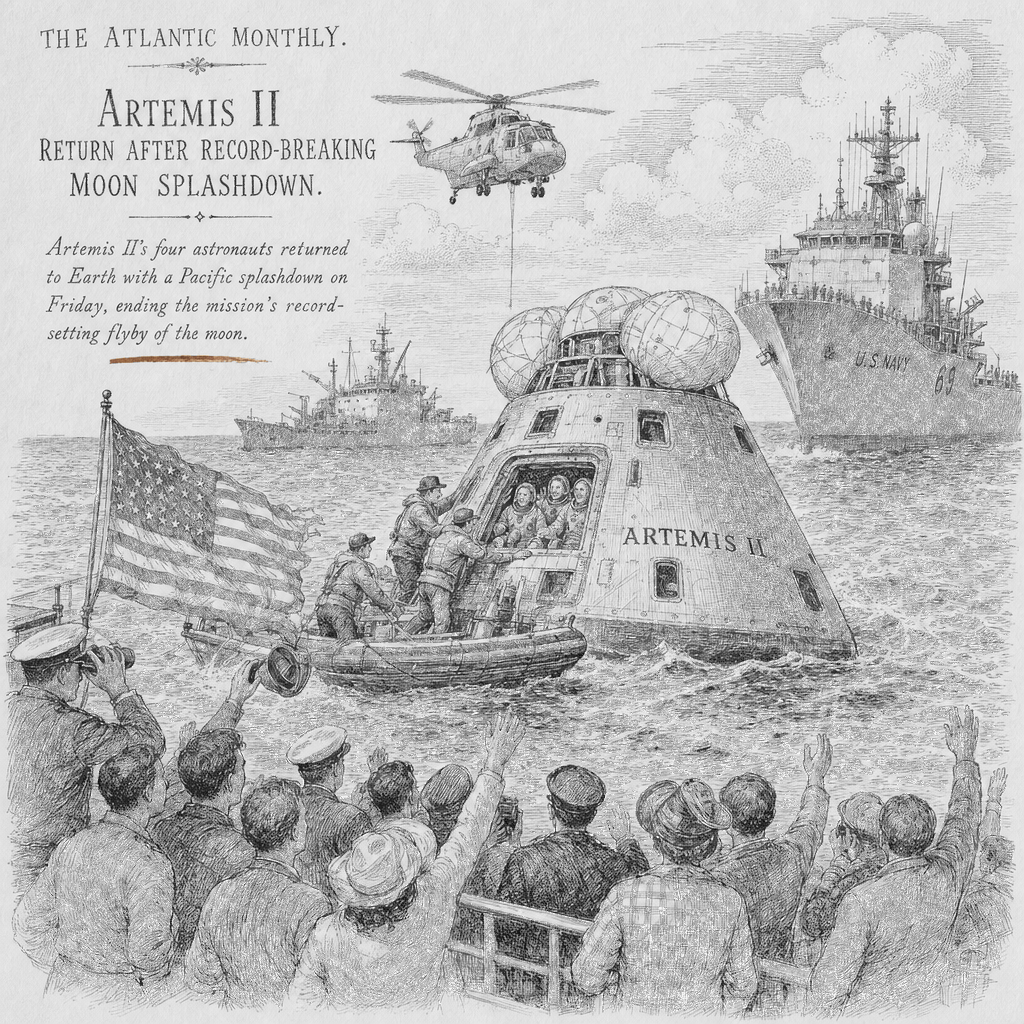
Artemis II’s astronauts ended NASA’s first lunar voyage in more than half a century with a Pacific splashdown on Friday, setting the stage for the next crewed mission in the Artemis program. The four astronauts—commander Reid Wiseman, pilot Victor Glover, Christina Koch and Canada’s Jeremy Hansen—emerged from their capsule into daylight off the coast of San Diego, NASA said. Military helicopters lifted them one by one from an inflatable raft docked to the capsule and carried them aboard the Navy’s recovery ship, the USS John P. Murtha.
NASA Administrator Jared Isaacman spoke from the recovery ship, describing the crew as part of the program’s longer arc toward sending astronauts to the moon and bringing them back. Lori Glaze, speaking at a news conference, celebrated the outcome as the team “did it” and welcomed the mission’s return as part of NASA’s “moonshot.” In Mission Control, NASA staff and families of the astronauts watched the capsule’s final phases, cheering when Orion emerged from its planned blackout and again after splashdown.
The capsule used for the return, Orion’s Integrity, made the drop on automatic pilot. As the spacecraft began its descent through the atmosphere, it reached peak heating and became engulfed in red-hot plasma, NASA said, triggering a scheduled communication blackout. The mission team focused on the capsule’s heat shield as it took the brunt of the reentry forces, with the six-minute blackout serving as one of the last hurdles before the crew could be recovered.
NASA said Artemis II’s return marked the first time since Apollo 17 in 1972 that NASA and the Defense Department jointly supported a lunar crew’s reentry. According to the report, Artemis II came back at 36,174 feet (11,026 meters) per second, or 24,664 mph (39,693 kph), then slowed to a planned 19 mph (30 kph) splashdown. The capsule’s sequence allowed controllers to step into a recovery phase that followed a decades-long test-flight tradition—one that the agency positioned as a bridge between Apollo-era engineering and Artemis-era operations.
Artemis II did not land on the moon or enter lunar orbit, but NASA said it still set distance records and opened a new chapter in lunar observation. Launched from Florida on April 1, the mission flew a trajectory that pushed human travel farther than any previous trip, reaching 252,756 miles (406,771 kilometers) from Earth. It also broke Apollo 13’s distance record, NASA reported, despite remaining a test flight designed to validate systems for the program’s future steps.
During the mission’s Monday record-breaking flyby, the astronauts documented scenes from the moon’s far side that had never been seen by human eyes, and they also observed a total solar eclipse. Glover said the eclipse “just blew all of us away,” adding that the spectacle stood out among the mission’s highlights. The astronauts later described how their images captured the Earth against deep space, and the report said the effect echoed the Earthrise image from Apollo 8 in 1968.
The crew’s journey also included personal moments and on-mission objectives tied to future exploration. Near the end of the flight, the astronauts asked permission to name a pair of craters after their moonship and after Wiseman’s late wife, Carroll. The mission emphasized preparing for subsequent lunar landings, with NASA saying that its Orion Integrity return was part of work that supports Artemis III, scheduled for the next two years, and a broader plan for a moon base within the decade.
Artemis II’s scientists and engineers also faced technical issues during the nearly 10-day flight, NASA said in the report. The capsule’s drinking water and propellant systems both had valve problems, and the astronauts dealt with a malfunctioning toilet while continuing mission operations. Even with those challenges, NASA said crews and teams planned additional examinations, including reviews of the heat shield using military aircraft photography during reentry and divers checking it from below as the capsule floated in the Pacific.
In the final moments of mission life, NASA said the crew aimed their attention toward the future crews that would follow them. Koch said they “can’t explore deeper” without accepting inconvenience, sacrifices and risks, and Hansen added that ground testing is different from the “final test” of getting hardware into space. Wiseman described the mission’s larger purpose, saying the crew hoped the world would pause to remember that Earth is “a beautiful planet” and that people should cherish what they have been given.