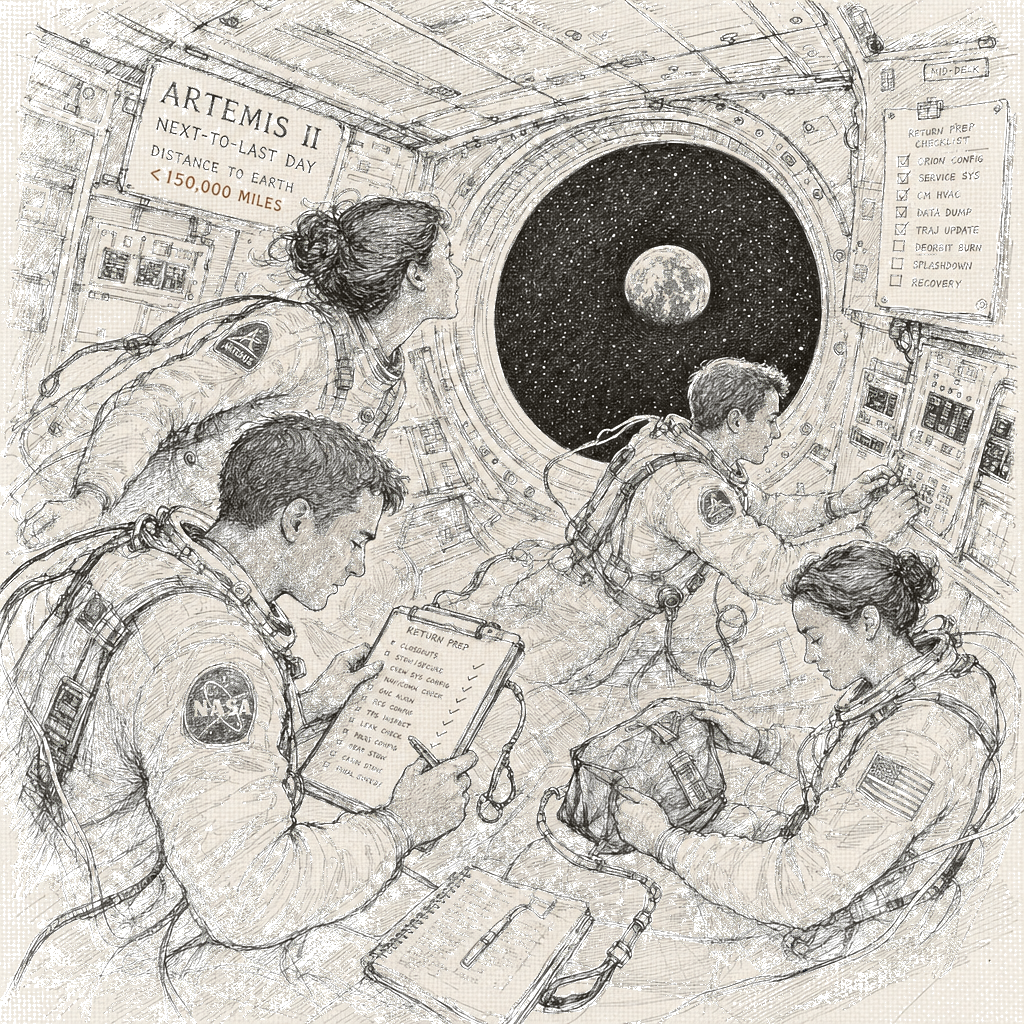
The Artemis II astronauts entered the next-to-last day of their mission less than 150,000 miles (240,000 kilometers) from home, tidying up their lunar cruiser ahead of Friday’s “fireball” return and describing their journey around the moon as both surreal and deeply meaningful.
Pilot Victor Glover told reporters that although there was already a flood of information from the flight, “all the good stuff is coming back with us,” adding that “riding a fireball through the atmosphere is profound as well.” Glover’s comments came as the crew, including commander Reid Wiseman and also mission specialists Christina Koch and Canada’s Jeremy Hansen, prepared for Earth return after humanity’s first lunar trip in more than half a century.
Wiseman said the experience of being cut off from contact with Earth while the spacecraft passed behind the moon on Monday was especially “surreal.” He said there was “a lot that our brains have to process … and it is a true gift,” describing the communication blackout and the mental adjustment as something the crew valued even as it was unlike anything most people ever experience.
As the crew moved to the farthest point of their flight, NASA said the mission team also marked a distance milestone: Wiseman, Glover, Koch and Hansen became the most distant humans ever, recording 252,756 miles (406,771 kilometers) from Earth before beginning the return. As they emerged from behind the moon, they experienced a total solar eclipse from their vantage point, with the moon blocking the sun from their perspective, according to the astronauts’ comments.
Glover noted that the timing of the launch from Florida on April 1 meant the crew had less illumination on the lunar far side, but he called the eclipse “the consolation prize” and said it was “one of the greatest gifts.” Even with the brightness differences, the crew’s reflections highlighted how the mission delivered rare views while closing in on the final phases of flight.
As the agency and its partners focus on recovery and landing, NASA Associate Administrator Amit Kshatriya said the crew’s “expressions of love and devotion to family” warmed hearts worldwide and served as an example of why NASA sends humans instead of relying only on robots. “If you can’t take love to the stars, then what are we doing?” Kshatriya said, adding that “that’s why we send humans instead of robots sometimes, that’s why we have that firsthand witness.”
The return brings heightened attention to reentry and landing planning, with the recovery ship USS John P. Murtha already at sea and a squadron of military planes and helicopters positioned to join the operation. The Artemis II mission will mark the first time NASA and the Defense Department have teamed up for a lunar crew’s reentry since Apollo 17 in 1972.
NASA officials said the Orion capsule will come screaming back into Earth’s atmosphere at a predicted 34,965 feet (10,657 meters) per second, or 23,840 mph (38,367 kph), describing the speed as not a record but still extremely fast. Flight director Jeff Radigan said the reentry depends on precision, telling reporters the capsule must nail the reentry angle within a single degree and warning, “Let’s not beat around the bush. We have to hit that angle correctly — otherwise we’re not going to have a successful reentry.”
Mission Control will also monitor how the heat shield performs during the reentry, and NASA pointed to experience from the only other Orion test flight to the moon, in 2022 without a crew. During that earlier mission, officials said the heat shield suffered more damage than expected after exposure to about 5,000 degrees Fahrenheit (2,760 degrees Celsius); NASA later adjusted Artemis II’s descent to reduce the blisteringly hot exposure without replacing the heat shield. NASA said Artemis III and later missions will fly with redesigned heat shields.
In discussing what remains for the crew and the mission team, NASA said officials had been reluctant to provide specific risk assessment numbers for the nearly 10-day flight, noting that the biggest threats involve the launch and the entry back to Earth. “We’re down to the wire now,” said NASA’s Lakiesha Hawkins, adding that safely getting the crew home and landed is “a significant part of the risk that’s still in front of us.”