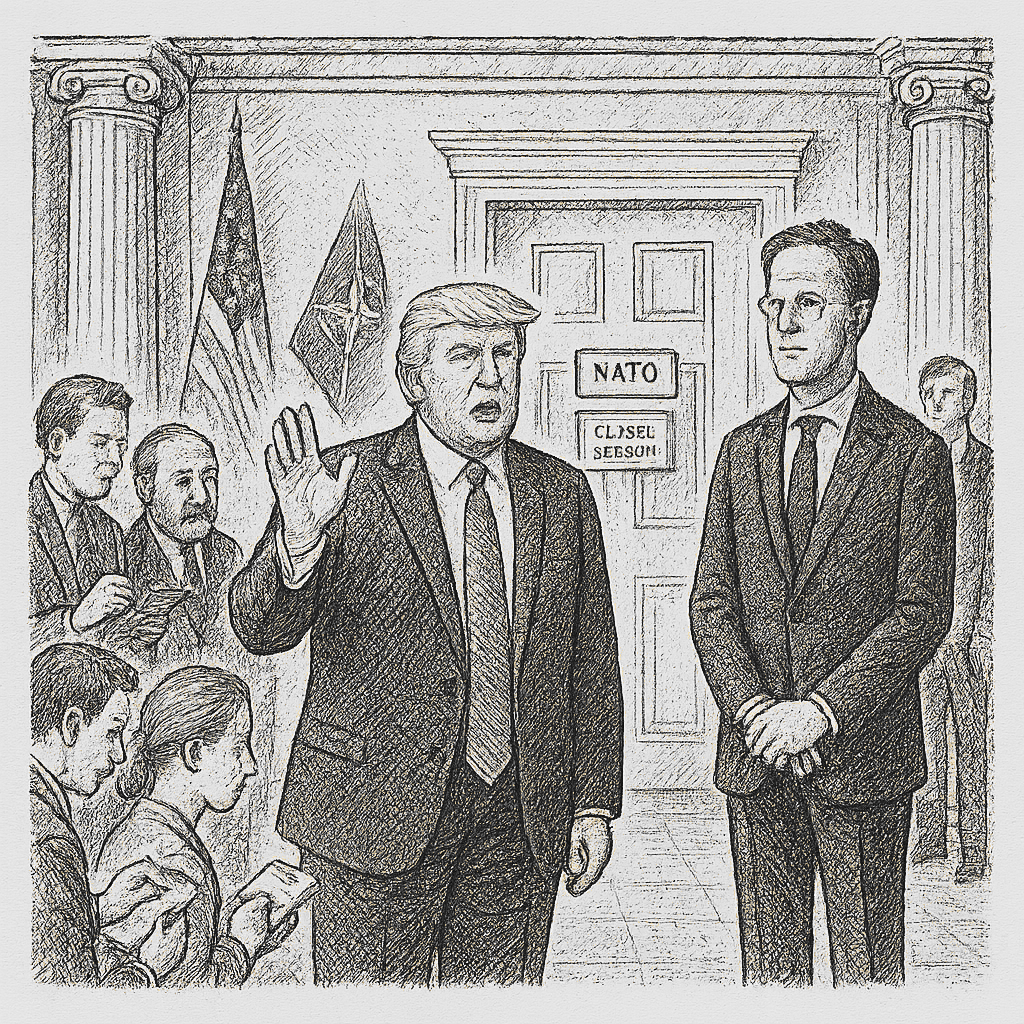
President Donald Trump returned to a familiar theme—complaining that NATO has not done enough for the United States—after a closed-door meeting with the alliance’s secretary-general, Mark Rutte, in Washington on Wednesday.
The meeting followed expectations that the two leaders would discuss the U.S. response to the Iran war and the administration’s interest in soothing Trump’s anger with the alliance. Trump nonetheless repeated his complaint, issuing a message afterward that said NATO was not there when the U.S. needed it and warned that it would not be there again.
In an all-caps post, Trump wrote: “NATO WASN’T THERE WHEN WE NEEDED THEM, AND THEY WON’T BE THERE IF WE NEED THEM AGAIN,” according to the Associated Press report. The White House did not immediately provide further details about the substance of the meeting beyond what was said in advance.
Ahead of Trump and Rutte meeting, Trump had floated the idea that the U.S. might consider leaving NATO, tying the concern to the Iran war and the disruption around the Strait of Hormuz, which he said had effectively been shut down and had contributed to higher gas prices. White House press secretary Karoline Leavitt said Trump would be discussing leaving NATO with Rutte in the hours ahead.
The timing put the NATO discussion alongside a diplomatic development: the U.S. and Iran agreed late Tuesday to a two-week ceasefire that includes reopening the strait. The ceasefire deal was reached after Trump said he would strike Iran’s power plants and bridges, setting off alarm in Washington that a broader escalation could follow.
For Trump, the complaint about NATO did not appear limited to the immediate Iran crisis. The report said he also appeared to be angry about NATO’s stance on Greenland, a semi-autonomous territory of Denmark, and he previously pressed for U.S. control over the island before backing off after talks with Rutte. On Wednesday, Trump posted: “REMEMBER GREENLAND, THAT BIG, POORLY RUN, PIECE OF ICE!!!”
Even with Trump raising the prospect of leaving NATO, the report pointed to a legal constraint. Congress passed a 2023 law that prevents any U.S. president from pulling out of NATO without congressional approval. It noted that when the law passed, it was championed by Trump’s current secretary of state, Marco Rubio, who at the time was a senator from Florida.
Rubio met separately with Rutte on Wednesday morning at the State Department, according to a statement from the State Department. The statement said Rubio and Rutte discussed the war with Iran, U.S. efforts to negotiate an end to the Russia-Ukraine war, and “increasing coordination and burden shifting with NATO allies.”
Other senior Republicans publicly pressed Trump to stay aligned with NATO. Sen. Mitch McConnell, a Kentucky Republican and a member of a committee that oversees defense spending, said in a statement Tuesday night that following the Sept. 11 attacks, NATO allies sent “their young servicemembers to fight and die alongside America’s own in Afghanistan and Iraq,” and urged Trump to be “clear and consistent.”
The Associated Press report also said NATO has been strained over the past year as Trump returned to power, reduced U.S. military support for Ukraine, and threatened to seize Greenland from Denmark. According to the report, Trump’s badgering of NATO intensified after the Iran war began at the end of February, with Trump arguing that securing the Strait of Hormuz was not America’s responsibility but that of countries dependent on the flow of oil through it.
As the ceasefire framework put attention back on reopening the strait, the report said the U.K.’s Prime Minister Keir Starmer was set to travel to the Gulf on Wednesday to support the ceasefire. It said the U.K. has been working on a post-conflict security plan for the waterway, through which about one-fifth of the world’s oil passes, according to the report.
The NATO alliance has a core mutual-defense commitment among its 32 member countries, under which an attack on one is considered an attack on all. The report said NATO’s Article 5 commitment has been activated only once before, in 2001 after the Sept. 11 attacks. Even so, Trump has repeatedly complained during the Iran war that NATO has shown it will not be there for the U.S., and the dispute has also touched on allies’ decision-making during the conflict, including restrictions that Spain and France placed on U.S. use of their airspace or joint military facilities.