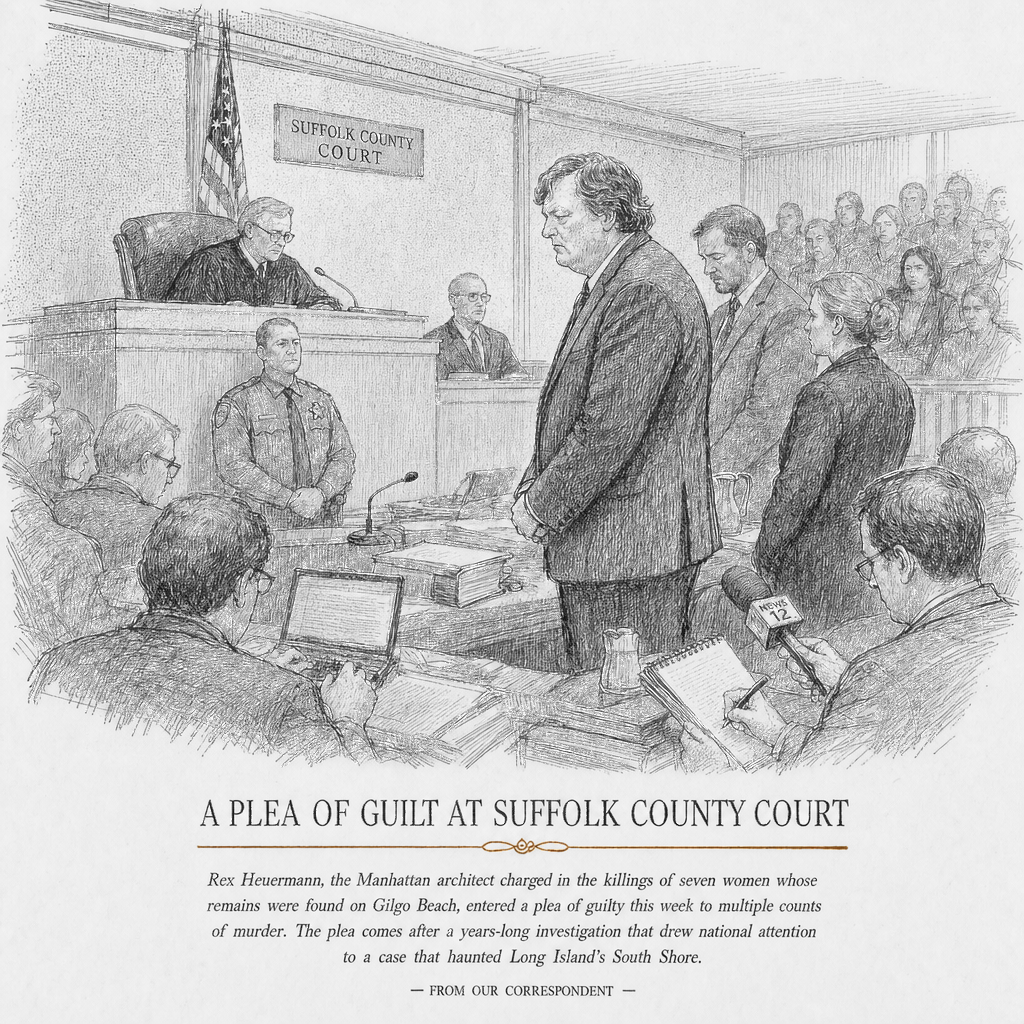
A Long Island architect who prosecutors said led a secret life as a serial killer pleaded guilty Wednesday to murdering seven women in the Gilgo Beach killings and admitted he killed an eighth, bringing a long-unsolved case toward sentencing. Rex Heuermann, 62, entered the pleas in a packed courtroom in Riverhead, with reporters, police, and victims’ relatives present as he described his murders, according to prosecutors and testimony reported by the Associated Press.
Heuermann’s guilty pleas were to three counts of first-degree murder and four of intentional murder. Prosecutors said he will be sentenced in June to life in prison without parole.
Suffolk County District Attorney Ray Tierney said after the hearing that the defendant “walked among us play-acting as a normal suburban dad when in reality, all along, he was obsessively targeting innocent women for death,” tying the plea to a case that investigators said resisted resolution for years. Tierney also thanked victims’ relatives and members of the Gilgo Beach Homicide Investigation Task Force, describing how the investigation developed evidence that included DNA lifted from a discarded pizza crust.
Victims’ families spoke about the personal weight of the moment. Melissa Cann, the sister of Maureen Brainard-Barnes, said the guilty pleas marked “a long journey of hope — hope that one day we would stand here and say her name with justice beside it,” adding, “Today, that long, painful journey brings us to this moment,” as reported by AP in statements given during a post-hearing news conference.
Other attorneys for victims’ families also described the years of unresolved loss. Gloria Allred, an attorney for some families, said several of the women were young mothers who were trying to earn extra money to support their children, and she told reporters that “Little did they know that the defendant, Rex Heuermann, did not care about their hopes and dreams, or that they had families and friends who loved them.”
Elizabeth Baczkiel, whose daughter Jessica Taylor was murdered by Heuermann, said: “I am glad that this is over as far as him pleading guilty. It took a big chunk of stress off of me and my family.” Heuermann’s ex-wife, Asa Ellerup, and their daughter attended the hearing and were met by reporters when they arrived and left, according to AP. Ellerup told reporters she and her family had no knowledge of or involvement in the killings, and she asked for privacy for her family during what her lawyer described as a “very difficult time.”
Heuermann’s attorney, Michael Brown, said it was Heuermann’s decision to plead guilty, in part to spare victims’ relatives and his family from a trial, and he said that when asked whether Heuermann was sorry, “I would hope so. … I would expect at sentencing he would have something to say.” As part of the plea, Heuermann agreed to cooperate fully with the FBI’s behavioral analysis unit as part of an academic and scientific exercise, AP reported.
Prosecutors said Heuermann admitted that he strangled all eight victims and dismembered some of them before dumping their bodies. The women, many of them sex workers, were killed over a 17-year span, according to AP’s account of the case.
Authorities have said remains associated with six victims were found along Ocean Parkway near Gilgo Beach beginning in late 2010, and that the remains of Sandra Costilla were found more than 60 miles (100 kilometers) away in the Hamptons. Prosecutors also said the remains of Karen Vergata were found on Fire Island more than 20 miles (32 kilometers) west, including one set dating to 1996 and another near Gilgo Beach in 2011.
The case’s renewed momentum came after a fresh look by investigators. In 2022, AP reported that six weeks after a new police commissioner formed the Gilgo Beach task force, detectives identified Heuermann as a suspect by using a vehicle registration database to connect him to a pickup truck a witness said they saw when one of the victims disappeared in 2010. Investigators also said some victims were believed to have disappeared in the Massapequa Park area, about a 25-minute drive from where prosecutors said Heuermann lived, and that cellphones tied to the case pinged towers in the region.
AP reported that after investigators traced the truck connection, a grand jury authorized more than 300 subpoenas and search warrants. Prosecutors said detectives collected billing records for burner phones Heuermann used to arrange meetings, retested DNA from bodies, and examined his internet search history, including what investigators said showed an interest in the Gilgo Beach killings. Prosecutors also said a surveillance team tailed him in Manhattan, where they watched him throw the remnants of his lunch—a box of partially eaten pizza crusts—into a sidewalk garbage can; they then grabbed the box and sent it to the crime lab, where DNA from the crust matched a male hair found on burlap used to restrain a victim.
Heuermann was arrested in July 2023. AP reported that investigators said they found a “blueprint” for the killings on his computer, including checklists that included reminders to limit noise, clean the bodies, and destroy evidence.