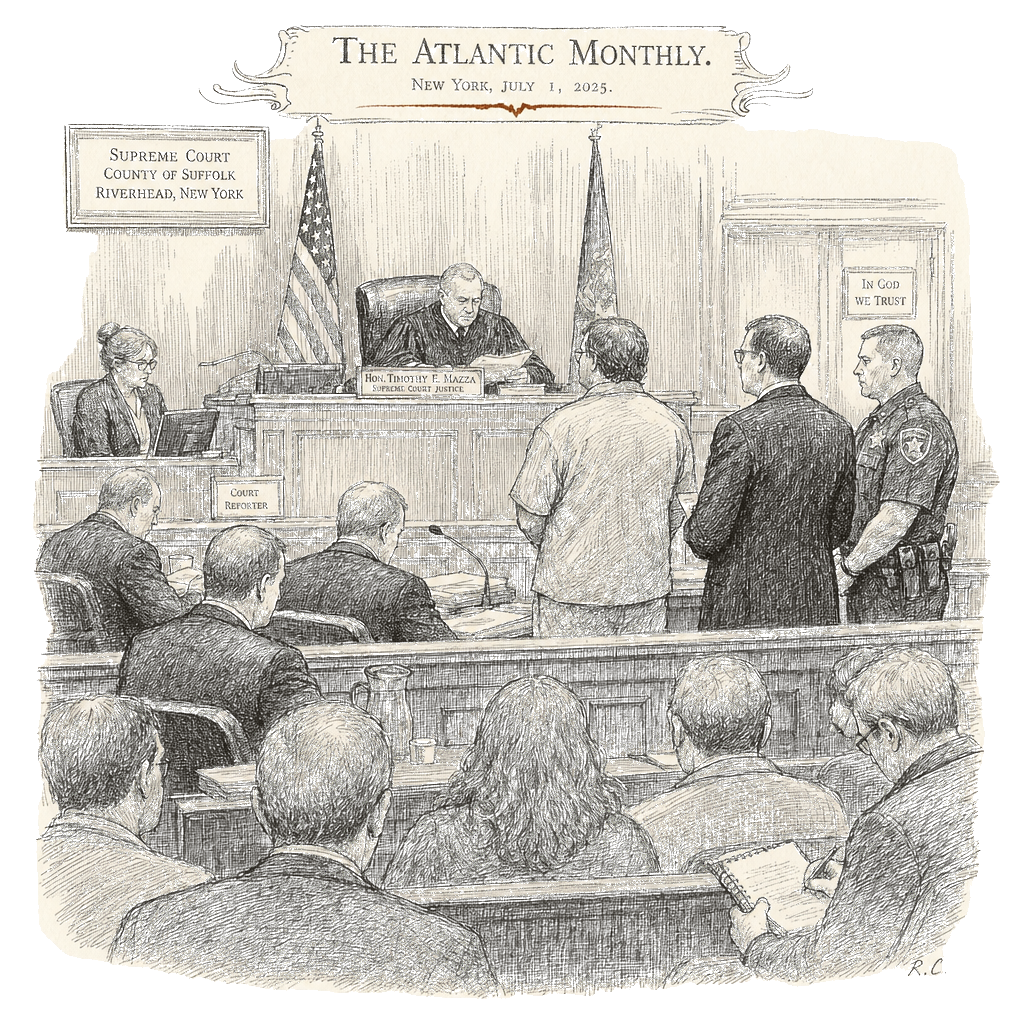
Rex Heuermann, an architect who prosecutors tied to the Gilgo Beach killings, pleaded guilty to murder charges involving seven women in a case that has stretched for more than three decades, prosecutors said. He also admitted killing an eighth woman, according to prosecutors and court reporting. He is scheduled to be sentenced in June to life in prison without parole.
Prosecutors said Heuermann pleaded guilty to three counts of first-degree murder and four counts of intentional murder covering the killings of seven women between 1993 and 2010. During the plea hearing, the 62-year-old appeared in court, prosecutors said, entering the guilty pleas without showing emotion and without turning back toward the packed gallery of relatives.
The Gilgo Beach killings came to national attention in the years after multiple sets of human remains were found along Long Island’s South Shore beginning in late 2010, prompting investigators to search for a serial killer and drawing global attention. Family members of the victims grew doubtful that a suspect would ever be identified as the case stretched beyond a decade.
Prosecutors described the evidence that ultimately led to Heuermann’s arrest in 2023, including DNA. They said detectives identified Heuermann as a suspect in 2022 after using a vehicle-registration database to connect him to a pickup truck a witness reported seeing around the time one of the victims disappeared in 2010.
Investigators also relied on digital and forensic evidence, prosecutors said. They said cellphone data showed Heuermann was in contact with some victims just before they disappeared, and that his internet search history included interest in the Gilgo Beach killings. As part of the investigation, a surveillance team tailed him while he worked in Manhattan and, prosecutors said, watched as he discarded a box of partially eaten pizza crusts into a sidewalk garbage can.
Prosecutors said investigators rushed to retrieve the box and sent it to a crime lab for analysis. They said the lab matched DNA from a hair found on burlap used to restrain one of the victims, linking Heuermann to evidence tied to the case. Suffolk County District Attorney Ray Tierney described investigators’ approach to maintaining secrecy around the probe, saying, “We wanted the one person who mattered, the murderer, to think it’s business as usual.”
At Wednesday’s hearing, prosecutors said Heuermann admitted strangling eight female victims and dismembering some before dumping their bodies along remote stretches of New York’s coastline. Prosecutors said many of the victims were sex workers and that Heuermann admitted killing Karen Vergata in 1996, though he has not been charged in her death.
Prosecutors also described where remains were found. They said remains of six victims—Melissa Barthelemy, Maureen Brainard-Barnes, Amber Lynn Costello, Valerie Mack, Jessica Taylor and Megan Waterman—were discovered along Ocean Parkway near Gilgo Beach. They said Sandra Costilla’s remains were found more than 60 miles (100 kilometers) away in the Hamptons, and that Vergata’s remains were found on Fire Island in 1996 before being found again near Gilgo Beach in 2011.
Family members attended the plea hearing, and some wept as Heuermann detailed the murders, prosecutors said. Elizabeth Baczkiel, the mother of Jessica Taylor, said she was glad the case had ended as far as Heuermann pleading guilty, describing how the delay had created a long period of stress for her and her family.
Melissa Cann, the sister of Brainard-Barnes, said at a news conference after the hearing that the case brought hope and then a moment of justice. She said the journey of hope and pain ended as she and others reached the point where they could say her sister’s name “with justice beside it,” adding that the plea marked the moment that long struggle arrived.
Heuermann’s ex-wife, Asa Ellerup, and their daughter were also in court for the guilty pleas, according to court reporting. Ellerup said her thoughts were with the victims’ families and that she was asking for privacy for her own family, and Heuermann’s lawyer, Robert Macedonio, said Ellerup and their daughter had no knowledge of or involvement in the killings. As part of his guilty plea, prosecutors said Heuermann agreed to cooperate fully with the FBI’s behavioral analysis unit to help catch other serial killers.