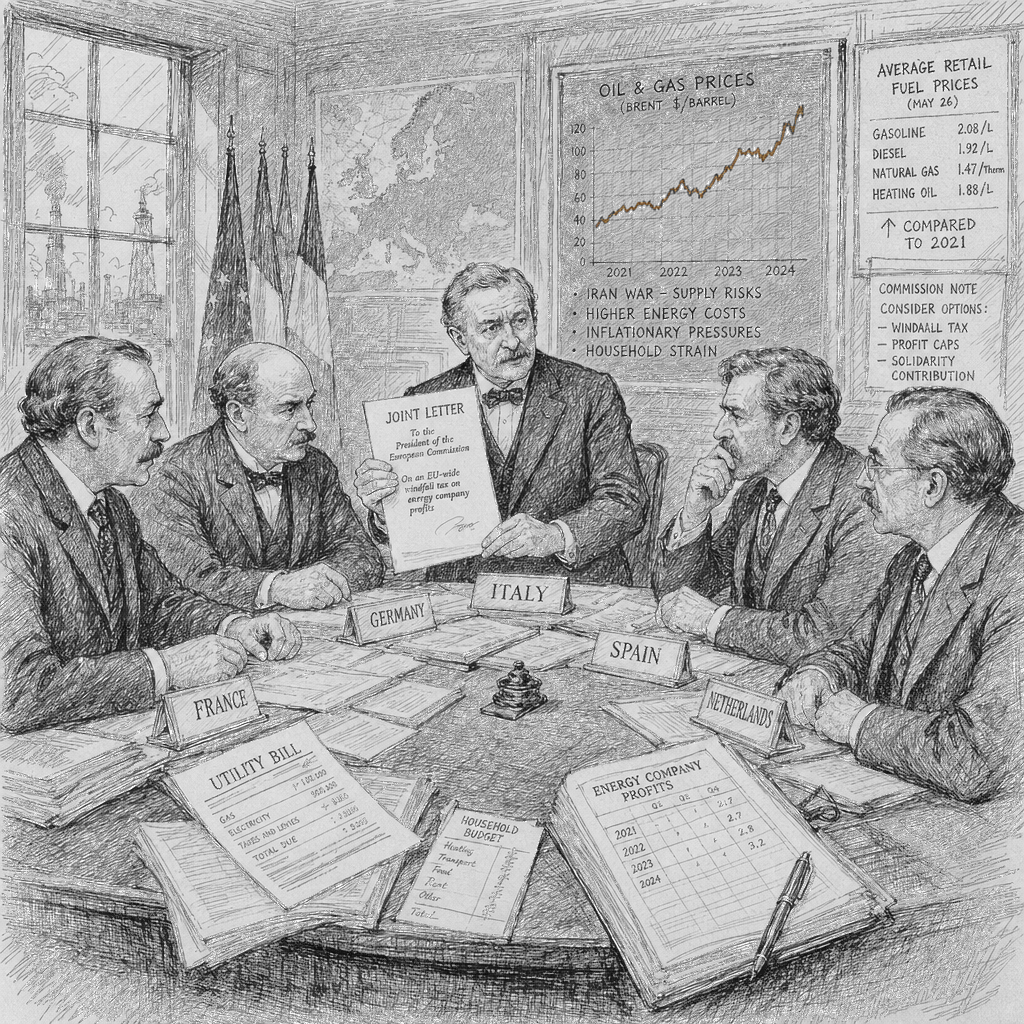
The finance ministers of Spain and four other European countries have urged the European Commission to respond to surging energy prices they link to the Iran conflict by capping energy companies’ profits across the European Union, a move intended to prevent the spike from worsening inflation and adding pressure to household budgets.
Spain’s Economy Minister Carlos Cuerpo said Saturday that his counterparts from Germany, Italy, Portugal and Austria had signed the letter, dated Friday, and that he made it public in an online post. Cuerpo said the letter points to “market distortions” created by the price surge and calls for an EU-wide contribution mechanism.
The letter says the conflict in the Middle East has pushed oil prices higher and, in the signatories’ view, has “placed a significant burden on the European economy and on European citizens.” It also argues that the burden should be distributed fairly, adding that it is “important to ensure that this burden is distributed fairly.”
Europe relies heavily on imported oil and gas, and officials say the region remains vulnerable to external shocks that can quickly feed into domestic costs. In 2022, after Russia’s full-scale invasion of Ukraine disrupted energy markets and inflation rose into double digits across many European countries, the EU adopted a “solidarity contribution,” which included caps on excess energy profits.
The letter’s signatories said the commission should “swiftly develop a similar EU-wide contribution instrument” in light of current “market distortions” and fiscal constraints. They also said such a step would send “a clear message that those who profit from the consequences of the war must do their part to ease the burden on the general public.”
The price pressure comes as euro zone inflation has climbed again. The annual inflation rate in the 21 countries that use the euro rose to 2.5% in March from 1.9% in February, with the increase driven largely by higher oil prices.
Iran has also blocked most tanker traffic through the Strait of Hormuz, a chokepoint for about 20% of global oil and gas. This disruption threatens to stress fuel markets for months, according to the EU’s warning this week.
EU Energy Commissioner Dan Jorgensen said the disruption caused by the closure means fuel prices are unlikely to “go back to normal in a foreseeable future.” MSI previously reported that Europe could face prolonged high oil and gas prices even if the Iran conflict ends, highlighting how difficult it may be to unwind the immediate shock.
Separately from the ministers’ push, the request underscores a renewed policy debate inside the bloc about whether profits from wartime-linked energy price moves should be limited or taxed in order to spread the costs of the disruption, especially as households confront higher living costs and governments face competing budget demands.