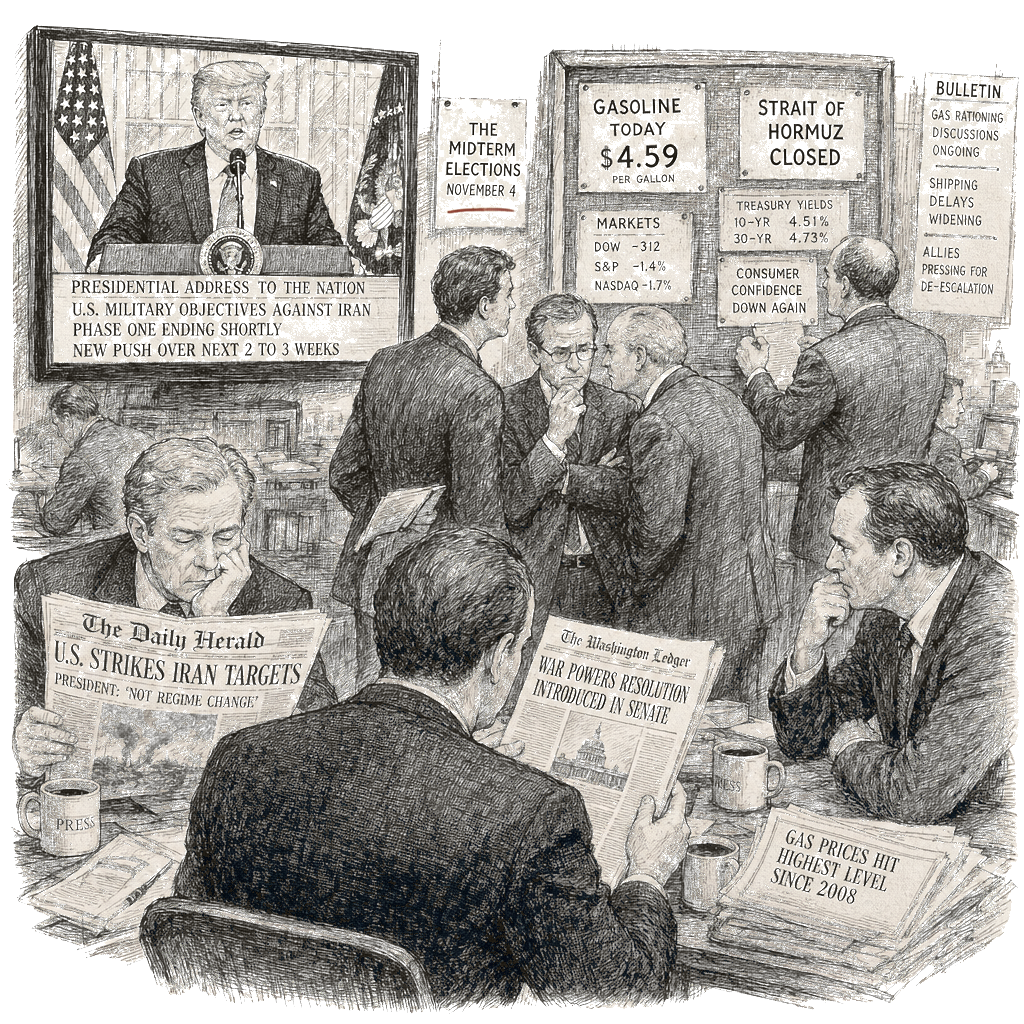
This week’s political tension centers on how Republicans explain—if they can—an Iran conflict that Trump has cast as both winding down and accelerating. In his White House prime-time address, Trump said the United States was approaching completion of its military objectives while warning Americans to expect heavy strikes soon after, according to the AP report.
His remarks landed against a backdrop of shifting expectations within the Republican Party as the midterms near, with the party facing what AP described as a far tougher path than many leaders had anticipated earlier in the year. Trump is entering the final two years of his term with Republicans already controlling all branches of government in Washington, but senior strategists and lawmakers have privately shifted their assumptions about what races they can win.
AP reported that some Republicans believe the House is “all but lost,” while Democrats have a realistic shot at taking the Senate. At the same time, the party has struggled to coalesce around a single midterm message on Iran, with the Republican National Committee avoiding the war in some campaign messaging and some vulnerable candidates sidestepping the issue rather than defending Trump publicly.
Publicly, Trump has kept support among high-profile Republicans. Sen. Lindsey Graham of South Carolina praised the president’s address on social media, writing that it “gave the American people a clear and coherent pathway forward,” AP said. But the war also prompted sharp criticism from within the party, with former Rep. Marjorie Taylor Greene posting that she heard “WAR WAR WAR” instead of steps to “lower the cost of living for Americans.”
Trump’s argument to voters hinges on the idea that the conflict’s endgame will quickly deliver benefits at home, but AP said he offered limited clarity earlier in the war and continued to send mixed signals. The AP report noted that Trump’s address came after a U.S. fighter jet was shot down in Iran—an episode that dominated headlines—and also after Trump claimed Tehran’s military capabilities had been “all but destroyed.” AP said one crew member was rescued.
Energy prices and costs remain a visible pressure point for Republican candidates. AP reported that the Strait of Hormuz—a key shipping passage for a portion of global oil—remains closed. It also said AAA put the U.S. average gasoline price at $4.08 a gallon on Thursday, nearly a full dollar higher than it was on Joe Biden’s last day in office, and that Trump, in earlier comments, suggested allies would need to reopen the strait themselves.
AP also described the military and fiscal scope of the campaign, saying at least 13 U.S. service members have been killed and hundreds more injured since the initial U.S. attack. The AP report said thousands more troops have converged on the region and that the Pentagon requested $200 billion in new funding.
A central concern for Republicans is whether public sentiment will damage them as election season unfolds. AP-NORC polling from March found that about 6 in 10 U.S. adults say the Iran military action “has ‘gone too far,’” while roughly a third approve of how Trump is handling Iran overall. The same polling showed that about 6 in 10 adults oppose sending U.S. troops on the ground to fight Iran, including about half of Republicans, while only about 1 in 10 favor that scenario.
Trump’s wider approval picture has also remained weak, AP said, with about 4 in 10 Americans approving of how he is handling the presidency—roughly in line with how it has been throughout his second term. Republican strategist Ari Fleischer, a senior aide in George W. Bush’s administration, acknowledged that Trump has not received the polling boost that Bush experienced after the 2003 invasion of Iraq, and he said Trump faces a different kind of political test: “he is not going to get judged on his persuasion or his explanations or his assertions, he’s going to get judged on results,” according to AP.
Fleischer said he hoped Trump’s experience would be the “exact opposite” of the Bush Iraq War experience, which Fleischer said later helped fuel a generation of anti-war Republicans. He added that Trump may see “a very significant political upside” if the conflict ends well, oil prices fall, and markets rally—outcomes that, at the moment, remain uncertain as Republicans try to craft midterm messages around a war they acknowledge has unsettled voters.