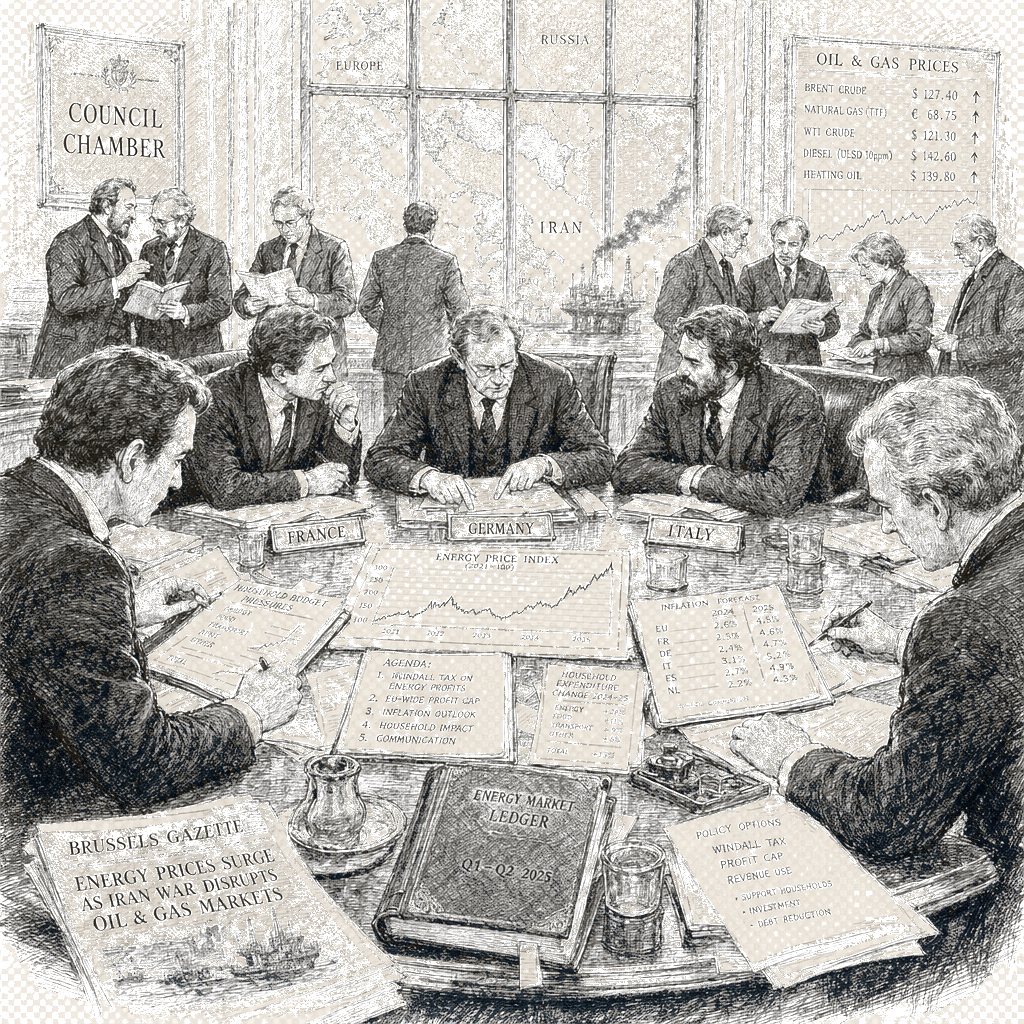
Spain’s Economy Minister Carlos Cuerpo said a group of European finance ministers from five countries has asked the European Commission to impose an EU-wide windfall tax or profit cap on energy companies, citing “market distortions” amid surging oil and gas prices tied to the war in Iran. Cuerpo said Germany, Italy, Portugal and Austria signed the letter alongside Spain, which was dated Friday and made public by Cuerpo in an online post on Saturday.
The letter argues that the conflict in the Middle East has raised oil prices and created a “significant burden on the European economy and on European citizens,” while warning that Europe’s exposure is heightened because it is “largely dependent on imported oil and gas.” It also says the burden should be handled through an EU-wide mechanism rather than a patchwork of national responses.
Cuerpo said in the post that the ministers want the European Commission to “swiftly develop a similar EU-wide contribution instrument,” referencing an earlier response to energy-market turmoil. In 2022, after Russia’s full-scale invasion of Ukraine, the EU imposed a “solidarity contribution” that included caps on excess energy profits.
The letter calls for an approach that also addresses the distribution of the cost, saying: “It is important to ensure that this burden is distributed fairly.” It adds that those who “profit from the consequences of the war must do their part to ease the burden on the general public,” tying the proposed policy to both consumer impact and the allocation of windfall gains.
While European policymakers weigh possible new measures, the pressure on energy markets has also been shaped by shipping disruptions. The cluster described Iran as blocking most tanker traffic through the Strait of Hormuz, a chokepoint for about 20% of global oil and gas that can stress fuel supplies for months.
EU Energy Commissioner Dan Jorgensen warned that the closure’s effects are likely to persist, saying disruption linked to the closure means fuel prices are unlikely to “go back to normal in a foreseeable future.” His comments were aimed at expectations for price relief as markets adjust to the changed flow of crude and fuel shipments.
The inflation backdrop adds urgency to the policy push. The annual inflation rate in the 21 euro-area countries rose to 2.5% in March from 1.9% in February, the cluster said, driven largely by higher oil prices. The letter’s argument is that higher energy prices can quickly translate into broader costs for households, reviving an EU policy debate that had been active during the 2022 shock period.