Body
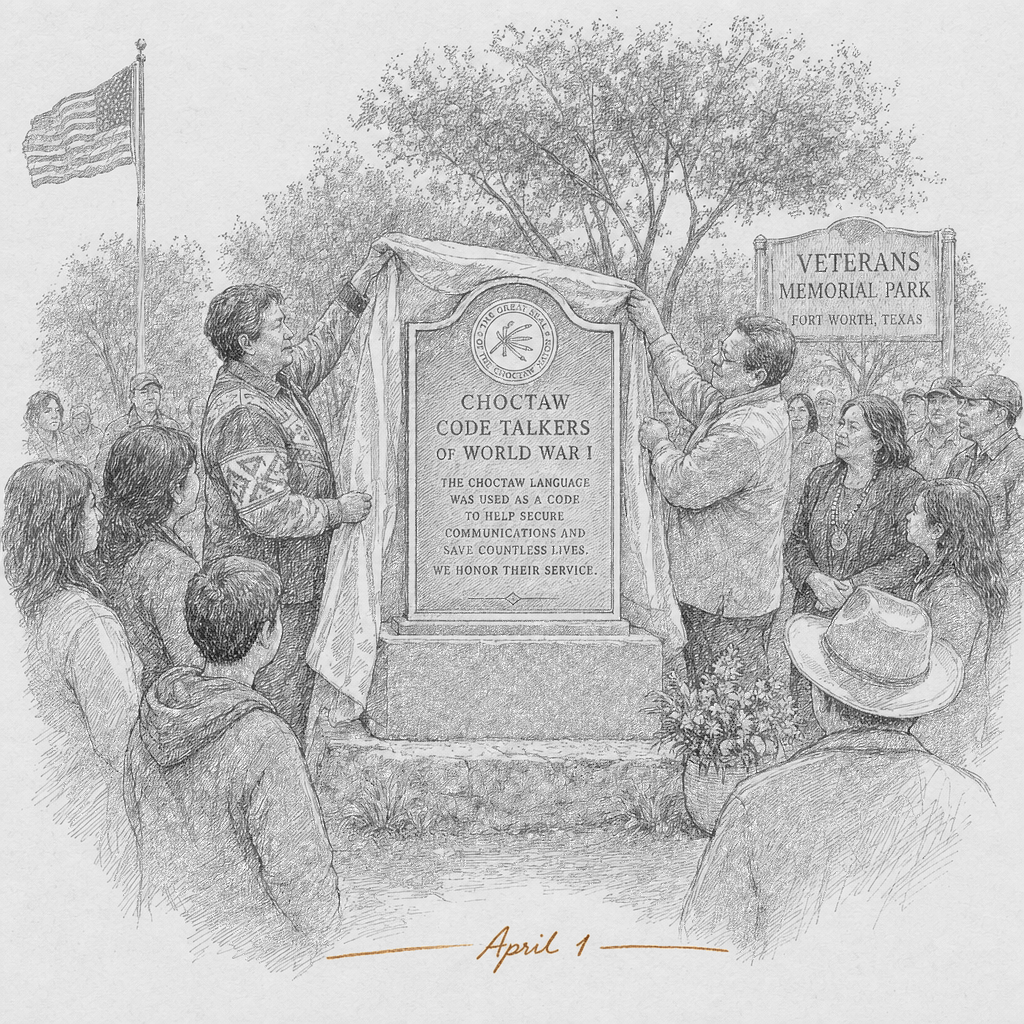
Descendants of Choctaw code talkers gathered in Fort Worth on April 1 to mark the unveiling of a new historical marker at Veterans Memorial Park, recognizing the group’s role using Choctaw language as wartime encryption during World War I. The ceremony drew descendants and officials from Oklahoma and Texas, with representatives hosting the event including the Oklahoma tribe, the Texas Historical Commission and the city’s parks and recreation department.
Nuchi Nashoba, president of the Choctaw Code Talkers Association, traced her family’s story through a photograph she grew up seeing inside her grandmother’s home in Oklahoma. She said she did not know much about her great-grandfather Ben Carterby until 1989, when she learned he was among the Choctaw code talkers.
According to information on the historical marker, the Choctaw code talkers were 19 Native American soldiers who used their language to transmit encrypted messages to Allied forces during campaigns in northern France. The soldiers were sworn to secrecy, and families were not told about their service for decades, the marker says, as Nashoba described how her work over the past 20 years has focused on bringing that hidden legacy to wider public view.
The ceremony also highlighted how the soldiers’ contributions fit into the broader history of Native participation in the U.S. military at a time when Indigenous people were not recognized as citizens. The marker notes that some of the men were overheard speaking Choctaw while on the battlefield in France, then trained to use their words as “code,” placing them on front lines and command posts so messages could reach headquarters.
Officials and descendants at the event described the language used in the wartime messaging, including terms the marker attributes to artillery and warriors. The marker also says German forces failed to decipher the Choctaw transmissions within 24 hours throughout the war, and it frames the Choctaw group as a precedent for the Navajo code talkers later in World War II.
At the unveiling, Col. Brent Kemp, commander of the 56th Infantry Brigade Combat Team of the National Guard, said the code talkers’ story reflects “the resilience and patriotism of the Choctaw Nation,” adding that “their ingenuity and bravery reminds us of the power of cultural heritage and the importance of preserving Indigenous languages.” Council member Macy Hill, who represents Camp Bowie, said the Fort Worth marker honored a connection to the soldiers’ training, noting that the site was where the code talkers were “initially trained.”
Ta’Na Alexander, the great-great-granddaughter of Carterby, attended the ceremony as the marker was unveiled in Fort Worth. She said she felt proud as the story traveled beyond her family and across the country, and she described the marker as a bridge between generations.
Alexander, who credited Nashoba’s leadership for education efforts that have brought wider attention to Native soldiers’ work, pointed to related recognition underway. She said the association led efforts last May to place a bronze sculpture honoring the group at the Choctaw Cultural Center in southern Oklahoma, and it also advocated for 23 Oklahoma bridges to be renamed for the code talkers and other Native veterans.
Nashoba said the Fort Worth marker was the association’s first venture into Texas, and she said the group is exploring additional statewide recognitions. For now, Alexander invited residents to visit the memorial park to learn that her ancestors’ stories are also about what it means to be American, including the right to vote and civic voice.