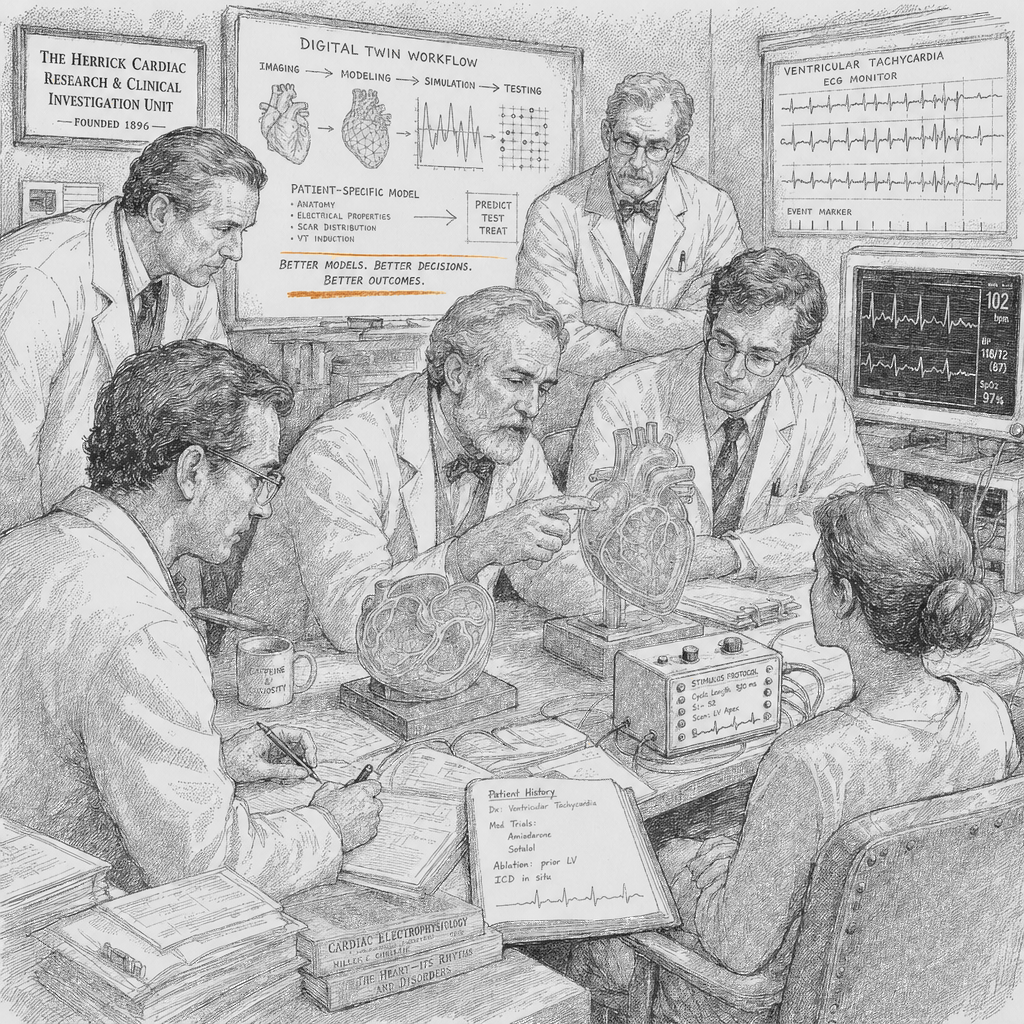
Scientists and cardiologists are beginning to test whether “digital twin” models—computer replicas designed from a patient’s data—can help doctors treat dangerous heart rhythm disorders more effectively. The work, described in results published Wednesday in The New England Journal of Medicine, focuses on ventricular tachycardia, a fast, irregular heartbeat that can trigger sudden cardiac arrest and is considered notoriously difficult to treat.
In the Johns Hopkins trial, researchers first built individualized digital replicas of patients’ diseased hearts, then used those models to decide where to perform catheter ablation. The trial was authorized by the Food and Drug Administration to guide treatment in 10 patients, marking an early step for technology that has been used for years in aerospace and other industries before moving into clinical care.
The basic problem with ventricular tachycardia is that the heart’s electrical system can produce a repeating, rapid rhythm that prevents the lower chambers—the ventricles—from pumping blood effectively to the rest of the body. The AP report described the arrhythmia as an electrical wave that short-circuits in the bottom chambers, sometimes likened by Natalia Trayanova to a swirling motion that can become trapped on damaged tissue.
Traditional management can include medication, but the main intervention is ablation: doctors thread catheters to the heart and burn or destroy tissue that is misfiring electrically. Ablation often involves trial-and-error, with patients undergoing hours under anesthesia while physicians determine where to aim. Repeat ablations are common, and many patients also receive implanted defibrillators as a backup for sudden dangerous rhythms.
Trayanova, a Johns Hopkins biomedical engineer whose lab has focused on interactive digital-twin models using advanced MRI and other patient-specific data, described the intended advantage of “true digital twins” as the ability to predict how a real organ reacts to different treatments. “We treat the twin before we treat the patient,” she said in the AP report, describing how doctors can test whether a virtual ablation solves the problem and whether new arrhythmias might emerge that would require different or additional care.
In the trial, researchers created customized ablation targets for each of the 10 participants and then translated those targets to a cardiac mapping system used during procedures. Cardiologists aimed at those specific targets rather than “hunting their own,” according to the report’s description of how the digital-twin guidance fit into clinical workflows.
More than a year later, the reported outcomes were promising for the small study. The lead author, Jonathan Chrispin, said eight patients had no arrhythmias while two experienced only a single brief episode while they were healing. AP reported that this compared favorably with what is described as typical success rates for the procedure, and that nearly all participants stopped their anti-arrhythmia medicine—except for two.
Chrispin also said the approach may reduce how much tissue must be burned during ablation by allowing targeting of “specifically the areas that we think are critically important.” He said the team could potentially make procedures shorter, safer, and more effective, AP reported.
Outside experts told AP that the findings align with what earlier efforts had envisioned. Jeffrey Goldberger, a heart specialist at the University of Miami not involved with the study, praised the results and said, “This is what we envisioned,” noting that he had experimented with more rudimentary versions of the concept about 15 years ago.
The Johns Hopkins group said it plans to study the digital twin approach in larger trials with other hospitals and has begun work using the technology to treat atrial fibrillation, a more common type of irregular heartbeat. Other researchers are also exploring digital-twin applications in areas such as cancer care.