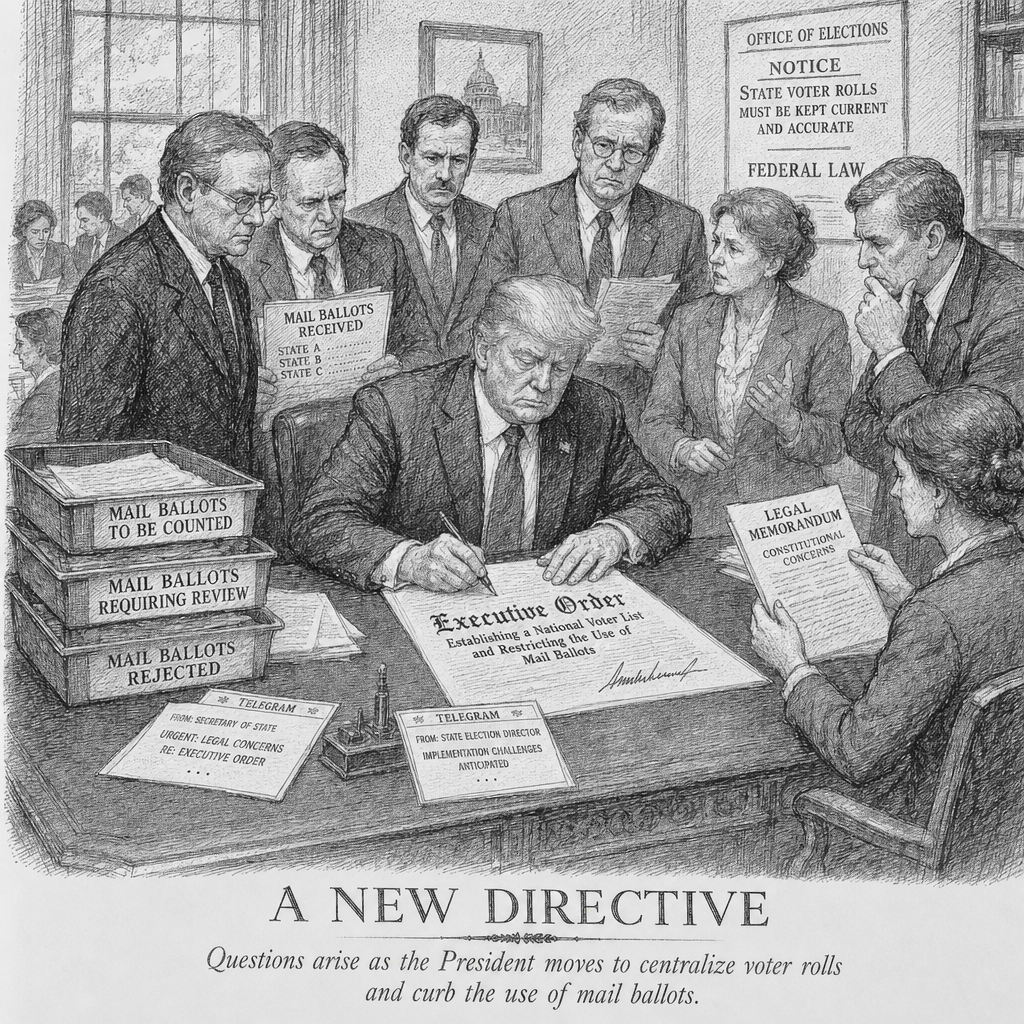
President Donald Trump signed an executive order on Tuesday directing the creation of a nationwide list of verified eligible voters and seeking to restrict mail-in voting, a move that state officials quickly said would be met with lawsuits ahead of this year’s midterm elections.
The order directs the Department of Homeland Security to work with the Social Security Administration to compile the list of eligible voters in each state, and it calls for the restriction of absentee-ballot sending by the U.S. Postal Service to people not on each state’s approved list. The order also calls for ballots to use secure envelopes with unique barcodes for tracking, and it includes the possibility of withholding federal funding from states and localities that do not comply, according to the Associated Press report.
Trump publicly defended the steps as a response to allegations that mail voting is vulnerable to fraud. As he signed the order, he repeated his claims about mail-in voting and said, “The cheating on mail-in voting is legendary. It’s horrible what’s going on,” adding, “I think this will help a lot with elections.”
The reaction from Democratic state election officials was swift, with leaders in at least two states that rely heavily on mail ballots saying they planned to sue. Arizona Secretary of State Adrian Fontes said in a statement to the Associated Press that the state would challenge the order, arguing that Arizona’s vote-by-mail system was designed by Republicans and is used by 80% of voters.
Fontes said, “It is just wrongheaded for a president of the United States to pretend like he can pick his own voters,” adding, “That’s just not how America works.” Nevada Secretary of State Francisco Aguilar said Trump’s order would cripple local election officials and silence voters who count on mail ballots, and he said it “doesn’t benefit anybody in this country except himself,” according to the report.
Maine Secretary of State Shenna Bellows also said her state would not comply, telling the Associated Press that the order was “laughably unconstitutional.” Bellows said more than a quarter of Maine voters cast mail-in ballots in the 2024 election.
Legal experts raised additional concerns about how the executive order would operate, including whether the president could limit what the Postal Service delivers. David Becker, a former Justice Department lawyer who leads the Center for Election Innovation and Research, said the Postal Service is governed by a board of governors and that the president has no power to tell the agency what mail it can and cannot deliver.
A spokesperson for the U.S. Postal Service said the agency would review the order. The Associated Press report also noted that Trump has proposed folding the Postal Service into the Commerce Department, and that Commerce Secretary nominee Howard Lutnick was present for the signing ceremony.
The executive order fits within a broader pattern of Trump administration efforts to alter election administration and tighten verification systems, critics say. The Associated Press report said Trump’s March 2025 election executive order sought sweeping changes, including adding documentary proof-of-citizenship requirements to the federal voter registration form and requiring mailed ballots to be received at election offices by Election Day; it said those changes have been blocked through legal challenges.
The report also cited concerns around the government’s voter-verification system known as SAVE, which the Department of Homeland Security uses to verify citizenship and immigration status. It said the system has faced scrutiny for producing flawed results tied to unreliable data and for privacy concerns, including criticism that states can conduct bulk searches using Social Security numbers.
For example, the Associated Press report said the Brennan Center for Justice pointed to privacy and error-risk concerns, and it noted that the administration has overhauled SAVE, but that it still faces legal challenges alleging it can lead to mistakes affecting eligible voters. The report also said at least one Republican election official defended SAVE while downplaying widespread voter fraud, and that Robert Sinners, a spokesperson for Georgia Secretary of State Brad Raffensperger, said their recommendations have strengthened voter verification and that “the small number flagged as potential non-citizens cannot vote by mail or in person until they provide proof of citizenship.”
The Associated Press report further said Trump is a vocal critic of mail voting and has pushed for a far-reaching elections bill. It cited a 2025 report by the Brookings Institution that found mail-voting fraud occurred in only 0.000043% of total mail ballots cast—about four cases per 10 million—and noted that Trump has used mail ballots himself, including in local Florida elections last week.