Body
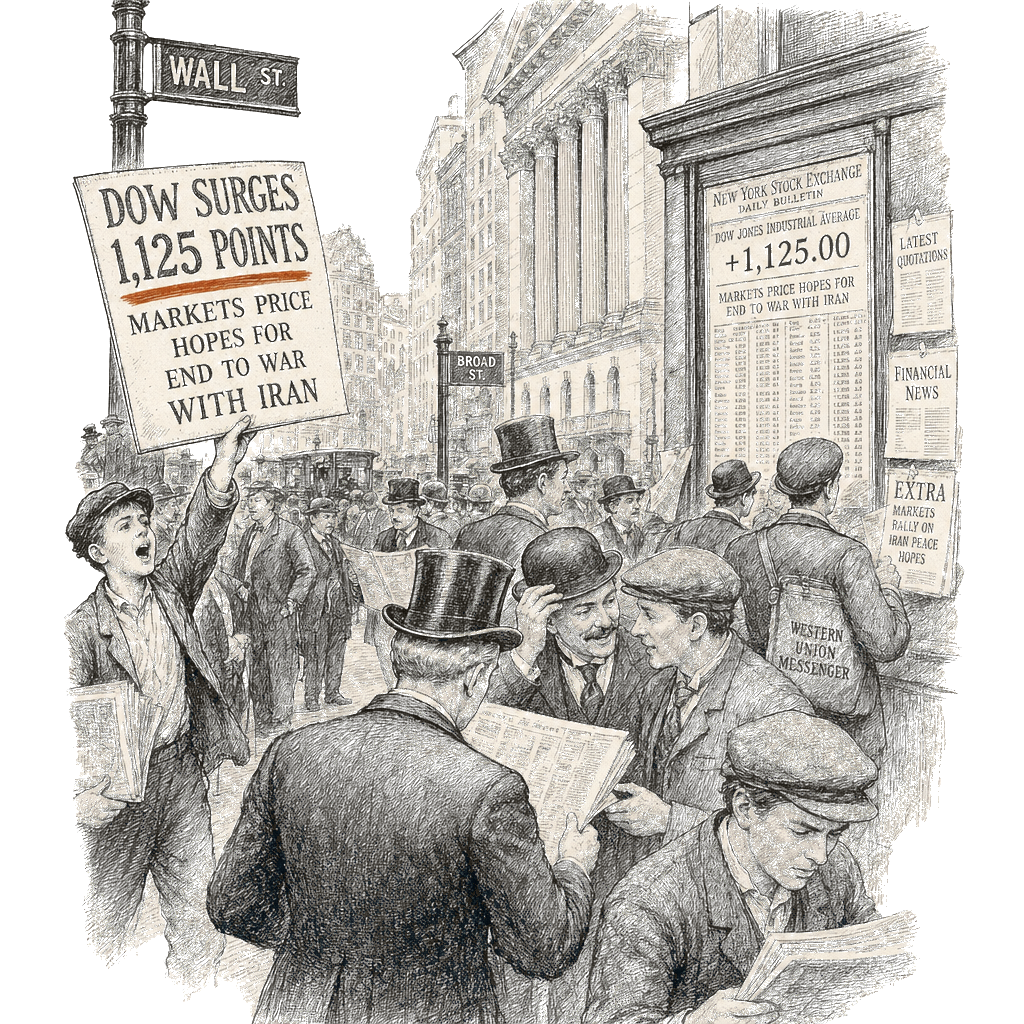
U.S. stocks surged Tuesday to what the Dow called its best day since last spring, with the Dow Jones Industrial Average climbing 1,125 points as investors shifted from doubt to hope about a possible end to the war with Iran. The rebound lifted the S&P 500 2.9%—its biggest gain since May—while the Nasdaq composite rose 3.8%, turning a prior selloff tied to war anxiety into a sharp reversal.
The session’s turn relied on what markets took as early signs for negotiations. The Associated Press reported that Wall Street’s mood improved overnight after a report said President Donald Trump told aides he was willing to end the U.S. military campaign against Iran even if the Strait of Hormuz remained largely closed. The Strait of Hormuz connects the Persian Gulf to the open ocean, and the report cited that a fifth of the world’s oil sails through it on a typical day.
Oil prices then reversed course during the day, adding to the volatility. In midday trading, Brent and U.S. crude prices moved sharply lower after a Middle East report quoted Iranian President Masoud Pezeshkian as saying Iran has “the necessary will to end the war” as long as certain requirements are met, including “guarantees to prevent a recurrence of aggression.” The conflicting signals fed investors’ rapid reassessment of how long the war might continue and whether energy disruptions could ease.
The war-related risk has been a central driver of inflation fears, according to the Associated Press. The report said Wall Street’s worry has been that the conflict could last a long time and keep oil and natural gas out of global markets, which could trigger a “brutal blast of inflation.” It also noted that markets were factoring in the possibility that even sharp oil moves could reverse quickly if tankers cannot pass through the Strait of Hormuz easily, referencing Iran’s attack on a fully loaded Kuwaiti oil tanker in the Persian Gulf in the latest fighting in the region.
After the intraday drop, Brent crude settled $103.97 a barrel, easing 3.2%, while U.S. benchmark crude settled $101.38, down 1.5%. The Associated Press report linked the easing in oil prices to a cooling pressure in the pricing outlook, pointing to data that showed Europe’s inflation accelerated to 2.5% in March from 1.9% in February and to U.S. gasoline averaging over $4 a gallon for the first time since 2022.
The boost in equities also reflected changes in the bond market and additional economic reports. The Associated Press said the 10-year Treasury yield fell to 4.31% from 4.35% late Monday, after closing near 4.44% at the end of last week. Lower yields can pull down rates for mortgages and other loans, and the report noted that traders had previously scaled back expectations for Federal Reserve rate cuts earlier after worries about high oil prices.
Several market-moving reports came during the day, the Associated Press said. One report cited consumer confidence unexpectedly improving, and another said U.S. employers advertised more job openings at the end of February than economists expected, though fewer than in the prior month.
In sectors tied to energy and consumer demand, some stocks swung higher. United Airlines rose 8.1% and Norwegian Cruise Line Holding rose 5.9%, while the Associated Press attributed part of the support to oil prices easing—an effect that can reduce fuel costs for companies with large fuel bills. The report also said the S&P 500 closed Tuesday with its worst loss for a quarter since the summer of 2022, but that Tuesday’s move helped offset losses.
Technology led the broader rally, with the Associated Press saying four out of every five S&P 500 stocks rose. It singled out Marvell Technology’s gain of 12.8% after Nvidia invested $2 billion in Marvell and announced a partnership, while Nvidia rose 5.6% and was described as the single strongest force lifting the index. It also said Centessa Pharmaceuticals rose 44% after Eli Lilly said it was buying the company, with Lilly paying up to $7.8 billion under certain conditions.
Across commodities and individual companies, the Associated Press report also cited deal activity and offsets elsewhere in the index. It said McCormick fell 6.1%, even as the spice company agreed to buy most of Unilever’s food business for cash and stock valued at $44.8 billion. Overall, the Associated Press reported that the S&P 500 added 184.80 points to close at 6,528.52, the Dow rose 1,125.37 to 46,341.51, and the Nasdaq composite climbed 795.99 to 21,590.63.
The Associated Press further reported that indexes rose abroad, citing a tougher finish in Asia. It said South Korea’s Kospi fell 4.3% and Japan’s Nikkei 225 lost 1.6% for two of the bigger moves, while Europe’s markets rose following that backdrop.