Body
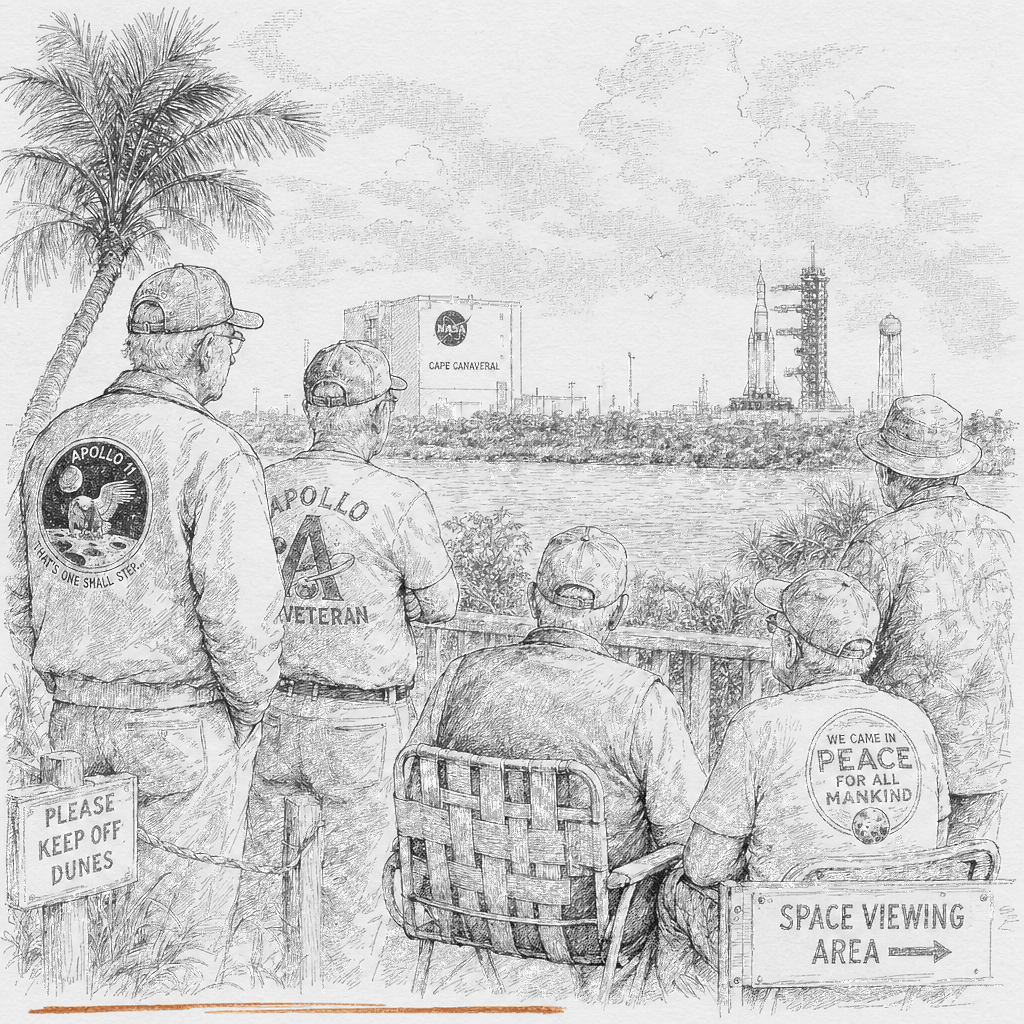
CAPE CANAVERAL, Fla. — Apollo workforce veterans now in their 80s and 90s say they are thrilled that NASA is going back to the moon, but many also wish the effort had started sooner while more of the people who built Apollo were still alive. With so few remaining from the original Apollo workforce of about 400,000, the veterans said there is no reunion planned for the April 1 Artemis II flight around the moon, with four astronauts; people living near Florida’s Kennedy Space Center plan to watch the launch from home.
Charlie Mars, 90, described a difference between the original Apollo era and what he sees now, saying, “Because it was the first time, there was an energy. There was a passion that probably is not exactly the same today and hasn’t been for a while.” Mars worked on Apollo’s command and lunar modules and helped establish the American Space Museum in nearby Titusville.
Another retired engineer, JoAnn Morgan, said she is frustrated with NASA’s pace and with decisions that affected the timeline after Apollo ended. Morgan said the last three Apollo moon landings were canceled under President Richard Nixon because of budget cuts, risk concerns and shifting priorities, and she described her own urgency to live long enough to see a return to the surface, saying, “I’m just trying to stay alive so I can see us actually get back and step foot on the moon.” Morgan, who said she is 85, added, “I’m 85 and still feeling cheated after 53 years.”
Morgan’s disappointment is part of a broader concern among former Apollo workers about Artemis moving too slowly, and Mars pointed to what he would do if he had authority. “It’s a good thing I’m not in charge,” Mars said, “because I would be out there beating the bushes and whipping up on people to get moving.” In contrast to those frustrations, the veterans also noted that women are taking visible roles in the current Artemis effort.
NASA’s Artemis launch director is Charlie Blackwell-Thompson, and the Artemis II crew includes Christina Koch, who holds the record for the longest single spaceflight by a woman, 328 consecutive days in orbit. Morgan said she hopes Artemis will deliver milestones that Apollo did not, saying, “It will be even greater when they actually have a woman who plants her boots on the moon.” Apollo 16 moonwalker Charlie Duke added historical context, saying half the world’s population was not yet born when he walked on the moon in 1972.
The veterans also focused on new NASA leadership and on changes Isaacman has made to the Artemis schedule and preparation. NASA’s new administrator Jared Isaacman, 43, is one of those younger relative newcomers, and the veterans said they are encouraged that he is trying to speed up Artemis launch cadence. They said Artemis has been flying about once every three years, a pace Isaacman has deemed unacceptable, and they pointed to Isaacman adding an extra Earth-orbit test flight to practice docking with lunar landers before astronauts use the technique on the way to the moon.
Isaacman also released a blueprint for a moon base that, along with a “battalion” of lunar drones and rovers, is expected to cost $20 billion over the next seven years, according to the report. Carlos Garcia-Galan, a NASA official described as the agency’s “moon base guy,” said the effort is designed to build excitement with “cool cameras” on what is happening around the base.
In the near term, the overriding goal is to beat China to the lunar surface, with NASA aiming to land astronauts in 2028 and China targeting 2030, the veterans said. The group noted that the U.S. beat the Soviet space program in the first race to the moon, landing 12 astronauts from 1969 through 1972, and they said the newer timeline reflects that competition. John Tribe, 90, who managed spacecraft propulsion for Apollo, said NASA’s revised plan appears more sensible, saying, “The other approach was ridiculous.”
Rusty Schweickart, an Apollo 9 astronaut, said he also likes the refashioned Artemis approach but questioned whether the public can match the original era’s excitement in real time. “We can all recall Columbus,” Schweickart said in an email, but he added that it is harder to remember what came next: “who came along 50 years afterward?” Duke said he expects the thrill of Apollo will return once Artemis astronauts start landing, particularly for younger people who missed out, and he said, “If the first ones are successful and we start landing at the south pole, I think millions are going to be watching that.”