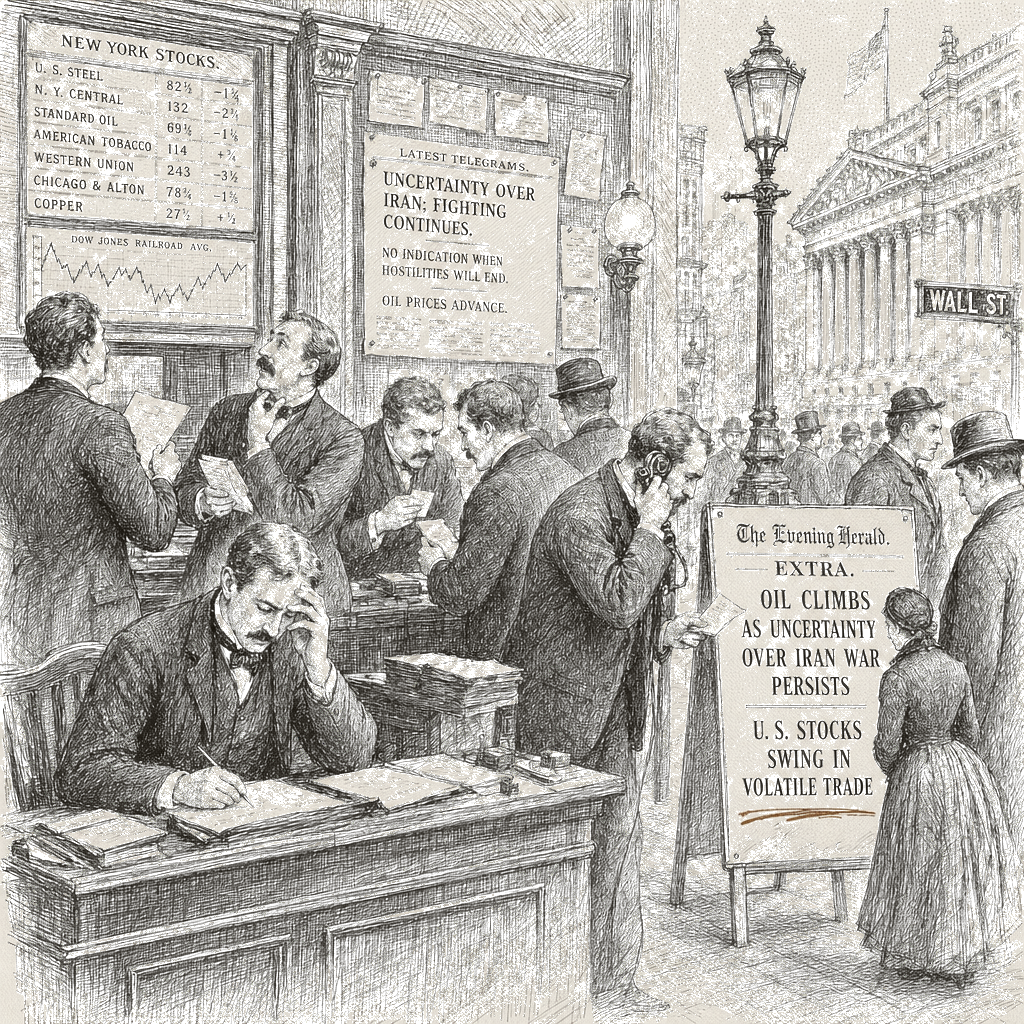
U.S. stocks swung Monday as investors looked to oil prices for clues about how the war with Iran might affect energy supplies and inflation. Trading followed another shaky pattern for markets, with the S&P 500 slipping 0.4% and deepening its loss since the war began. The Dow rose modestly, while the Nasdaq fell as caution spread across financial markets, even as some indexes rose in Europe.
The day’s moves reflected uncertainty over “when the war with Iran could end,” a question that market participants linked directly to expectations for oil and natural gas flows from the Persian Gulf. The cluster of weekend developments included an entry into the fighting by Houthi rebels in Yemen, but investors said the main issues still lacked clarity—when energy flows could resume and whether that timing would be fast enough to prevent a burst of inflation.
Early in the session, the S&P 500 briefly gained 0.9% before giving up most of that increase and moving lower through the rest of the day. By the end of trading, the index fell 25.13 points to 6,343.72. The Dow Jones Industrial Average added 49.50 points, or 0.1%, to close at 45,216.14, and the Nasdaq composite sank 153.72 points, or 0.7%, to finish at 20,794.64.
Oil continued to move higher as well. Benchmark U.S. crude rose 3.3% to settle at $102.88 a barrel, extending the upward pressure that had been building through the weekend’s fast-moving developments and the uncertainty that followed. In stock markets abroad, the FTSE 100 in London climbed 1.6% and the CAC 40 in Paris rose 0.9%, while some Asian markets fell—Seoul’s Kospi dropped 3%, Tokyo’s Nikkei 225 fell 2.8% and Hong Kong’s Hang Seng slid 0.8%.
The latest shift in market expectations came shortly before the U.S. market opened, after President Donald Trump posted remarks on his social media network about “great progress” and “A NEW, AND MORE REASONABLE, REGIME” to end U.S. military operations in Iran. The same post also raised the stakes by threatening that if a deal was not reached shortly and if the Strait of Hormuz was not opened immediately, he would consider “blowing up and completely obliterating” Iranian power plants. Traders have been reacting to that mixture of optimism and threat as it has moved between the two extremes.
The day-to-day market swings matched what the AP described as last week’s pattern: Trump would signal progress in talks, then doubts would rise quickly afterward about whether the war could end soon. Some investors said they were giving the remarks less weight than before, but they also pointed to valuations that had changed since the start of the conflict and argued that share prices had become cheaper than earlier in the war.
The S&P 500 finished last week 8.7% below its all-time high, which was set in January, and the Dow and Nasdaq were both more than 10% below their records—moves that professional investors described as a “correction.” Morgan Stanley strategists led by Michael Wilson pointed to “growing evidence the S&P 500 correction is getting closer to its ending stages,” while also tying that view to expectations about company profit growth over the coming year. By one measure included in the report, the S&P 500 looked roughly 17% cheaper than before the war.
Still, traders said the Federal Reserve could complicate that outlook if oil prices remain elevated long enough to keep inflation pressure high. Raising interest rates could help curb inflation, but it could also slow economic activity and weigh on a wide range of investments. Treasury yields, which investors had been pushing higher since the war began, eased somewhat Monday: the 10-year Treasury yield fell to 4.35% from 4.44% late Friday. Even with that decline, it remained far above 3.97%—a level the report cited as before the war.
Company-specific moves also fed into the day’s trading. Sysco fell 15.3% after saying it was buying Jetro Restaurant Depot for $21.6 billion in cash and enough Sysco shares to value the company at about $29.1 billion. Alcoa rose 8.2% on speculation it could get more business after attacks damaged rival aluminum facilities in the Middle East over the weekend.