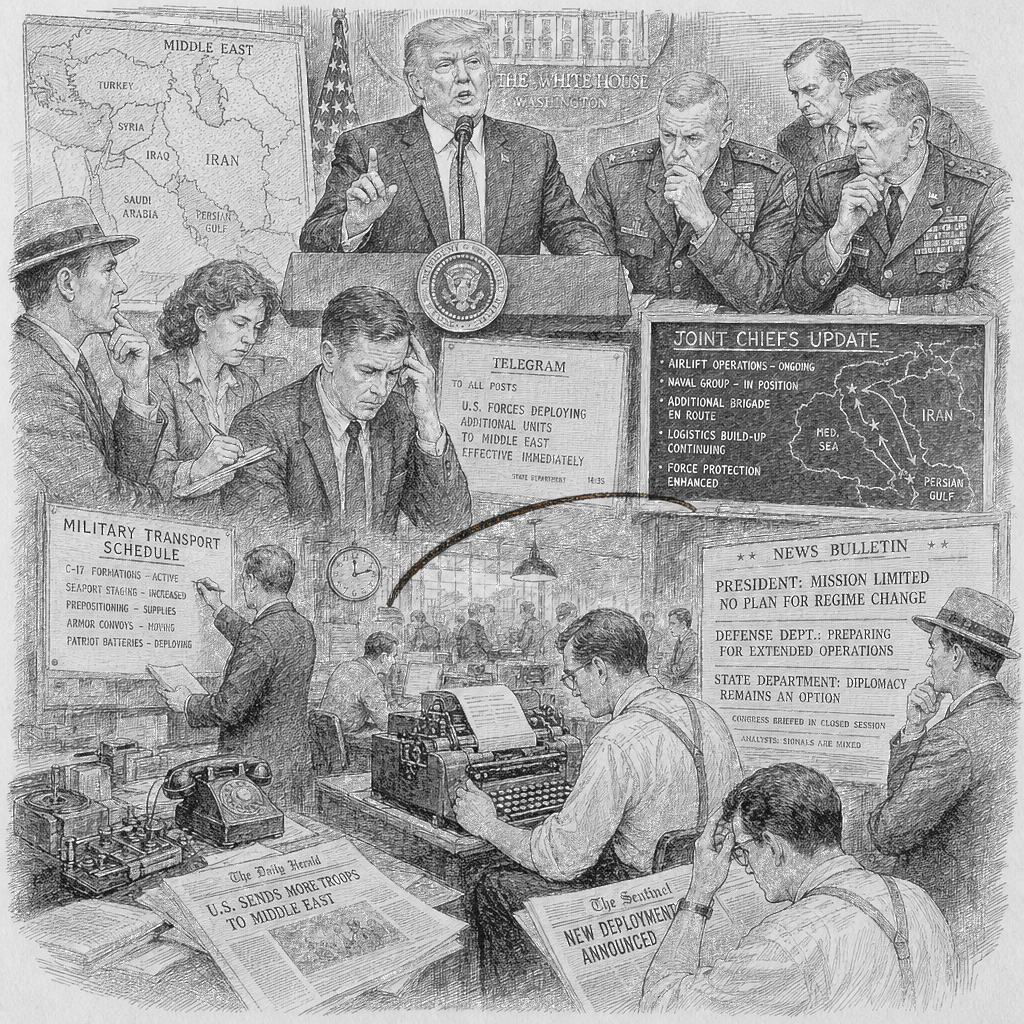
The controversy centers on the contrast between Trump’s public claims of progress and the simultaneous conduct and uncertainty that lawmakers and security officials see on the ground. As the Iran war entered its second month, the Associated Press reported that Trump said the U.S. was “winning” even as thousands more American troops deployed to the region, a juxtaposition that critics said makes it harder for audiences to understand what is actually happening.
The AP also described multiple shifts in Trump’s messaging toward allies and key diplomatic conditions. The report said Trump pilloried other countries for not helping the U.S. before later saying he does not need their assistance. It further said Trump delayed deadlines for Iran to reopen the Strait of Hormuz twice, at the same time that he threatened to “obliterate” Iran’s energy plants if the strait remained largely shuttered and told audiences the U.S. was “not affected” by the closure.
The report said Trump’s rhetoric this month also included claims that appeared to draw quick denials from prominent former leaders. It reported that at one point, Trump said a predecessor — whom he suggested was a Democrat — privately told him the predecessor wished they had taken similar action against Iran. Representatives for every living former president denied that such a conversation happened.
Former officials and outside advisers questioned whether the president’s style is becoming a liability in wartime. Leon Panetta, who served under Democratic presidents as defense secretary, CIA director and White House chief of staff, said he has “seen enough wars where truth becomes the first casualty.” Panetta added, “It’s not the first administration that has not told the truth about war,” but said Trump makes it “kind of a very standard approach to almost any question to in one way or another kind of lie about what’s really happening and basically describe everything as fine and that we’re winning the war.”
Michael G. Rubin, a historian at the American Enterprise Institute who worked on Iran and Iraq at the Pentagon from 2002 to 2004, also criticized the messaging pattern. Rubin said Trump is “the first president of any party in recent history that hasn’t self-constrained to live within rhetorical boundaries,” and said, “So of course it creates a great deal of confusion.” Both commentators framed the issue as less about rhetoric for its own sake and more about the consequences of inaccurate or shifting narratives when military decisions are already difficult for the public to monitor.
For critics on Capitol Hill, the inconsistency is not just a communication problem but a question of whether Congress can evaluate the administration’s war strategy. The AP reported that Rep. Gregory Meeks, the top Democrat on the House Foreign Affairs Committee, lamented that Trump is “going back and forth and constantly contradicting himself,” and said, “The administration is winging it,” arguing that lawmakers cannot know what to trust. The report said Republicans did not dismiss the concern in the same way, but some acknowledged their constituents remain worried about practical risks and costs.
The AP described lawmakers’ differing reactions to Trump’s approach. Sen. John Kennedy of Louisiana said his constituents “support what the president has done,” while also citing concern about costs of living. Republican Rep. Chip Roy of Texas, who sits on the House Budget Committee, said his constituents were on board with “blowing some crap up,” but said he was concerned about the prospect of ground troops and argued that briefings for lawmakers have not provided enough details beyond what he said members could “read in the papers.”
Polling cited by the AP suggested the political calculus could become harder if the war deepens. A poll from the Associated Press-NORC Center for Public Affairs Research found 63% of Republicans back airstrikes against Iranian military targets but only 20% back deploying American ground troops, the report said. The AP said this reflects the challenge of sustaining congressional support if the conflict becomes prolonged or escalates, at a time when Republicans face political pressure with majorities in Congress at risk ahead of November elections.
The AP also reported that the administration would likely need congressional support for an additional $200 billion for the war effort. It said Trump described the money as “nice to have” while also saying the war was “winding down,” and quoted White House spokesperson Anna Kelly as saying Trump was “right to highlight the vast success of Operation Epic Fury.” Kelly said, “Iran desperately wants to make a deal because of how badly they are being decimated,” adding that the president “reserves all options, military or not, at all times.”
Even some supporters of Trump’s overall direction suggested the president’s evolving rhetoric might still serve a strategic function, even if critics see it as chaos. Rubin told the AP that there could be “logic” behind Trump’s shifting approach, saying the president’s early comments about ongoing negotiations — which Iran denied — could “spread suspicion and fear within the regime circles.” Rubin said, “Perhaps Donald Trump or those advising him simply want the Iranians to grow so paranoid they refuse to cooperate with each other or perhaps they even turn on each other,” but warned, “But then again, there’s always a danger with Donald Trump of assuming that his rhetoric is anything more than shooting from the hip.”
On the Democratic side, the AP said Rep. Adam Smith, the top Democrat on the House Armed Services Committee, said Trump is not on a path to fully achieve objectives such as complete elimination of Iran’s nuclear program “in the current trajectory.” Smith said the president could instead rely on rhetorical skill to declare the U.S. won and end the war, telling the AP, “As I’ve jokingly said, nobody I have ever met or heard of in human history is better at exaggerating his own accomplishments than Donald Trump,” before adding, “So go knock yourself out and claim this was some great success.”