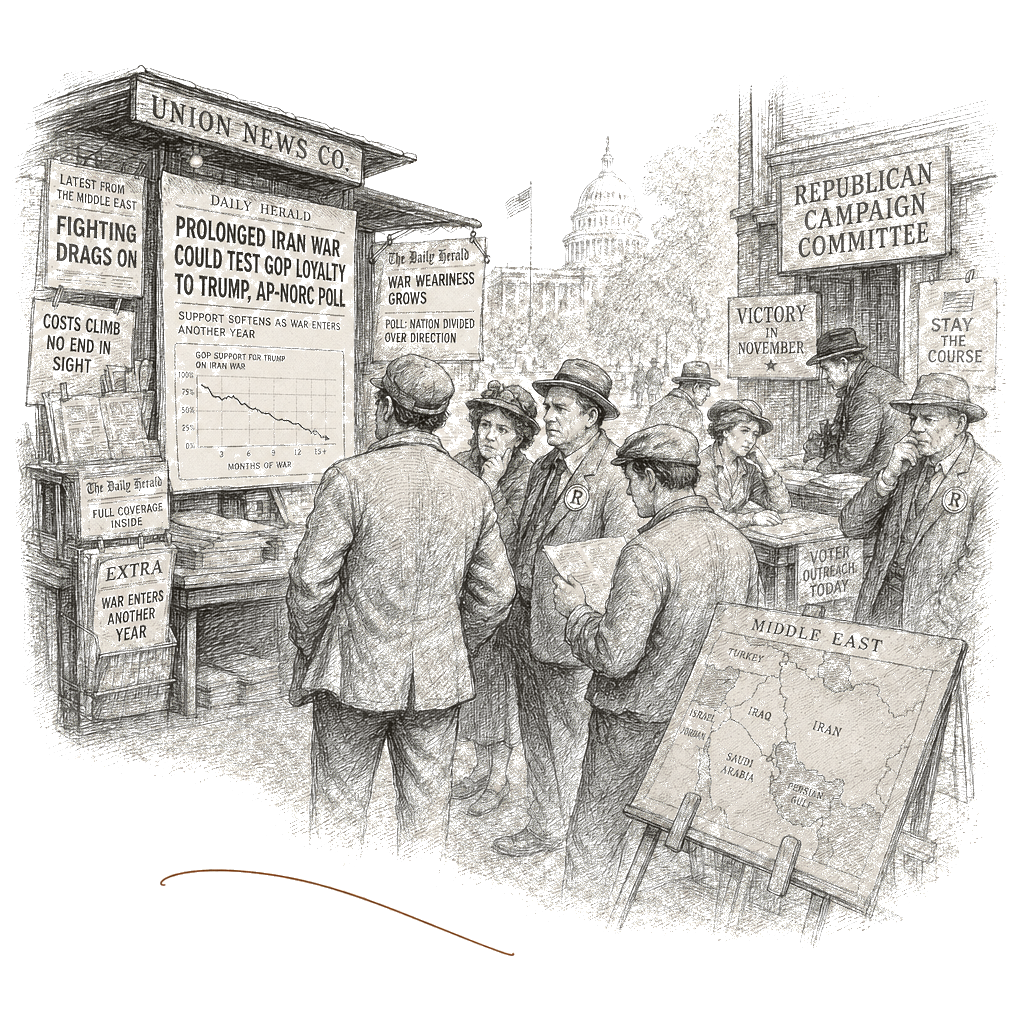
Prolonged Iran war could test GOP loyalty to Trump, AP-NORC poll
A prolonged U.S. conflict in Iran could strain support among Republicans for President Donald Trump, even as many in the party continue to approve of how he is handling the war and Iran-related policy, according to a new AP-NORC Center for Public Affairs Research poll. Respondents who backed Trump broadly also signaled that the longer the fight lasts—and the more it expands—could collide with issues that matter to them at home, including the cost of gasoline and the scope of U.S. military involvement.
The poll found Republicans’ approval levels remain high. About three-quarters of Republicans approve of Trump’s handling of the presidency, and roughly 70% approve of how he’s handling Iran. The figures are in line with Republicans’ support for Trump’s foreign policy generally and his approach to Cuba, where he has recently ratcheted up pressure on the island’s leadership.
Several Republicans interviewed in the report described support for Trump that can coexist with unease about the war’s direction. Donnie Beson, 68, of Woodland Park, Colorado, said he felt Trump was not focusing enough on the domestic issues that helped elect him. “Come on, Trump. Worry about us,” Beson said. “We’re in a billion-dollar-a-day war,” he added, describing it as a situation in which Trump had “forgot about the other stuff.”
At the same time, the report notes that many Republicans still support the core U.S. aims being pursued against Iran. The poll found that 81% of Republicans said it is extremely or very important for the United States to prevent Iran from obtaining a nuclear weapon. That emphasis tracks with one of the goals Trump has articulated since the war began.
But the survey also found limits on how far Republicans want the United States to go. Although 63% of Republicans back airstrikes against Iranian military targets, only about 20% back deploying American ground troops. Other efforts to increase U.S. involvement drew more resistance or uncertainty: about one-third of Republicans said they don’t have an opinion, while about half oppose deploying ground troops to fight Iran.
Trust in Trump remains a stabilizing factor within the party. The report said many Republicans have “a great deal” or “quite a bit” of trust in Trump to make the right decisions on foreign issues, including the use of military force outside the United States. Roughly half of Republicans said they have a high level of trust in him on the use of military force outside the U.S., and similar shares said they have a high level of trust regarding his dealings with adversaries and allies.
That trust, however, does not translate into unqualified support for every aspect of the war. Sharon Fuller, 68, a retired hospital analyst in Ocklawaha, Florida, said she approved of Trump’s handling of the job and of the war in Iran, but she expressed reservations. “I don’t really agree with the war, but on the other hand, I think it’s a necessity at this point,” Fuller said. Another Republican, Stephen Hauss, 40, of Camden, Delaware, described himself as libertarian-leaning and said he voted for Trump in 2024, but that the start of the Iran war changed his view of Trump’s approach.
Before the war, Hauss said, he had given Trump “some benefit of the doubt.” Now, Hauss said he cannot support the U.S. trying to change the leadership of another country. “I don’t think I am on board with this anymore,” he said. That sentiment reflects the poll’s finding that while many Republicans prioritize stopping Iran from obtaining a nuclear weapon, only about half see replacing Iran’s government with leaders more friendly to the United States as a high priority.
The poll also points to economic pressure as a potential fault line. About three-quarters of Republicans said it is extremely or very important for U.S. foreign policy to keep gas prices down, even as many supported military action against Iran. In addition, about 6 in 10 Republicans said they are at least somewhat concerned about being able to afford gas in the next few months, according to the poll, though the level of concern was lower than among the broader public.
The report includes an account of how some Republicans connect the rising costs of oil and gas to their daily finances. It also ties the war’s costs to broader anxiety among Americans about affording essentials. Thomas Sweeney, 76, a retired chemical engineer from Frisco, Texas, said he can’t get behind the war and that it has brought down his overall view of the president. “I’m not happy. I am frustrated,” Sweeney said. “Soldiers are very, very precious. You just don’t go in there and waste lives.”
Republicans’ concern about gas prices could become more politically significant if the conflict continues to push energy costs higher. Fuller said she would not vote for Democrats, but she told Trump to address lower costs for working people and retirees on fixed incomes. “I’d like him to see what he can do to get prices down for, quote, the working people and myself now living on a fixed income,” she said.
The AP-NORC poll included 1,150 adults and was conducted March 19-23 using a sample drawn from NORC’s probability-based AmeriSpeak Panel, which is designed to be representative of the U.S. population. The margin of sampling error for adults overall was plus or minus 4 percentage points, and for Republicans it was plus or minus 6.7 percentage points.