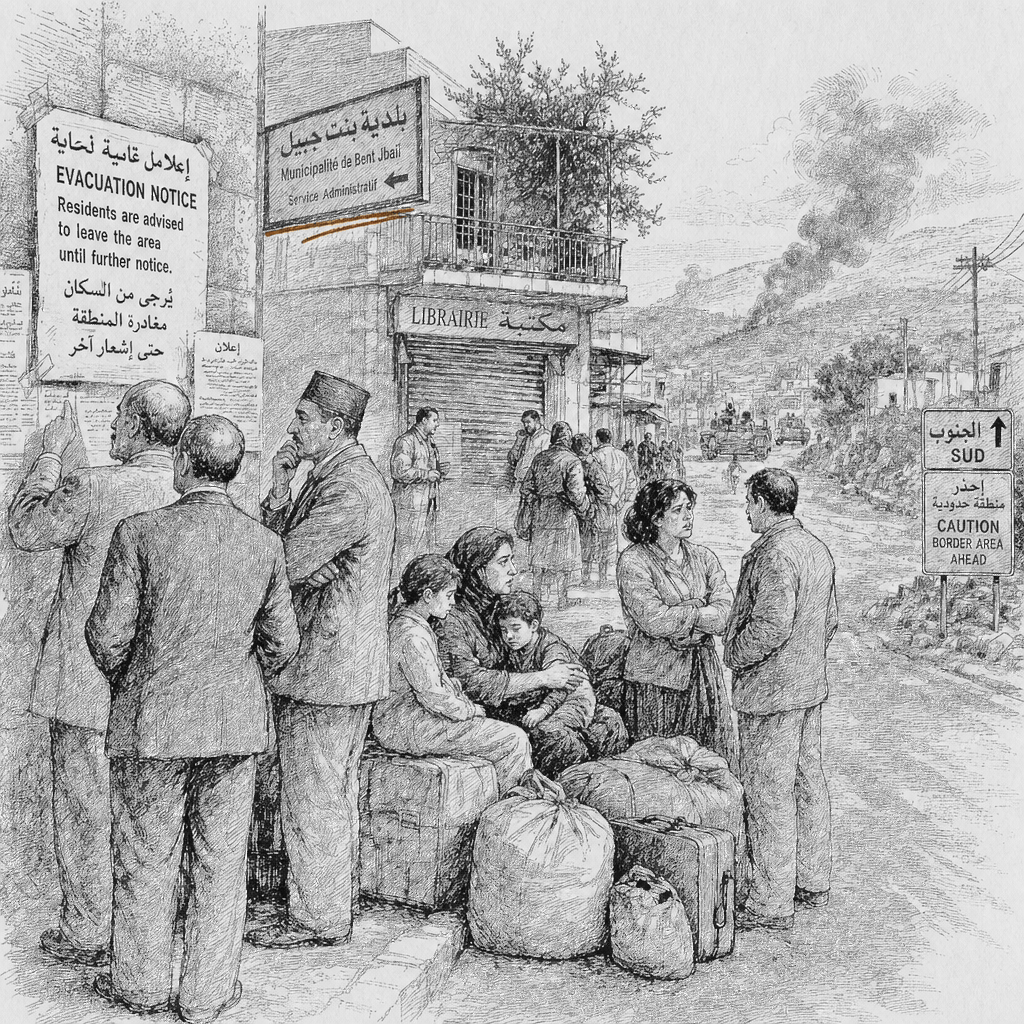
As Israeli tanks and aircraft intensified strikes alongside a stepped-up ground push in Lebanon, many Lebanese residents and officials feared the conflict is moving from a cross-border fight toward something closer to long-term control. The worry has sharpened as Israeli leaders have signaled that they want a controlled corridor in the depopulated south—an approach they have compared to Gaza after Oct. 7, 2023—while Israel’s military urged mass evacuation over a wide area.
On Thursday, Israel’s military said it had sent a third division across the border into Lebanon, deepening the ground presence during its exchanges with Hezbollah. Israel has also called for civilians to evacuate large parts of the south, extending from the border to the Zahrani River, about 55 kilometers (34 miles) away, as air raids hit areas beyond the immediate frontier.
Israel Katz, the defense minister, said this week that Israel would create a “security zone” up to the Litani River, roughly 30 kilometers (20 miles) from the border in some places, and he said troops would destroy homes he claimed were being used by militants. In the same line of argument, Katz said residents would not return until northern Israel is safe, and he described the campaign as mirroring Israel’s Gaza operation, where forces flattened and largely depopulated parts of the eastern territory. He later said, “We have ordered an acceleration in the destruction of Lebanese homes in contact-line villages to neutralize threats to Israeli communities, in accordance with the model of Beit Hanoun and Rafah in Gaza,” referring to border towns that were largely obliterated.
Lebanon’s leadership and many residents have interpreted those remarks as signaling an open-ended occupation rather than a temporary security operation. Joseph Aoun, Lebanon’s president, accused Israel after its attacks on infrastructure—particularly bridges over the Litani—of trying to isolate the south “to establish a buffer zone, entrench the reality of occupation, and pursue Israeli expansion within Lebanese territories.” Israel has said it bombed the bridges because Hezbollah was using them to move fighters and weapons and that its military would control the remaining crossings.
The fighting has also threatened to cut the south off from Lebanon’s other regions as heavy battles erupted in Khiam, where the fall of the town would disrupt access to the eastern Bekaa Valley, an area with a significant Hezbollah presence. U.N. peacekeepers said the bridge bombings and ongoing clashes have disrupted their work. Kandice Ardel, a spokesperson for UNIFIL, said, “This is the closest fighting activity we have seen to our positions,” adding that “Bullets, fragments, and shrapnel have hit buildings and open areas inside our headquarters.” Ardel said peacekeepers had seen a growing presence of Israeli troops and “engineering assets,” though she said they had not seen new military positions built.
Analysts in Beirut said Israel has already established varying layers of control around the frontier. Mohanad Hage Ali, a senior fellow at the Carnegie Middle East think tank in Beirut, described a framework in which the closest strip is effectively a “no-man zone,” which he called “basically a large parking lot that is facing Israel.” Hage Ali said movement is restricted farther north, including during last year’s olive harvest when farmers struggled to reach their groves because of Israeli strikes and had to be accompanied by Lebanese troops and UNIFIL peacekeepers who coordinated with Israel.
Sarit Zehavi, founder and president of the Alma Institute and a retired Israeli military officer, said Israel would likely extend control farther north even if it was unlikely to defeat Hezbollah outright. She acknowledged that the risk for Israel was being pulled into maintaining a long-term presence, but she argued that the alternative would also be dangerous, saying, “But the other alternative is to take the risk that we will be slaughtered. It’s as simple as that.”
Beyond the border area, displacement fears are driving the political debate inside Lebanon and shaping how residents describe their prospects. The latest fighting has included blistering air raids across Lebanon, with the Associated Press reporting that more than 1,000 people have been killed—mostly outside the border area—and that more than a million people have been displaced. Lebanon has also broken with a long-standing taboo by proposing direct talks with Israel, while taking steps against Hezbollah since the last war, including criminalizing its activities and saying it has dismantled hundreds of military positions, but both the U.S. and Israel have shown little interest in talks as they focus on the broader war with Iran.
For some displaced families, the debate over territory and occupation has become personal uncertainty. Elias Konsol and neighbors fled the Christian border village of Alma al-Shaab with UNIFIL’s help, and he later was reunited with his mother during funeral services in the Beirut area after a resident was killed in an Israeli strike. Konsol told reporters there were no weapons or Hezbollah fighters in his village, but he said it was forced to evacuate anyway, adding, “We no longer know our fate,” and “We don’t know if we will see our homes and village again.”