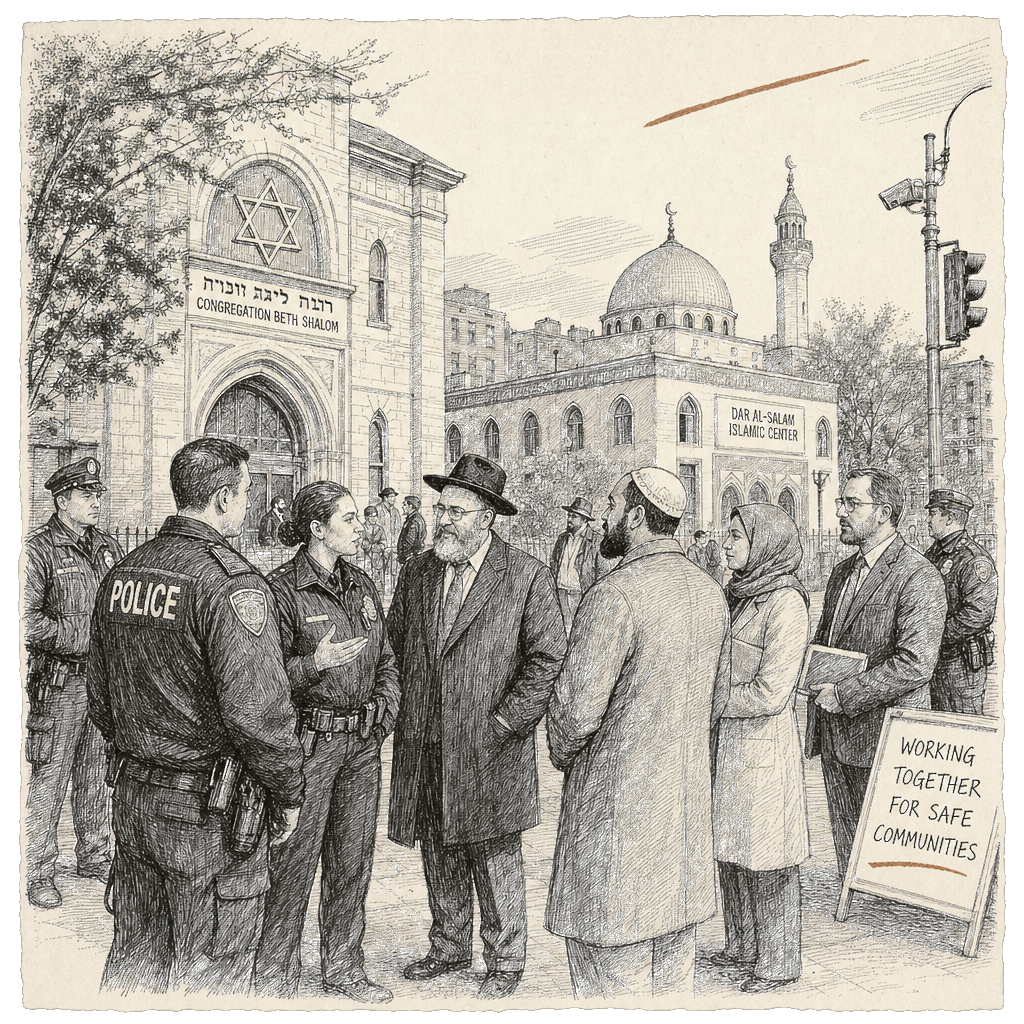
Law enforcement officials said they are taking steps to monitor and counter threats aimed at Jewish and Muslim communities across the United States, pointing to a rise in hateful incidents and to the threat environment after violence and attempts at terror tied to the Middle East war.
The officials discussed the posture during a national security briefing hosted by the Secure Community Network ahead of Passover, as federal and local law enforcement agencies shared assessments of threats to faith communities and strategies for maintaining safety and security at places of worship.
Central to the discussions was an FBI investigation into a March 12 incident in West Bloomfield, Michigan, where a driver drove a vehicle through the doors of Temple Israel, described as the nation’s second-largest congregation in Reform Judaism. Federal officials said the case was part of an ongoing look at extremist activity and potential threats.
Michael Masters, the national director of the Secure Community Network, said during the briefing that the goal of “our enemies” is to scare people into staying home. He said that strong safety and security measures mean Jewish congregations do not need to make decisions to avoid showing up.
The network said it coordinated security for Jewish communities in North America and held the briefing amid global tensions and reports of hateful incidents in multiple countries. The briefing took place as hateful incidents against Jewish people were recently documented in southern California and Toronto, and European officials were investigating car burnings in Antwerp and London as antisemitic attacks, according to the reporting.
Jewish leaders used the briefing to call for sustained government attention and for additional community measures. Gary Torgow, chair of the Jewish Federations of North America and a Michigan business executive, said that while “shocking” the Temple Israel incident was, it had become “no longer a surprise” for the Jewish community, and he warned that hate spreads quickly through misinformation on social media.
Torgow also described recent meetings with senior FBI officials, saying the discussion included federal efforts to combat antisemitic incidents since the Trump administration launched joint strikes with Israel on Iran, a move that officials said sparked retaliatory strikes and a wider regional conflict. Torgow said those conversations included FBI deputy director Andrew Bailey and that he believed the federal response showed “sincere concern” and “active engagement,” and he framed an attack on a synagogue as “an attack on the principle that every American should be able to worship in peace.”
Federal officials said they were monitoring for increased activity from radicalized individuals who may seek to attack places of worship or strike during high-profile upcoming events or religious holidays. Secure Community Network officials said they did not know of any active threats to Jewish communities at present. Matthew Kozma, under secretary for intelligence and analysis at the Department of Homeland Security, linked the security posture to both defense against malicious actors—including those encouraged by or sympathetic to Iran—and vigilance for other attackers as the U.S. prepares to host the 2026 FIFA World Cup and the America 250 celebrations later this year.
Separate officials described how U.S. intelligence efforts focus on people radicalized online. Director of National Intelligence Tulsi Gabbard, testifying earlier in March before the Senate, said intelligence agencies have focused on individuals “either who have been radicalized by Islamist propaganda and may not have ever had contact with ISIS or al-Qaida” but were nonetheless radicalized online while in the U.S.
The briefing also referenced recent incidents officials are investigating as terrorism, including an attempted bombing of anti-Muslim protests in front of the New York mayor’s residence and a deadly shooting at Old Dominion University in Norfolk, Virginia. Eric Fingerhut, president of the Jewish Federations of North America, said the Temple Israel incident showed that even “our most advanced security efforts can be overtaken by world events and by the very determined planning of terrorists,” and he said Jewish communities must increase security levels and work closely with law enforcement while addressing root causes of bigotry and extremism.
Local officials said the reverberations of such attacks can reach beyond houses of worship. Oakland County, Michigan, Sheriff Michael Bouchard said he had received antisemitic death threats himself after responding to the attacks. Bouchard said it was incumbent on everyone to “step up, stand out and do everything we can to protect our communities.”
Experts cited a mix of longstanding and newly intensified drivers behind spikes in antisemitic attacks and other hateful conduct, including heightened international tensions, polarized domestic politics, and the spread of ideas through digital channels. Seth Levi, chief strategy officer at the Southern Poverty Law Center, said the pattern included conspiracy theories and other ideas moving from the fringes into political debate, and he cited social media and the ease of hateful rhetoric reaching a mass audience.
Levi also said the center has monitored rising antisemitic and Islamophobic rhetoric over the last year that intensified after the war in the Middle East began. He described differences in how harassment can be felt, saying that “in person, physical harassment where you live creates a different, more visceral reaction than online activity,” and he said polling reviewed by the Southern Poverty Law Center shows many Americans still strongly disapprove of hateful violence and rhetoric.
Wendy Berger, chair of the Secure Community Network, said the moment underscored the need for greater resolve and closer community. She said that the “vibrancy of Jewish life” depends on local efforts and security, adding that the group has federal, local and state partners but that “security is up to us.”