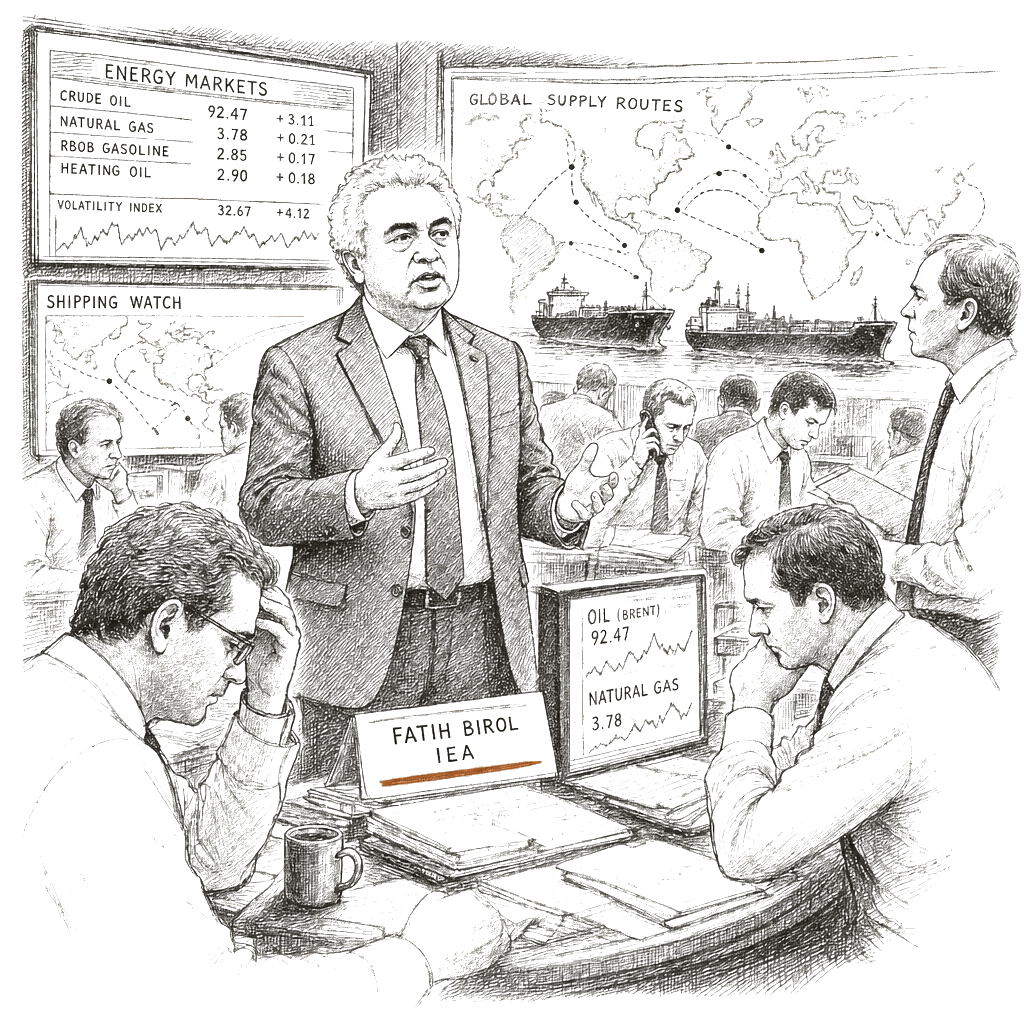
International Energy Agency executive director Fatih Birol told reporters Monday that the Iran war is threatening global economic stability, warning that the conflict is already disrupting energy supply at a scale he compared to past oil and gas shocks. Speaking at Australia’s National Press Club in Canberra, Birol said the global economy faces a “major, major threat” because of the war and cautioned that “No country will be immune to the effects of this crisis if it continues to go in this direction,” according to the Associated Press.
Birol framed the risk as both immediate and systemic. He said the Iran war’s impact on oil has been worse than the two oil shocks of the 1970s combined and that the war’s effect on gas has been worse than the Russia-Ukraine conflict, in part by highlighting how quickly disruptions can spread through energy-linked supply chains.
Israel launched a new wave of attacks early Monday against Tehran, and U.S. President Donald Trump warned the United States will “obliterate” Iran’s power plants if Tehran does not fully open the Strait of Hormuz within 48 hours, the Associated Press reported. The warning prompted Iran to say it would respond to any such strike with attacks on U.S. and Israeli energy and infrastructure assets.
Birol said one of the main dangers was that the war could knock out oil and gas production in the Middle East for a long time, meaning high prices could persist and contribute to inflation worldwide. He described how the U.S. stock market has historically rebounded relatively quickly from past Middle East conflicts when oil prices do not remain elevated for extended periods.
He also provided figures for the historical comparison that he said explained the scale of the current disruption. Birol said the oil crises of 1973 and 1979 “lost together 10 million barrels per day,” and he said that “today” the loss was 11 million barrels per day, which he said was “more than two major oil shocks put together.” On gas, he said that after Russia’s invasion of Ukraine, gas markets—especially in Europe—“lost about 75 billion cubic meters,” and he said that “as of now” the Iran war crisis had caused a loss of about 140 billion cubic meters.
Birol told the press that the IEA had identified damage across the region. He said 40 energy assets in nine countries across the Middle East were “severely or very severely damaged,” and he warned that essential inputs tied to those assets—he cited petrochemical, fertilizers, sulfur, and helium—have had their trade “interrupted,” with “serious consequences for the global economy.”
To stabilize markets, Birol said the IEA earlier released 400 million barrels of oil “in order to comfort the markets,” and he characterized the release as unprecedented in the agency’s history, saying the IEA “have never released so much oil to the markets.” He said the “single most important solution to this problem is opening up the Hormuz Strait as things stand now.”
Birol added that the IEA was consulting governments in Europe, Asia, North America and the Middle East about whether to release further stockpiled oil, saying the agency would “look at the markets” and assess whether doing so is necessary based on conditions.