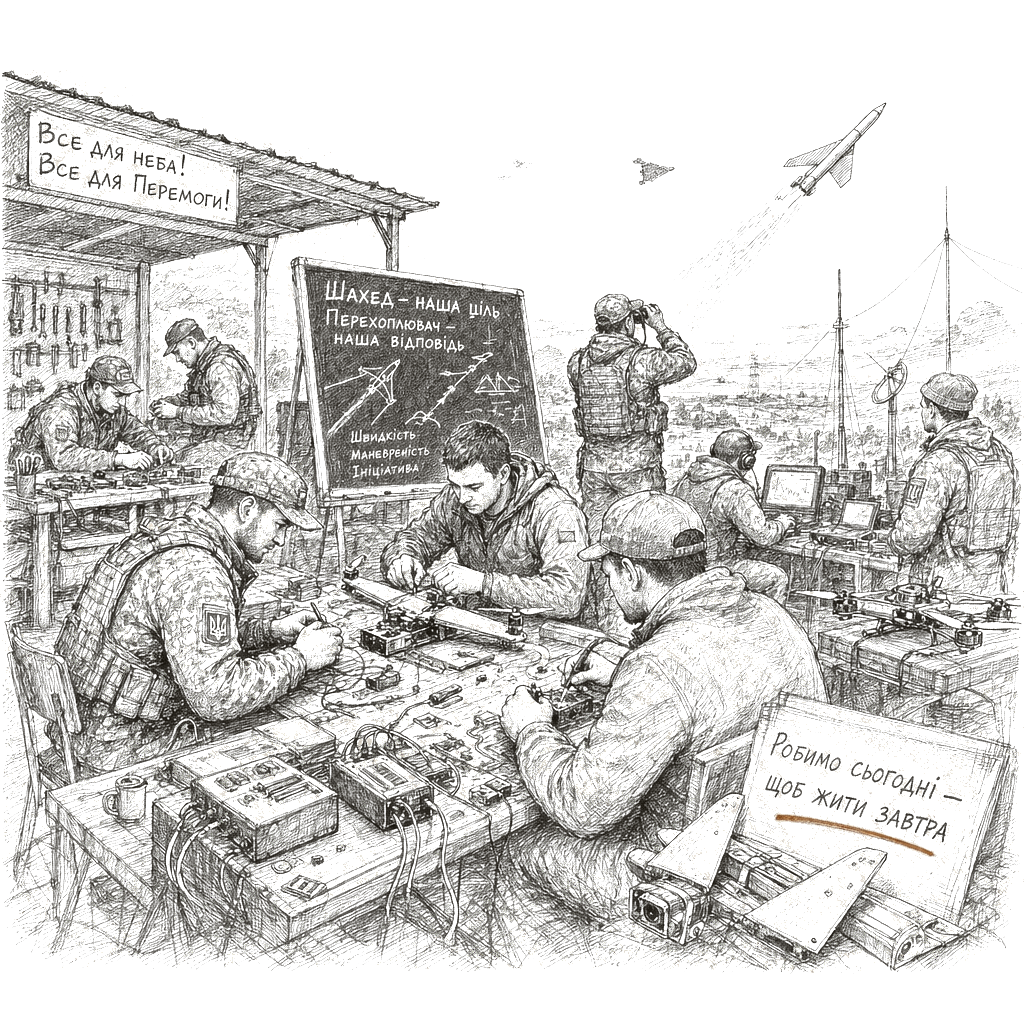
Night air over eastern Ukraine is crisp as soldiers from the 127th Brigade watch for Shahed drones launched by Russia in waves, according to an Associated Press report that describes Ukraine’s front line as a testing ground for counter-drone technology. The crews are not only waiting for attacks; they are also using lulls to test and fine-tune self-made interceptor drones in an effort to find weaknesses before the next incoming threat appears.
The report describes how Ukrainian drone teams learned to adapt as the Shaheds began arriving in autumn 2022, when, the AP story says, Ukraine had few ways to stop them. It adds that interceptor drone crews increasingly intercept the loitering munitions in flight as they revise their systems over time. One pilot from the 127th Brigade, speaking anonymously because military rules did not allow his name to be used, said the change was not a plan made in advance but a response to need—“It’s not like we sat down one day and decided to fight with drones. We did it because we had nothing else.”
The AP account describes how even so-called “disposable” drones can be treated as valuable assets for learning in a resource-constrained environment. It says the crew tries to preserve tools and sometimes reuses single-use drones to study weaknesses and improve future performance. The report also quotes the same pilot explaining the economic tradeoff: “Just imagine — a Patriot missile costs about $2 million, and here you have a small aircraft worth about $2,200,” adding that the smaller interceptor can be recovered and re-sent after fixes if it fails to hit a target.
The brigade’s broader approach centers on interceptor drone crews rather than shoulder-fired air-defense missiles, the report says, describing a model that is increasingly adopted elsewhere in Ukraine. It says the effort is led by a 27-year-old captain who previously helped organize a similar system in another formation and who also spoke on condition of anonymity. The captain recalled being assigned to intercept Russian reconnaissance drones using shoulder-fired air-defense missiles, but said the approach quickly proved ineffective against agile, camera-equipped drones that could maneuver away from slower, less-flexible weapons.
According to the AP, the captain’s search for alternatives led him to a simple answer: another drone. He described an earlier moment when a Russian Orlan reconnaissance drone hung overhead and transmitted coordinates for Russian artillery, and said a pilot from his unit downed it by using another drone. “That’s when I realized — this is a drone war,” he said, adding that the Orlan wreckage burned as it fell; the report says they never found the wreckage.
As Shaheds presented a further challenge—how to intercept hundreds of fast drones flying beyond the front line—the AP report says work expanded beyond the brigade itself to cooperation with a local defense company. It says the two groups produced aircraft-style interceptor drones capable of matching Shahed speeds, and that Kharkiv-based testing also reflects the reality that the city comes under Shahed attack. The report describes Skystriker as differing from more widely known interceptor systems such as Sting or P1-Sun, which it says rely on modified first-person view drones, describing Skystriker instead as a small winged aircraft intended to remain aloft longer.
The AP story also describes how nonprofit and volunteer networks have played an intermediary role between military needs and manufacturers. It says the Come Back Alive Foundation, a nonprofit charity and think tank, launched “Dronopad” in summer 2024, a project the report translates as “Dronefall.” The report says “Dronopad” was built from battlefield reports that FPV pilots sometimes managed to track and intercept aerial targets, and that the project aimed to determine whether that approach could be scaled rather than left as isolated incidents.
In describing the project, the AP quotes Taras Tymochko, who leads “Dronopad,” speaking on the foundation’s effort to turn early successes into a system. He said the goal was “to turn it into a system — to help units that already had their first successful cases build the capability and scale what they had achieved.” The report says the project helped shape evolving interceptor capability and that interceptor drones later reached speeds of more than 200 kilometers per hour, enabling interception of targets like Shaheds in the air, as Tymochko said.
The report says Tymochko framed the pace of innovation as a cycle of action and counteraction, with both sides adapting to improve their own technology and defenses. He said that cycle—“That cycle is what drives the evolution of drone warfare”—reflected the growing drone market and the need for close cooperation so engineers can receive feedback quickly from battlefield tests. The AP also includes quotes from Tymochko about early skepticism around interceptor drones and an eventual shift in outcomes, including his summary that “air defense for the poor” could sometimes outperform air defense aimed at “the rich.”
Ukraine’s drone-defense effort is also attracting international attention, the AP report says, in part because similar drones are used beyond the battlefield in Europe. It says President Volodymyr Zelenskyy told the story’s account that U.S. allies in the Middle East had approached Ukraine for help defending against Iranian drones—drones that Russia has fired by the tens of thousands in the war, the AP report says. The report further says Iran has used similar drones in retaliation for joint U.S.-Israeli strikes, at times overwhelming more sophisticated air defenses and underscoring the need, in the report’s framing, for cheaper and more flexible countermeasures.
Associated Press journalist Vasilisa Stepanenko contributed to the report.