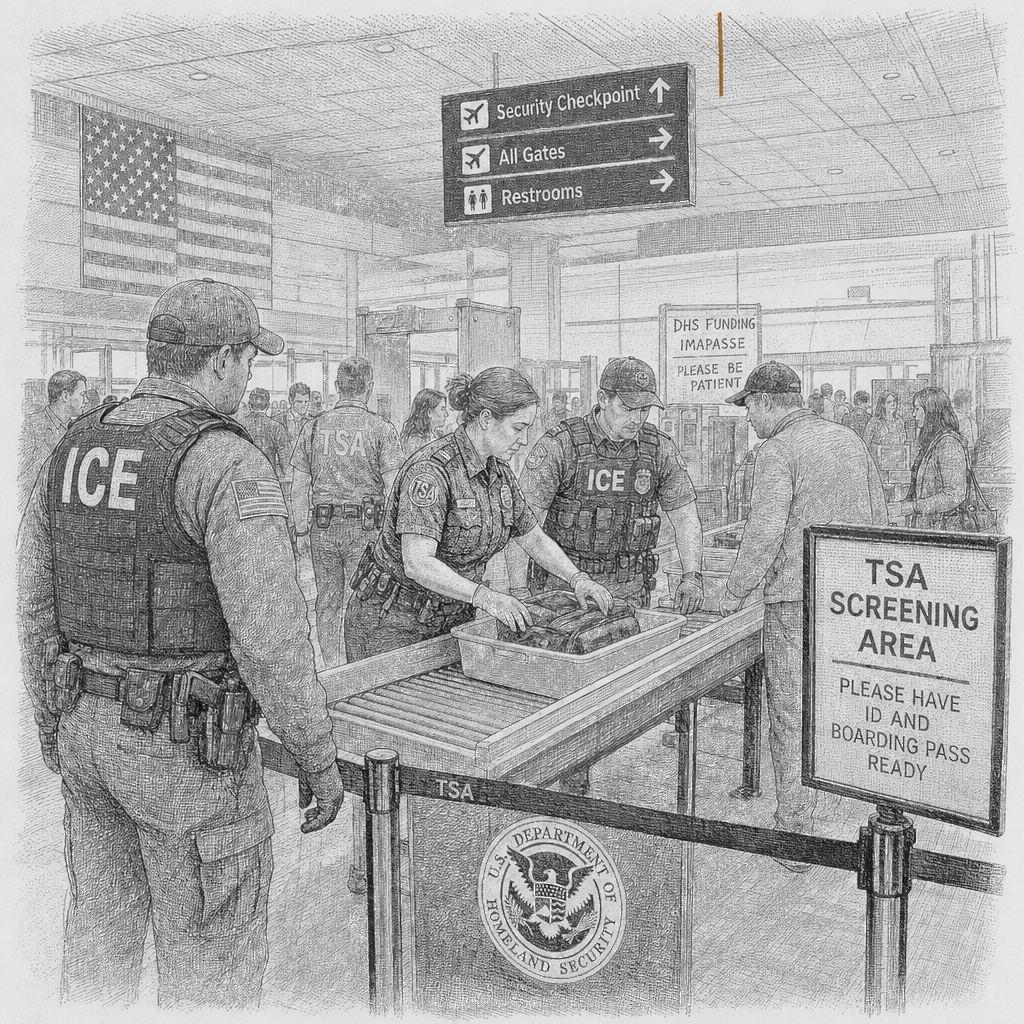
President Donald Trump’s decision to order immigration enforcement officers to assist TSA at U.S. airports beginning Monday is unfolding amid a partial Homeland Security shutdown that has left TSA and other agencies’ workers without pay and has contributed to long airport security lines. The White House framed the move as a response to traveler delays while DHS funding talks remain stalled in Washington.
Trump said he was moving forward with the plan to have immigration enforcement officers support airport security unless Democrats agreed to fund the Department of Homeland Security, according to the Associated Press account of Sunday remarks and negotiations. The proposal, which he described as a step toward helping TSA, would involve immigration enforcement officers guarding exit lanes or checking passenger IDs.
The staffing disruption has prompted concern in Congress and among TSA labor leaders about whether adding ICE personnel could worsen tensions among frustrated travelers and overwhelmed screeners. Sen. Lisa Murkowski, R-Alaska, called the plan a “Bad idea,” arguing that Congress and the administration should resolve the DHS funding issues and pay TSA agents rather than increase pressures at airports already operating through the shutdown.
Murkowski made the comments to reporters at the Capitol after senators held a rare weekend session, where they advanced the nomination of Sen. Markwayne Mullin, R-Okla., to be Trump’s next homeland security secretary. The Senate approved Mullin 54-37, with two Democrats joining most Republicans, and a confirmation vote could come as early as Monday, depending on the Senate schedule and the administration’s next steps.
Tom Homan, Trump’s “border czar” named to lead the airport security effort, met with a bipartisan group of senators over the partial shutdown and described the discussions as “good conversations” without saying they had reached agreement. Homan told Sunday news programs that the details of the increased ICE role—including its specific duties and the number of officers—were still under discussion with TSA and ICE leadership, and he described the plan as a “work in progress.”
Homan said in interviews that the effort would focus on “the large airports where there’s a long wait, like three hours,” and he described two operational possibilities: having immigration officers cover exits currently monitored by TSA agents, or having ICE personnel check identification before passengers enter screening areas. He also said ICE would be “a force multiplier,” while acknowledging limitations, adding that he did not see immigration agents trained for aviation screening equipment like X-rays.
DHS spokeswoman Lauren Bis said in Sunday statements that “hundreds” of ICE officers would be deployed but declined to identify the specific airports, citing security reasons. At the same time, Homan said he expected to have “a plan by the end of today,” including which airports would start and where officers would go.
As travelers navigated the impacts of delayed screening operations, some airport officials said additional personnel would arrive at terminals starting Monday. Atlanta Mayor Andre Dickens said in a statement Sunday night that ICE and Homeland Security Investigations officers would be deployed at Hartsfield-Jackson Atlanta International Airport beginning Monday morning, with federal personnel reporting to TSA and taking on tasks such as line management and crowd control, and with Dickens’ statement saying the deployment was not intended to conduct immigration enforcement activities.
Travelers at some airports reported major delays on Sunday, including nearly six-hour waits at Atlanta’s main security checkpoint midafternoon, when the report said only two TSA agents were on hand to check IDs. Some passengers missed flights and then scrambled to book later flights or add themselves to standby lists that were already dozens of names long, while crowds at John F. Kennedy International Airport in New York were described as anxious and pushing toward security checkpoints.
The TSA workforce and its representatives criticized the plan, arguing that ICE personnel were not prepared for aviation security tasks. Everett Kelley, president of the American Federation of Government Employees, which represents more than 50,000 TSA employees, condemned Trump’s airport security approach in a statement, saying ICE agents are not trained or certified in aviation security and that TSA workers have been showing up without pay because they believe in the mission of keeping the flying public safe.
Kelley argued that TSA personnel deserve to be paid, not replaced by what he described as untrained, armed agents, and he cited his view that such agents had demonstrated potential danger. Across Washington, senators said they had limited details about which airports and how many officers would be dispatched as negotiations continued behind closed doors.
For their part, some lawmakers welcomed the effort to reduce pressure on airport lines. Sen. Mike Rounds, R-S.D., said he did not think the plan could hurt and that immigration officers could help relieve pressure, while Sen. John Thune, R-S.D., said people were recognizing the need to “get this fixed” and solved.
The episode has also raised questions for Transportation Secretary Sean Duffy, including how to inform passengers about expected wait times. Duffy said on Sunday that travelers do not know until “the day of or the afternoon of their flight” what early arrival time would be needed, and he linked the operational uncertainty to broader political efforts to reduce leverage in DHS negotiations.
As described by the AP, Homan appeared on CNN’s “State of the Union” and Fox News Sunday, while Duffy was interviewed on ABC’s “This Week.”