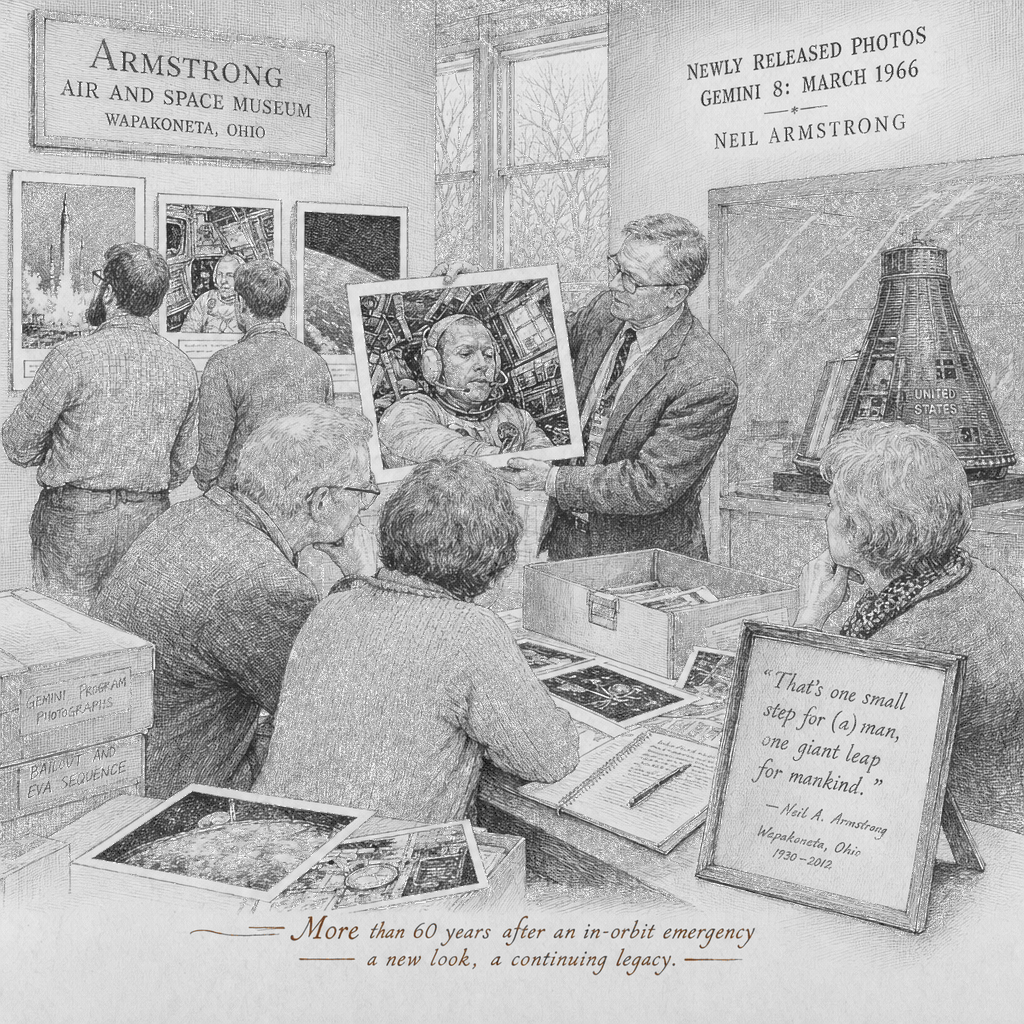
More than 60 years after Neil Armstrong and fellow astronaut David Scott faced a life-threatening emergency on Gemini 8, newly discovered photos of Armstrong’s return from orbit have been donated to the Armstrong Air and Space Museum in western Ohio. The museum said the images fill in gaps in how the mission is told to visitors, including moments after the spacecraft returned to Earth following an unplanned splashdown.
The Gemini 8 emergency began after a key milestone: the mission completed the first docking in space, then minutes later both spacecraft started tumbling uncontrollably. Armstrong and Scott separated from the other spacecraft as the spinning intensified, and Armstrong made a calculated decision by deploying the craft’s thrusters to stop the rotation—an action that drew on vital fuel. For safety reasons, the crew ended the mission early rather than continuing the planned flight.
The duo splashed down about 10 hours after the March 16, 1966 launch, and they were picked up by a recovery ship before being brought to Naha Air Base in Japan. Because the splashdown was not planned, few members of the media were on site, though NASA and military photographers captured the recovery. Ron McQueeney—a professional photographer and Army veteran who was at the recovery effort—was among the people unexpectedly called to help, and he took the photos that were later kept from public release.
The newly donated images were taken from new angles during the recovery and show Armstrong and Scott on the deck of a U.S. Navy vessel. They also show the astronauts waving to service members on land, and at least one image captures the Gemini 8 capsule being lifted into the air for transport. The museum donation came through McQueeney’s widow, according to the report.
Dante Centuori, the executive director of the Armstrong Air and Space Museum in Wapakoneta, said the details in the photographs stand out for the way they reflect the astronauts’ demeanor during a crisis. “Sometimes, an incredible event can actually be documented by some of the most ordinary means,” Centuori said. He also pointed to what he described as the smiles on Armstrong and Scott’s faces as evidence of their professionalism and ability to remain composed after the emergency.
Science historian Robert Poole offered a different emphasis on what the grins reveal. Poole, of the University of Lancashire, said, “The obvious thing that sticks out to me is that they are very happy to be alive.” In his view, Armstrong’s ability to stay cool in a crisis helped support his selection as the commander of Apollo 11.
The photos are expected to be used as part of the museum’s interpretation of Gemini 8. The Gemini 8 capsule is already on display at the Armstrong museum, and the new images are set to add detail to the mission’s emergency return story, including how recovery operations unfolded when plans changed in space.
The timing of the donation also comes as NASA looks ahead to a new lunar effort. The report said NASA is preparing for a lunar fly-around by Artemis astronauts in April, and it described past missions as reminders of the effort required to reach space and adapt when circumstances shift unexpectedly. Emily Margolis, a curator at the National Air and Space Museum, said, “Seeing people launch to space frequently can suggest that it’s easy, but it’s very hard. And it requires a lot of resources and attention.”