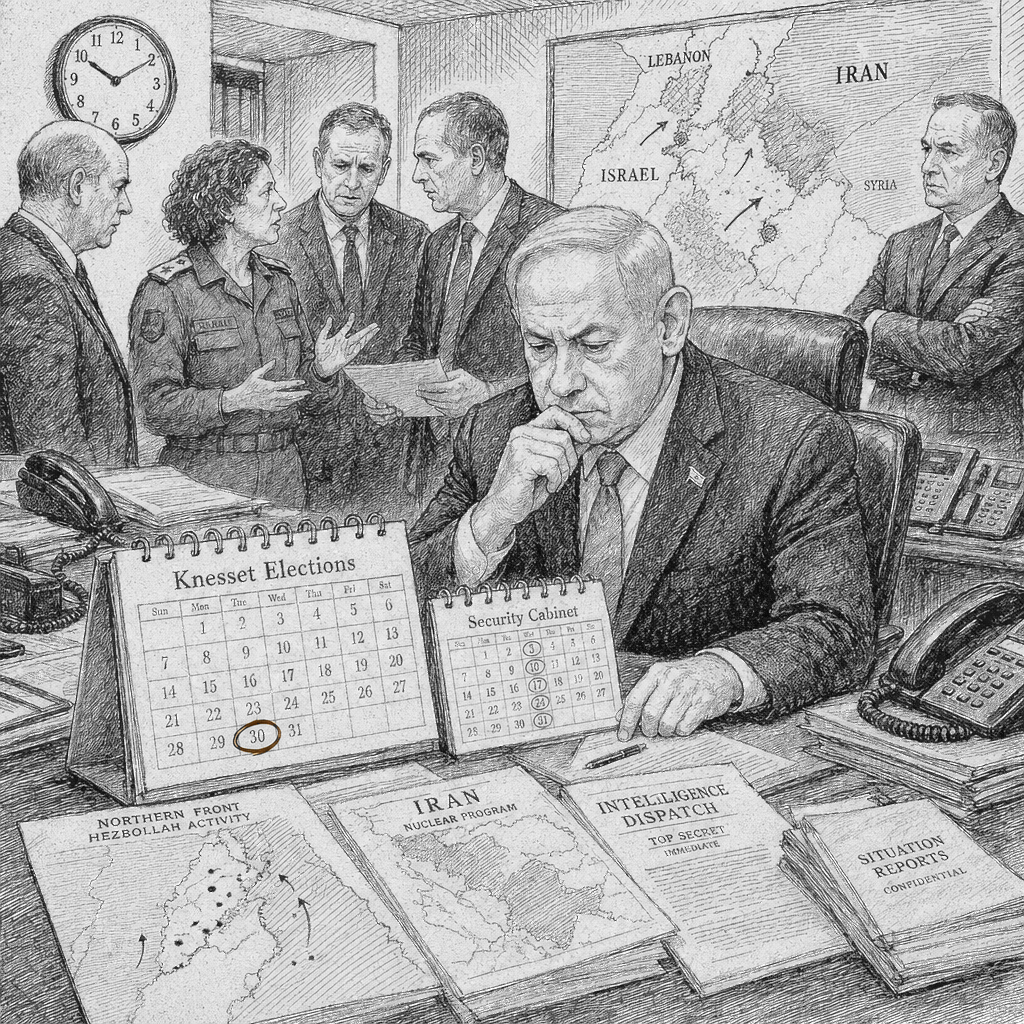
Israel’s Prime Minister Benjamin Netanyahu is nearing a key political decision: when to hold the next election, as the country fights war on multiple fronts and lacks a clear path to the conflicts ending. Under Israel’s electoral timetable, his government is in the final months of its four-year term and elections are required by the end of October, though Netanyahu can dissolve the governing coalition and call early elections.
The timing question is bound up with how the wars are affecting the public and how quickly Netanyahu thinks he can restore political standing. Because elections are scheduled about three months ahead of the vote date, Netanyahu has options including setting a ballot for late June, just before the summer vacation season, or waiting until the fall, depending on whether he believes his coalition can benefit from the situation on the ground.
Associated Press reported that the stakes are high for Netanyahu’s legacy and political survival. A victory would add to his record as Israel’s longest-ruling prime minister and would help deflect calls for a reckoning tied to the Oct. 7, 2023 Hamas attacks that triggered more than two and a half years of war across the region. A defeat, by contrast, could cast him as the most prominent political casualty linked to those attacks, a day that already has driven resignations and firings and continues to shape national attitudes.
Within that political math, the wars involving Iran and Hezbollah are described as potential drivers of Netanyahu’s decision. The conflict with Iran has continued to send missiles into Israel each day, disrupting the lives of many voters and adding to what AP characterized as anxiety and exhaustion. At the same time, Israel’s fight against Hezbollah militants in Lebanon has been intensifying, with northern Israel described as taking especially heavy fire in recent days and residents voicing anger over Israel’s inability to stop the attacks.
AP also reported that the economic and diplomatic consequences of the Iran war are feeding into the pressure on Netanyahu’s coalition. The war has disrupted oil flows from the Persian Gulf and upended the global economy, and in the United States, Trump has not given an indicated timeline for an end to the fighting. AP reported that members of the “America First” wing of the Republican Party have begun accusing Israel of dragging the U.S. into a needless war, raising the possibility of tensions between Washington and Jerusalem as the conflict continues.
Polling in Israel, AP said, suggests that while Israelis largely support the war, Netanyahu and his coalition have not been seen as benefiting politically. In this environment, AP reported there is little incentive for Netanyahu to move up the election date. Yohanan Plesner, president of the Israel Democracy Institute in Jerusalem, said there has not “seem” to be “any remarkable change in Israeli public opinion,” and that Netanyahu would “rather buy more time and exhaust the full term that is available to him.”
Netanyahu still has weeks to finalize the timetable, but AP said he appears to be leaning toward a fall election. At a news conference last week, Netanyahu said he hopes elections will be in “September or October,” a window that could allow him more time to rebuild public support. AP reported that a prolonged war could make that harder by increasing the risk of additional Israeli casualties and further exhausting the public, while also raising the likelihood of disagreements with Trump.
The article also noted that a drawn-out conflict could worsen Israel’s international standing after the heavily criticized war in Gaza, for which Netanyahu faces allegations addressed by the International Criminal Court—allegations AP said he denies. Plesner told AP that a narrow window in early September, just before the monthlong holiday season, could be the best time for Netanyahu to hold the vote. Otherwise, AP reported, the election may fall close to the Oct. 7 anniversary, when Israelis are again reminded of the 2023 attacks.