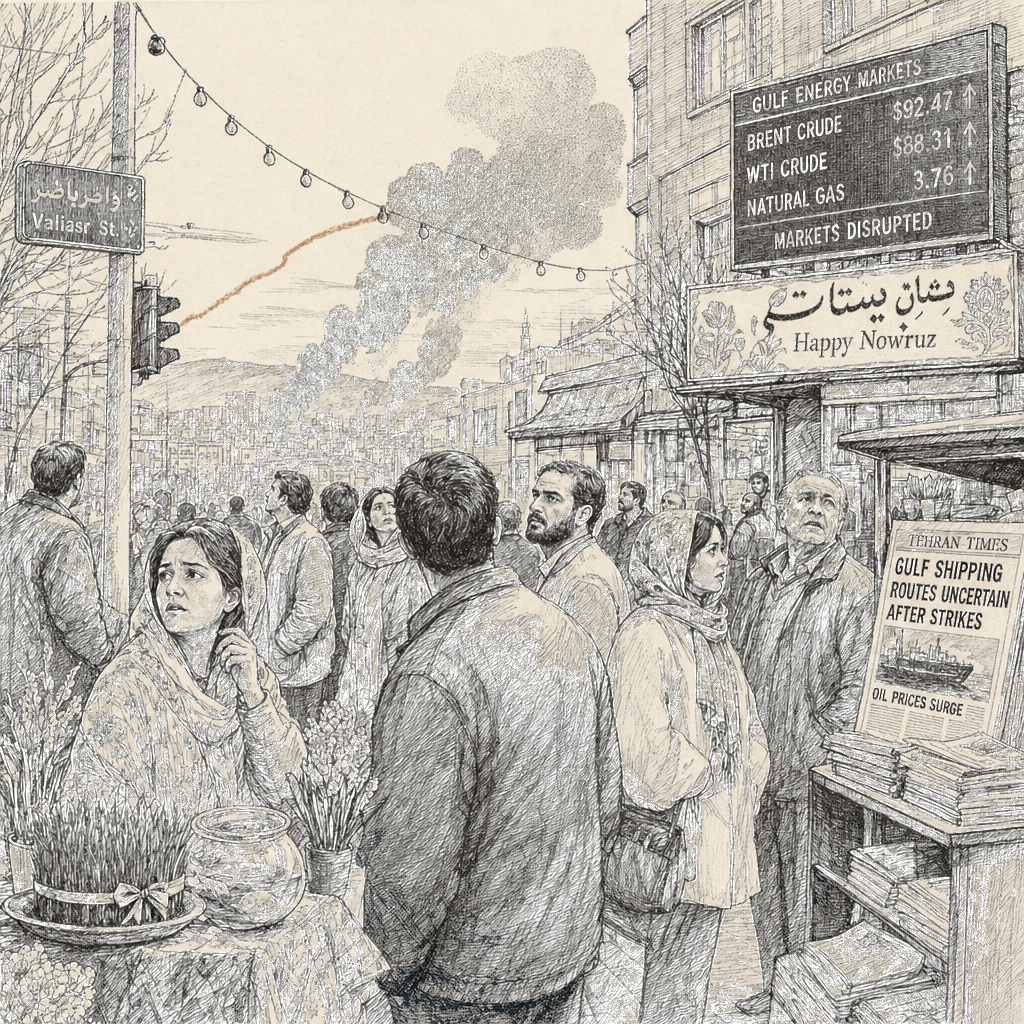
Israel carried out airstrikes on Tehran on Friday while Iranians marked Nowruz, the Persian New Year, as the conflict between Israel and Iran widened into a broader regional and economic shock, the Associated Press reported. Activists told AP they heard strikes around Iran’s capital, and the attacks came as observers worried that Iran’s Arab neighbors could be drawn directly into the fighting.
AP reported that the strikes followed an earlier pledge by Israel to refrain from additional strikes on Iran’s offshore South Pars gas field. At the same time, AP said Iran intensified attacks on oil and natural gas facilities around the Gulf.
In the United Arab Emirates, heavy explosions shook Dubai early Friday as air defenses intercepted incoming fire over the city, AP reported. The early morning attacks also occurred while people were observing Eid al-Fitr, marking the end of Ramadan, with mosques calling the day’s first prayers.
AP said Iran kept up its wave of attacks launched at Israel, with sirens sounding across a wide swath of the north—from Haifa to the Galilee and toward the border with Lebanon. The renewed pressure followed an intense day on Thursday, when AP reported Israel’s military said more than a dozen missile launches occurred.
The conflict’s impact on energy markets has come alongside the military escalation, AP said. Global fuel supplies faced intense pressure because of Iran’s control over the Strait of Hormuz, a strategic waterway through which AP said a fifth of the world’s oil is transported. AP reported that Brent crude oil, the international standard, briefly surged above $119 a barrel and was up more than 60% since the war started.
In Europe, AP reported sharp rises in natural gas prices and said the European benchmark had roughly doubled in the past month. AP also tied the latest cycle of attacks to already-elevated energy prices, and said Gulf allies pressed President Donald Trump to rein in Israeli Prime Minister Benjamin Netanyahu.
At the diplomatic level, AP reported that the U.N. Security Council met in an urgent closed session Thursday as Gulf states urged Iran to halt attacks on them. Bahrain’s U.N. ambassador, Jamal Alrowaiei, said Gulf countries stressed the need for Iran to stop, AP reported.
AP also said Iran’s attacks hit energy infrastructure beyond the Gulf’s immediate region. Saudi Arabia said its SAMREF refinery in Yanbu was hit, and AP reported that Saudi Arabia had begun pumping large volumes of oil west toward the Red Sea to avoid the Strait of Hormuz. Qatar, a key supplier of natural gas, told AP that Iranian missiles caused extensive damage to the Ras Laffan liquefied natural gas facility, reducing exports by about 17% and costing about $20 billion in lost revenue a year, with repairs expected to take up to five years even though production had been halted after earlier attacks.
AP reported that Kuwait authorities said two oil refineries and gas operations in Abu Dhabi were targeted as well. The Associated Press also reported on risks to shipping in the region, saying a vessel was set ablaze off the UAE’s coast and another was damaged off Qatar, and that efforts to bypass the strait were strained after an Iranian drone hit a Saudi refinery in the Red Sea.
In a televised address Thursday, Netanyahu told foreign journalists that, at the request of Trump, Israel would hold off further attacks on South Pars, AP reported. Netanyahu also told AP he hoped for an uprising by the Iranian people against the Islamic Republic, while AP said there had been no sign of organized opposition since Iran crushed mass protests in January.
AP also reported that at Thursday’s news conference Netanyahu said Iran’s air defenses had been “rendered useless,” its navy was “lying at the bottom of the sea,” and its air force was “nearly destroyed,” without presenting evidence. AP further reported that Iran’s leadership had insisted its nuclear program was peaceful and that it had enriched uranium up to 60% purity, a step AP described as close to weapons-grade levels, while saying Iran’s stockpile of highly enriched uranium still remained.
As the war moved into its third week, AP said more than 1,300 people had been killed in Iran during the conflict. In Lebanon, AP reported that the Israeli attacks against the Hezbollah militant group had displaced more than 1 million people and that more than 1,000 people had been killed, according to the Lebanese government, while Israel said it had killed more than 500 Hezbollah militants.
In Israel, AP reported that 15 people were killed by Iranian missile fire, and that four people were killed in the occupied West Bank by an Iranian missile strike. AP also reported that at least 13 U.S. military members had been killed.
As part of the wider escalation questions, AP reported that U.S. intelligence and other developments added pressure to both Trump and Netanyahu during the same period. AP said Trump also warned on social media that if Iran continued striking Qatar, the U.S. would “massively blow up the entirety” of the South Pars field, and that when asked about possible ground troops in Iran, Trump responded: “No. I’m not putting troops anywhere.”